🨴 Pot Size Calculator
Calculate exactly how much potting soil or mix you need for any container, planter, or raised pot
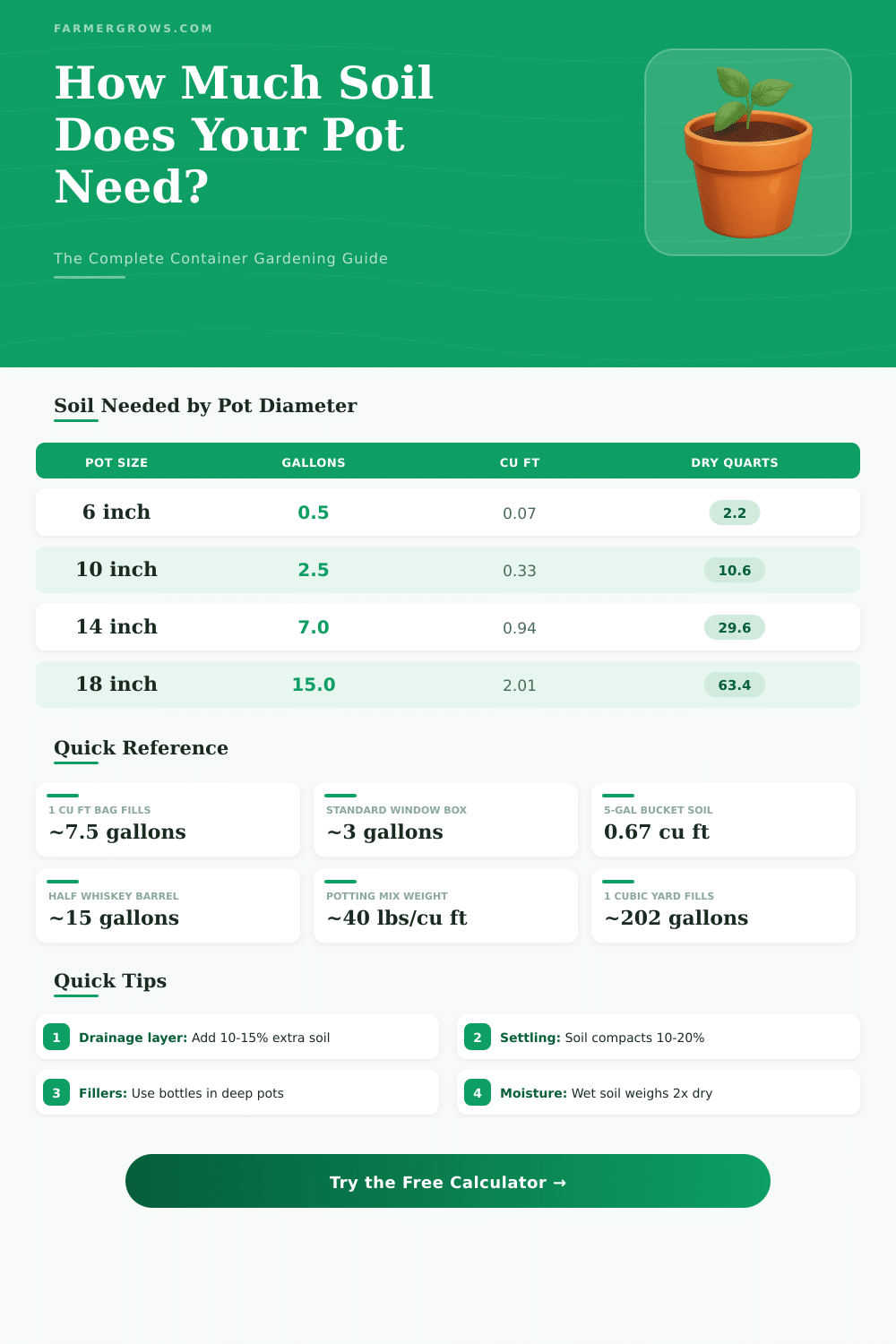
| Pot Diameter | Depth (in) | Volume (gal) | Volume (cu ft) | Dry Quarts | Liters |
|---|---|---|---|---|---|
| 4 in (10 cm) | 4 | 0.22 | 0.03 | 0.9 | 0.8 |
| 6 in (15 cm) | 6 | 0.73 | 0.10 | 3.1 | 2.8 |
| 8 in (20 cm) | 7 | 1.53 | 0.20 | 6.5 | 5.8 |
| 10 in (25 cm) | 8 | 2.72 | 0.36 | 11.5 | 10.3 |
| 12 in (30 cm) | 10 | 4.90 | 0.65 | 20.7 | 18.5 |
| 14 in (36 cm) | 12 | 8.02 | 1.07 | 33.9 | 30.4 |
| 16 in (41 cm) | 12 | 10.47 | 1.40 | 44.3 | 39.6 |
| 18 in (46 cm) | 14 | 15.46 | 2.07 | 65.4 | 58.5 |
| 20 in (51 cm) | 16 | 21.77 | 2.91 | 92.1 | 82.4 |
| 24 in (61 cm) | 18 | 35.19 | 4.70 | 148.9 | 133.2 |
| Bag Size | Volume | Fills (6″ pot) | Fills (10″ pot) | Fills (14″ pot) |
|---|---|---|---|---|
| 4 qt (3.8 L) | 0.13 cu ft | 1.3 pots | 0.4 pots | 0.1 pots |
| 8 qt (7.6 L) | 0.27 cu ft | 2.7 pots | 0.7 pots | 0.3 pots |
| 16 qt (15.1 L) | 0.53 cu ft | 5.3 pots | 1.5 pots | 0.5 pots |
| 1 cu ft (28.3 L) | 1.0 cu ft | 10.0 pots | 2.8 pots | 0.9 pots |
| 1.5 cu ft (42.5 L) | 1.5 cu ft | 15.0 pots | 4.2 pots | 1.4 pots |
| 2 cu ft (56.6 L) | 2.0 cu ft | 20.0 pots | 5.6 pots | 1.9 pots |
| Container Type | Typical Dimensions | Volume (gal) | Soil Needed (cu ft) |
|---|---|---|---|
| Small Herb Pot | 6″ dia × 6″ deep | 0.7 | 0.10 |
| Standard Flower Pot | 10″ dia × 8″ deep | 2.7 | 0.36 |
| Window Box (24″) | 24″L × 6″W × 6″D | 3.7 | 0.50 |
| Large Patio Planter | 14″ dia × 12″ deep | 8.0 | 1.07 |
| Half Whiskey Barrel | 22″ dia × 14″ deep | 18.3 | 2.45 |
| Grow Bag (5 gal) | 12″ dia × 10″ deep | 4.9 | 0.65 |
| Grow Bag (10 gal) | 16″ dia × 12″ deep | 10.5 | 1.40 |
| Raised Planter Box (2×2) | 24″L × 24″W × 18″D | 32.3 | 4.32 |
| Raised Planter Box (4×2) | 48″L × 24″W × 12″D | 43.1 | 5.76 |
| Large Tree Container | 24″ dia × 20″ deep | 39.1 | 5.24 |
A 12 inch round pot at 10 inches deep holds roughly 5 gallons of soil, which honestly doesnt sound like much until youre filling 8 of them on a patio and suddenly that single bag of potting mix is gone. Most all purpose potting mix weighs between 400 and 600 pounds per cubic yard dry. Wet it down and youre closer to 900.
Peat based mixes run lighter (around 300 to 500 per yard) which matters a lot if your containers sit on a balcony with weight limits.
Soil Basics and How to Care for It
What you are ready read, do not come from any computer or device… It is based directly on actual chats, discussions in forums and experiences, that folks truly lived in the real world.
Soil in short is a living mix, that is made up of organic material, minerals, gases, water and various life forms, that it involves. Those elements come together to help plants and ground animals stay active. One sometimes hears folks talk about “dirt”, even so according to scientific view dirt differs from soil, dirt simply is soil, that was removed or moved, while real soil stays in its natural form.
When one crushes soil to study it, one finds five main parts: minerals, organic matter, living things, gases and water. The mineral part splits into three main groups… Clay, silt and sand.
The share of each of them decides the texture of the soil. The balance between sand, silt and clay explains how soil feels and acts. Under the upper layer of the garden lies sand, clay, gravel and rocks in different stages of breakdown.
Loamy soil and silt gives other kinds, taht affects the behaviour of various soils.
Soil is not simply a dead object, that lies around. It forms a surprisingly active system, in which rocky minerals and rotting organic material always interact with living tiny organisms, roots of plants, water, air and nutrients. One gram of soil can carry around 50 000 different species, that all play a part.
Worms are especially common here below.
Health of soil means, that it can work as a living system, that supports plants, animals and folks. Healthy soil helps a lot, it provides clean air and water, helps to grow plenty of crops and forests, keeps proper shape of the ground and creates helpful natural areas. Also, it delivers food to our tables, filters water, protects against floods and helps during dry spells.
Most seriously, soil keeps huge amounts of carbon, which is key for solutions about climate.
Soil works as a store of water and nutrients, while it physically holds plants locally. Most garden plants do best in soil rich in nutrients, that has texture, that holds moisture without getting too wet. Improving the quality of soil commonly comes down to changing its feel, boosting its nutrients or caring about both.
The soil in your growing area is what you work with. Those ground life forms break down nutrients from organic matter and feed your plants, that later feeds you.
Leaving soil alone is among the strongest actions, that one can take. Less digging and fewer chemical or physical disturbances help, that the structure of soil stays unchanged, germs stay active and carbon with nutrients stays their more long. Sometimes simple steps indeed give better results.
Soil declines in terrible haste, what causes loss of crops and increase of prices for foods. While farms face bigger tension, care about ground health becomes key for balancing farm production with lasting methods and actual profit. Regenerative farming settles that by means of rebuilding ground health, growth of biodiversity and improvement of farm economies; by means of using cover crops, rotation of crops and capture of carbon.
Most commercial mixes for pot also hold water and ultimately pack down. Adding perlite solves that problem. Those special mixes, that one sees in garden stores, for succulents, cacti, orchids, truly are only tiny variations of the same base.
A wiser step is to take basic soil for pot and mix in coconut fiber or perlite according to your need. Combining perlite, peat and mix for orchids works well for gardening in tins.
Mix with compost every spring and scatter dug leaves each autumn to change soil step by step through time. Wooden bits can serve, when you need fast help. Covering your crops with mulch is also useful.
Clay soil certainly can hold a nice flower garden without needing crowds of changes or heavy digging. The surface area of clay bits is almost 1 000 times bigger than that of sand, when one compares equal masses. It is a huge difference.
Sand, especially beach sand, almost does not have nutrients, whatmakes it entirely bad for growing anything.
Soil shows up everywhere (from sandy), wind cut coasts to wet peat bogs and freezing frozen ground areas. It covers almost all land surfaces and sets every ecosystem on the globe.