🪨 Polymeric Sand Calculator
Calculate exactly how much polymeric sand you need for pavers, patios & walkways
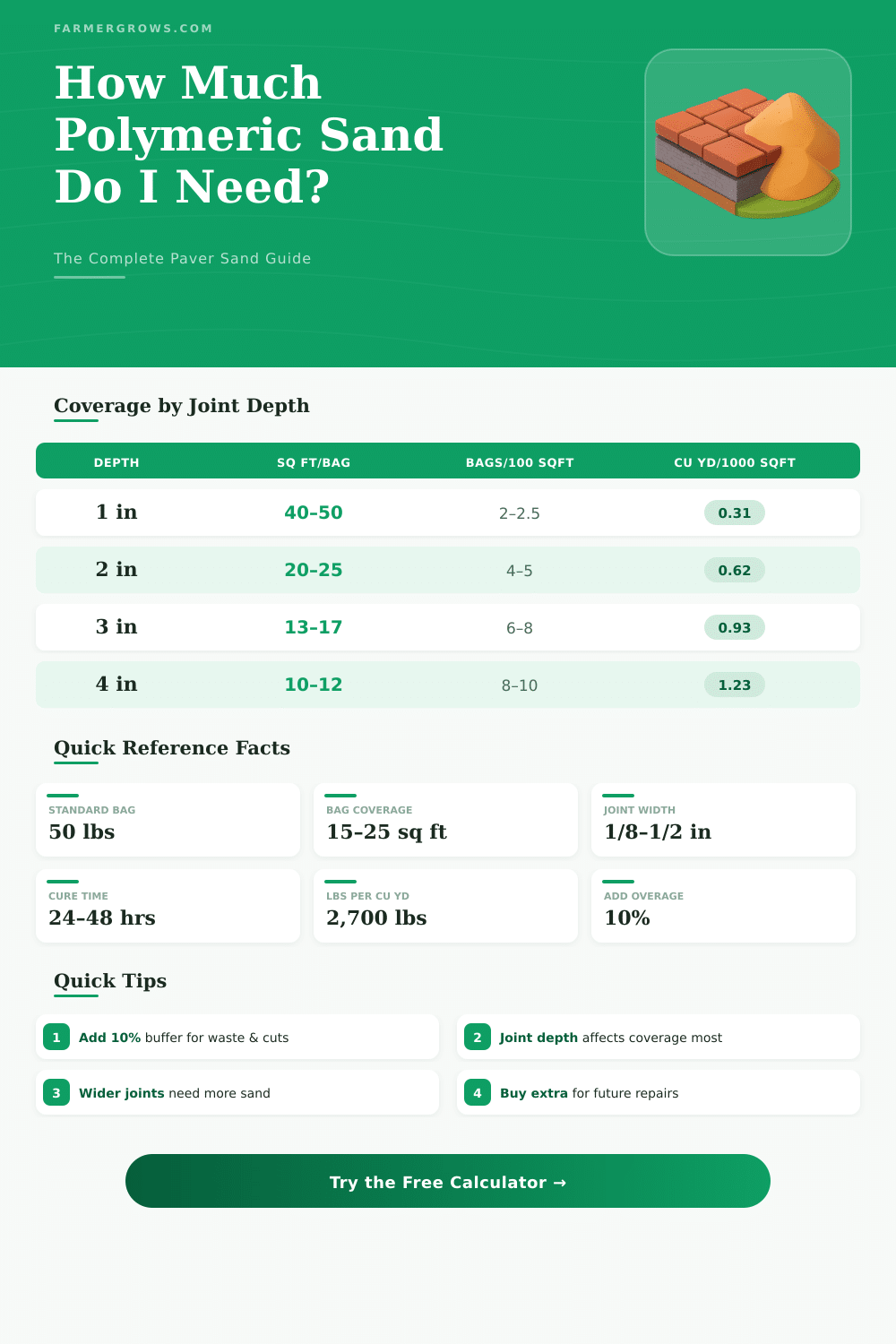
| Joint Depth | Sq Ft per 50 lb Bag | Bags per 100 Sq Ft | Cu Yd per 1,000 Sq Ft | M² per Bag |
|---|---|---|---|---|
| 3/4 in (19 mm) | 45 – 55 | 1.8 – 2.2 | 0.23 | 4.2 – 5.1 |
| 1 in (25 mm) | 35 – 45 | 2.2 – 2.9 | 0.31 | 3.3 – 4.2 |
| 1.5 in (38 mm) | 25 – 32 | 3.1 – 4.0 | 0.46 | 2.3 – 3.0 |
| 2 in (51 mm) | 18 – 25 | 4.0 – 5.6 | 0.62 | 1.7 – 2.3 |
| 3 in (76 mm) | 12 – 17 | 5.9 – 8.3 | 0.93 | 1.1 – 1.6 |
| 4 in (102 mm) | 9 – 13 | 7.7 – 11.1 | 1.23 | 0.8 – 1.2 |
| Bag Weight | Cu Ft per Bag | Bags per Cu Yd | Typical Coverage at 2 in |
|---|---|---|---|
| 40 lb bag | 0.44 | 61 | ~15 sq ft |
| 50 lb bag | 0.55 | 49 | ~18–22 sq ft |
| 60 lb bag | 0.67 | 40 | ~22–28 sq ft |
| 80 lb bag | 0.89 | 30 | ~30–36 sq ft |
| Bulk 1 ton | 13.3 | 2.0 tons/yd | ~450–550 sq ft |
| Project | Area (sq ft) | Cu Yards (2 in depth) | 50 lb Bags Needed |
|---|---|---|---|
| Small Walkway 4x20 | 80 | 0.49 | 24 |
| Small Patio 10x10 | 100 | 0.62 | 30 |
| Mid Patio 12x20 | 240 | 1.48 | 73 |
| Large Patio 20x30 | 600 | 3.70 | 182 |
| Driveway 20x40 | 800 | 4.94 | 242 |
| Pool Surround 30x50 | 1,500 | 9.26 | 454 |
polymeric sand are made up of rough grain sand, polymer materials and binding substances. One lays it in the spaces between the pavers after sweep and later activated by means of water. Before wetting one must sweep the surface of the pavers to escape troubles.
It also calls polymeric sand or usual building material. When one adds water, it sets in link with properties like concrete. Like this it helps to set the pavers in place and stop grasses grow here.
Polymeric Sand: What It Is and How to Use It
The main parts are quartz and crystal silica, that most commonly forms around 80 to 95 percent of the whole. Silica help to tie the fine particles of sand flatly. That is entirely different than the sand from sandboxes or from coast.
The sand are covered by means of polymer, that activates water, thus the grains join when one leaves to dry. The mix fills the gap, but it creates soild space.
polymeric sand operate best, if it fills the whole height of the space between pavers. It answers most for spaces of quarter of inch to one and half inches broad. For bigger spaces needs more time to harden, and one must keep ways closed for more time.
Some kinds operate even for spaces to four inches broad. Polymeric sand are not grout and do not carry cement.
Paved terrace with polymeric sand feel firm, almost as average concrete plates. Without it, the terrace can feel unstable under feet. It is the best way to slow the growth of grasses between pavers.
Over time, even so, some spaces can crack and require too repeat.
Install it can be hard, even for expert workers. It is very sensitive to reach right result. Too much water is common mistake.
More well are apply weak mist repeated, until the sand soaks, than one strong pour, that can spill the material. Strong rains also can carry the polymer over time, leaving sand bits on the surface. The sand require protection against rain during at least twelve hours and require around 24 hours for drying.
If one does not clean well the surface of pavers before lay the sand, it can change the face of the stones. One calls that residue polymeric sand mist. With porous materials like travertine, the sand can enter little holes and harden here.
Some brands are done to reduce mist and dust during the install.
When one installs it correctly, polymeric sand can serve very long time. Are terraces, that stayed good while almost fifteen years without issues. It is good choice for stop pavers stable andfor keep everything clean.