🌿 Playground Mulch Calculator
Calculate exactly how much safety mulch your playground needs
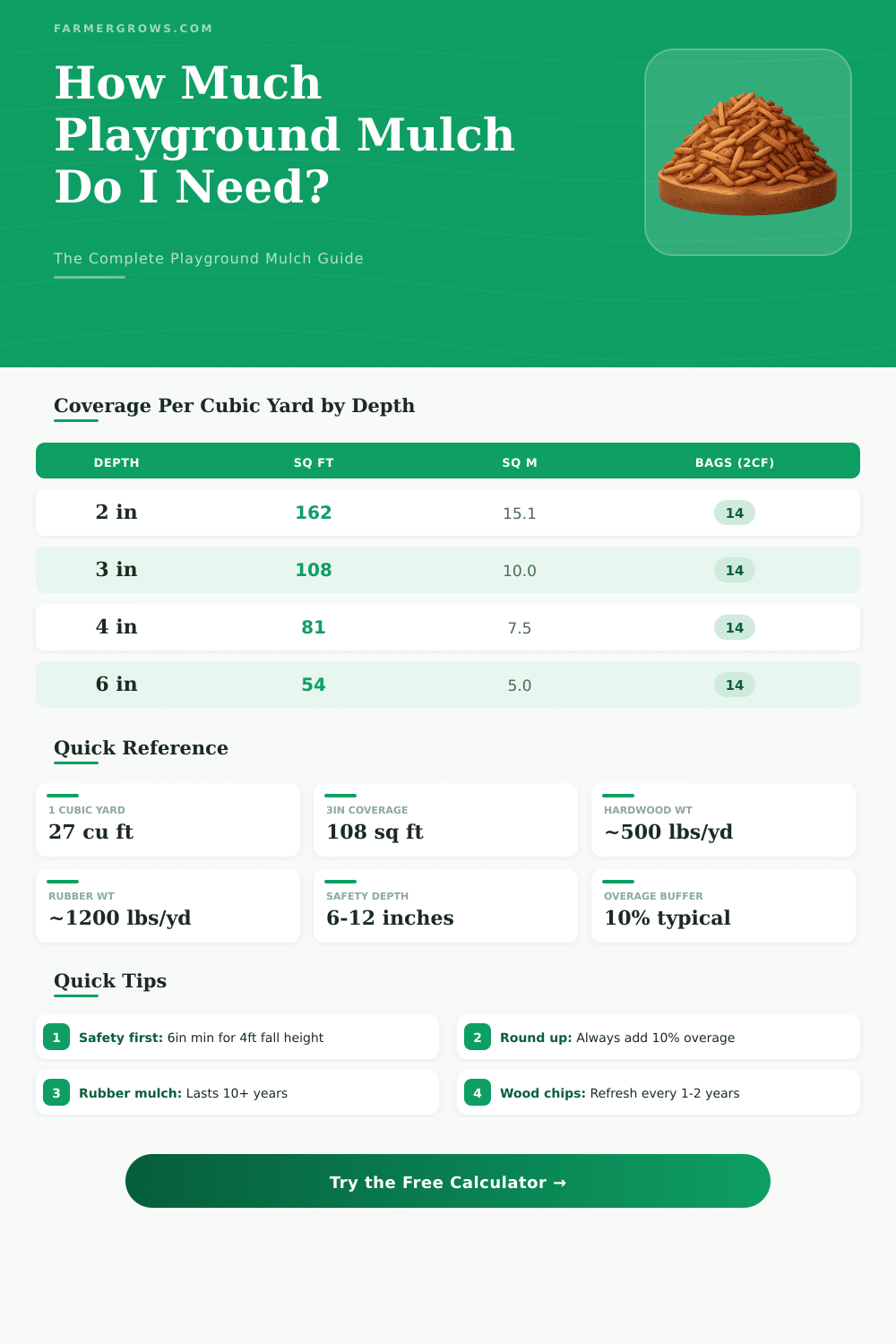
| Depth | Sq Ft / Yard | Sq M / Yard | Metric Depth |
|---|---|---|---|
| 1 in | 324 | 30.1 | 2.5 cm |
| 2 in | 162 | 15.1 | 5.1 cm |
| 3 in | 108 | 10.0 | 7.6 cm |
| 4 in | 81 | 7.5 | 10.2 cm |
| 6 in | 54 | 5.0 | 15.2 cm |
| 9 in | 36 | 3.3 | 22.9 cm |
| 12 in | 27 | 2.5 | 30.5 cm |
| Bag Size | Volume / Bag | Bags / Cubic Yard | Coverage @ 6 in |
|---|---|---|---|
| 2 cu ft bag | 0.074 yd³ | 13.5 | 4.0 sq ft |
| 3 cu ft bag | 0.111 yd³ | 9.0 | 6.0 sq ft |
| Project | Area | Cubic Yards | 2 cu ft Bags |
|---|---|---|---|
| Small backyard set (10×10) | 100 sq ft | 1.9 | 25 |
| Swing set area (12×15) | 180 sq ft | 3.3 | 45 |
| Standard playground (15×15) | 225 sq ft | 4.2 | 56 |
| Medium play area (20×20) | 400 sq ft | 7.4 | 100 |
| Large playground (30×20) | 600 sq ft | 11.1 | 150 |
| School playground (50×30) | 1,500 sq ft | 27.8 | 375 |
At 6 inches deep a single cubic yard only covers about 54 square feet, which honestly doesnt go far on a playground. Bump that to 9 inches for taller equipment and youre down to 36 square feet per yard. Rubber mulch weighs around 1,200 pounds a yard so hauling gets real serious real fast compared to engineered wood fiber at roughly 300.
The information below does not come from any computer program or automatic translator. It is based on actual users, discussions in forums and experiences of the community, that one finds everywhere on the net.
Playground Mulch: Wood or Rubber?
Play mulch is made up of cover that creates a soft deposit above hard surfaces. It works well for areas in public parks, playgrounds of schools, kindergartens and home play spaces. One uses it also for pathways, picnic places and dog areas.
Those soft layers, that parks and schools apply globally, now are available for play areas at home also.
One makes this typical mulch from pure wood. It is prepared from soft tree like pine and fir, and one picks the raw matter carefully to escape branches and twigs. Some certified versions use pure strong wood, chiefly oak, and they double the ground for better stability.
Chips from hemlock wood forms another option, because hemlock does not split easily. The mulch stays quite soft for bare feet and helps guard against painful falls.
Big advantage of play mulch is its natural makeup. When one removes a play structure after many years, the wood simply breaks down on its own. No need to extract rubber bits.
It helps to keep the soil wet, because it reduces the drying of water, and it can keep the temperature in balance. Some species have a light brown shade, that does not absorb much sun heat, so teh surface stays safer for children with bare feet.
Certified play mulch meets strict rules. One bids it to match standards of ASTM about processed wooden fibers, and it can receive reference from the International Association of Makers of Play Gears. For commercial or public play areas one must use only IPEMA-certified materials from processed wooden fibers.
That forms the best solution for safe play space and it matches codes for professional play setups. One considers the mulch also safe for children and pets.
That is natural mulch, what matters. Well chopped material can bond too strongly, so more loose soil works more. Deposit fabric under the mulch helps it serve more time.
Even so, in wet or rainy regions organic mulch can quickly break down into compost, and children then can bare black marks to nearby areas. Mold or fungus can show up under the upper deposit in humidity already after some days after assembly.
Rubber mulch offers an alternative. It lasts more long, does not break down and blocks insects. But it is more expensive and cannot be renewed.
Mulch from cypress wood stays in position better than rubber and one can refresh it. Interlocking floors work well inside, but they slip when they get wet outside. Mat under swings helps to reduce the mulch that kicks away.
Keeping around nine inches of wooden chips, one can greatly soften the impact of falls in a play area, even so only fewplay spaces indeed reach that depth.