🌱 Plant Spacing Calculator
Calculate exactly how many plants you need for any garden bed, border, or landscape area
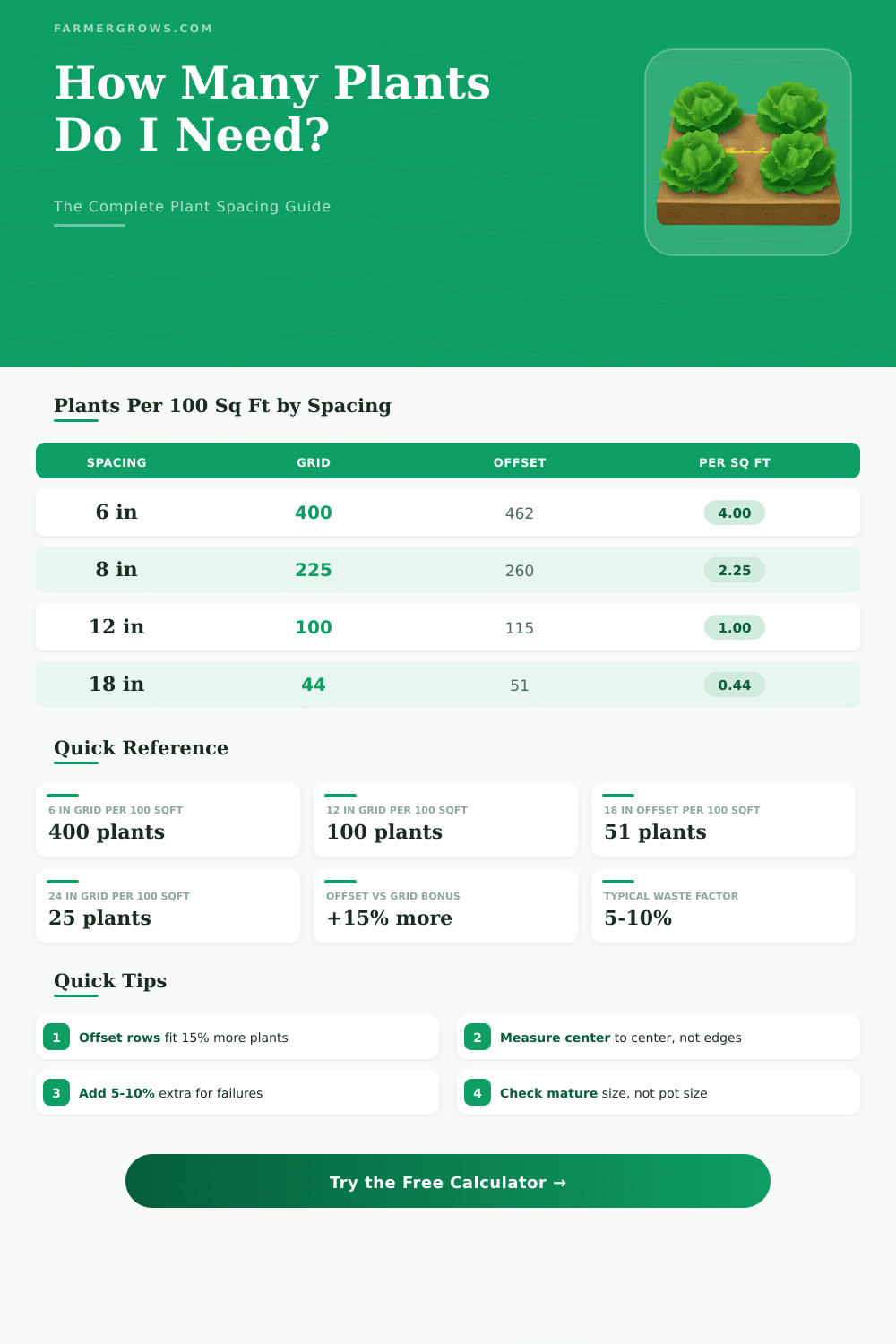
| Spacing | Grid Pattern | Offset Pattern | Metric Equiv. |
|---|---|---|---|
| 4 in (10 cm) | 900 | 1,039 | 969 / m² |
| 6 in (15 cm) | 400 | 462 | 431 / m² |
| 8 in (20 cm) | 225 | 260 | 242 / m² |
| 10 in (25 cm) | 144 | 166 | 155 / m² |
| 12 in (30 cm) | 100 | 115 | 108 / m² |
| 18 in (45 cm) | 44 | 51 | 48 / m² |
| 24 in (60 cm) | 25 | 29 | 27 / m² |
| 36 in (90 cm) | 11 | 13 | 12 / m² |
| 48 in (120 cm) | 6 | 7 | 7 / m² |
| Plant Type | Typical Spacing | Pattern | Notes |
|---|---|---|---|
| Annual Flowers (Petunias, Marigolds) | 6–12 in (15–30 cm) | Grid or Offset | Closer for mass color |
| Perennials (Coneflower, Salvia) | 12–24 in (30–60 cm) | Offset preferred | Allow for mature spread |
| Ground Cover (Creeping Thyme, Vinca) | 4–8 in (10–20 cm) | Offset | Tight spacing fills faster |
| Shrubs (Boxwood, Azalea) | 24–48 in (60–120 cm) | Grid | Based on mature width |
| Vegetables (Peppers, Tomatoes) | 12–24 in (30–60 cm) | Grid rows | Varies widely by crop |
| Herbs (Basil, Cilantro) | 6–12 in (15–30 cm) | Grid | Compact varieties closer |
| Ornamental Grasses | 18–36 in (45–90 cm) | Offset | Dramatic when massed |
| Bulbs (Tulips, Daffodils) | 4–8 in (10–20 cm) | Offset clusters | Group in odd numbers |
| Project | Area (sq ft) | Plants @ 12 in Grid | Plants @ 12 in Offset |
|---|---|---|---|
| Small Flower Bed | 25 | 25 | 29 |
| Foundation Planting | 80 | 80 | 92 |
| Garden Border 20×4 | 80 | 80 | 92 |
| Medium Bed 10×10 | 100 | 100 | 115 |
| Large Bed 20×15 | 300 | 300 | 346 |
| Veggie Garden 25×20 | 500 | 500 | 577 |
| Full Landscape 50×20 | 1,000 | 1,000 | 1,155 |
| Commercial Bed 100×10 | 1,000 | 1,000 | 1,155 |
| Tray Size | Plants per Tray | Trays for 100 Plants | Trays for 500 Plants |
|---|---|---|---|
| 6-cell pack | 6 | 17 | 84 |
| 4-pack | 4 | 25 | 125 |
| 18-cell flat | 18 | 6 | 28 |
| 36-cell flat | 36 | 3 | 14 |
| 50-cell plug tray | 50 | 2 | 10 |
| 72-cell plug tray | 72 | 2 | 7 |
| 128-cell plug tray | 128 | 1 | 4 |
Note: This article is based on descriptions and conversations about Omni-plants from video game groups and various other resources.
The Omni-plant is a special plant that happens in The Sims 3. It enters the category of special plants. What makes it new is that it makes copies of everything it receives as food.
All About the Omni-plant in The Sims 3
That tiny bush can double several other plants and even some objects for instance certain books or fishes. It ranks between the most exciting finds of the game.
To receive an Omni-plant is not simple. It belongs to the very rare. Only Sims that reached the right level in gardening deserve to get one.
That requires many hours given to the improvement of gardening, before one can get to this plant. In The Sims 3 there are separate garden challenges that unlock the Omni-plant. Doing tasks as Unusual Good, Rare and the Omnificent chain forms part of the process.
Along the way the Sims also learn to grow other funny things, as plants for steak, egg, cheese and hamburger.
The skill of gardening has various grades. At the seventh level Sims can plant odd seeds, as lime, watermelon, onion and potatoes. To the usual seeds belongs apple, grapes, lettuce and tomatoes.
Such special plants as Alive Fruit, Fatal Flower, Flame Fruit and Money Tree come only by means of challenges. The Omni-plant sits in that same exclusive gruop together with plants for cheese and eggs, likewise as for hamburgers and steak.
The feeding of the Omni-plant forms the main mechanism. Almost every object can serve as food, and it will produce copies of it. Even so there are exceptions.
Not everything works well. Here comes the tricky spot, the only way to get an Omni-plant from an Omni-plant is by feeding it by means of another Omni-plant. Because of that, finding seeds that it produces matters a lot in the start.
There are also some known mistakes. Sometimes the Omni-plant does not arrive by means of mail. Sometimes it stops growing or gets stuck in the inventory.
One famous bug relates too feeding by means of Marine Slime, which can stop the plant in the state of growth during harvest, but it stays stuck for days. Too many objects in the inventory could cause some of these troubles.
To reach perfect quality of an Omni-plant takes effort. A Sim with the trait green thumb, that talks with the plant, has a small chance to improve its quality by one grade per talk. That is the only known way to reachperfection.
The Omni-plant played a big role in the fun and discovery of new objects, when The Sims 3 launched fresh packs.