🌱 Plant Spacing Calculator
Calculate exactly how many plants you need for any garden bed, border, or landscape area
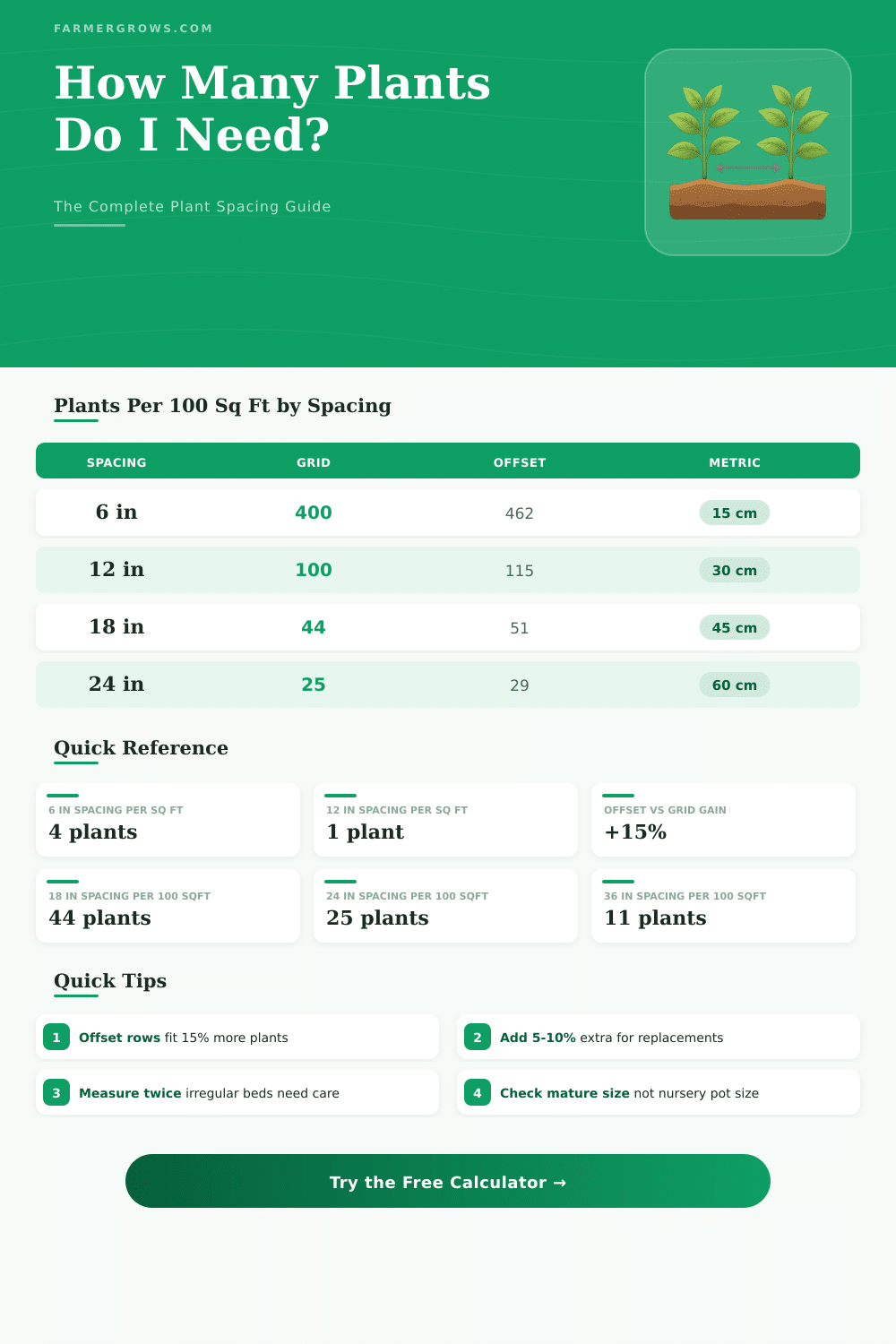
| Spacing | Plants / 100 sq ft | Plants / 10 m² | Sq Ft / Plant |
|---|---|---|---|
| 4 in (10 cm) | 900 | 968 | 0.11 |
| 6 in (15 cm) | 400 | 431 | 0.25 |
| 8 in (20 cm) | 225 | 242 | 0.44 |
| 10 in (25 cm) | 144 | 155 | 0.69 |
| 12 in (30 cm) | 100 | 108 | 1.00 |
| 18 in (45 cm) | 44 | 48 | 2.25 |
| 24 in (60 cm) | 25 | 27 | 4.00 |
| 36 in (90 cm) | 11 | 12 | 9.00 |
| 48 in (120 cm) | 6 | 7 | 16.00 |
| Spacing | Grid (per 100 sq ft) | Offset (per 100 sq ft) | Offset Gain |
|---|---|---|---|
| 6 in | 400 | 462 | +15.5% |
| 12 in | 100 | 115 | +15.5% |
| 18 in | 44 | 51 | +15.5% |
| 24 in | 25 | 29 | +15.5% |
| 36 in | 11 | 13 | +15.5% |
| Plant Type | Typical Spacing | Plants / 100 sq ft (Grid) | Plants / 100 sq ft (Offset) |
|---|---|---|---|
| Annuals (Petunias, Impatiens) | 8–12 in | 100–225 | 115–260 |
| Perennials (Daylilies, Coneflower) | 12–24 in | 25–100 | 29–115 |
| Groundcover (Vinca, Pachysandra) | 6–12 in | 100–400 | 115–462 |
| Shrubs (Boxwood, Azalea) | 24–48 in | 6–25 | 7–29 |
| Hedging (Privet, Holly) | 18–36 in | 11–44 | 13–51 |
| Ornamental Grass | 18–36 in | 11–44 | 13–51 |
| Vegetables (Tomatoes, Peppers) | 18–36 in | 11–44 | 13–51 |
| Herbs (Basil, Thyme) | 6–12 in | 100–400 | 115–462 |
| Trees (Ornamental/Fruit) | 8–25 ft | <1 | <1 |
| Project | Area (sq ft) | 12 in Grid | 12 in Offset |
|---|---|---|---|
| Small Flower Bed | 40 | 40 | 46 |
| Front Border | 100 | 100 | 115 |
| Side Yard Bed | 200 | 200 | 231 |
| Large Garden Bed | 500 | 500 | 577 |
| Foundation Planting | 250 | 250 | 289 |
| Full Landscape | 1000 | 1000 | 1155 |
| Meadow Planting | 2500 | 2500 | 2887 |
| Commercial Site | 5000 | 5000 | 5774 |
Offset (staggered/triangular) planting fits roughly 15.5% more plants than a square grid in the same area. This creates denser coverage and a more natural look. Use offset for groundcovers, mass plantings, and beds where you want full coverage faster.
Plan for 5–10% extra plants for rectangular beds and 10–20% for irregular or curved shapes. Some transplants may not survive, and edge areas often need partial fills. Buying a few extras saves a second trip and ensures uniform coverage.
At 12 inch spacing using a grid pattern, a 100 square foot bed needs exactly 100 plants. Switch to offset rows and that jumps to about 115. Thats roughly 15% more plants for the same area, which caught me off guard the first time I ran the numbers.
A 500 sq ft bed at 6 inch spacing needs around 2,000 plants on a grid.
How to Space Your Plants in the Garden
The information below does not come from a computer calculator or automatic translator. It is based on actual knowledge, forum changes and experiences of gardening communities, that one finds everywhere on the net.
The distance between plant plants matter much more than many folks believe. If one lays them too close one to the other, they struggle because of nutrients, water and light. Too dense crop reduces the flow of air, what causes humidity, that brings diseases as mildew and wilting spread.
The leaves stay wet for longer time after rain or watering, so infections happen easily. Too tight spacing can also block the growth of roots, what results in shallow or weak root systems.
Packets of seeds and labels of plant plants point precise distances. Tomatoes usually require 24 to 36 inches between them. Salads require 8 to 12 inches.
If one follows those tips, the garden can seem half empty for weeks, with bare ground around, while the young plants grow. That empty look commonly urges gardeners to sow too much or transplant too dense young plants. Even so, patience always pays off.
The distance, that one points on packets, normally relate to the gap between the centers of two plant plants. So, if a label mentions 6 inches, each plant plants require 3 inches of space from every side. Moreover, the spacing on many seed packets intends traditional rows in gardens, where the rows themselves are quite far apart for walk between them or use little tractors.
In raised beds one commonly can ignore the space between rows and only consider the distance between separate plant plants.
Intensive crop is a mode, that uses every available bit of space. The principle is to give to every plant plants only the needed place for roots and leaves, but no more then that. One lays plants more closely, so that their leaves touch one the other, and the rows can be zigzagged to fit more plant plants in less surface.
With 3-inch spacing it is possible to lay up to 16 plant plants in one square foot.
Zigzag or diagonal crop helps to fit more plant plants in same area, while one keeps the same distance between their centers. In rectangular arrangement the rows divide equally, and plant plants lined inside every row. Triangular crop gives denser look, while one keeps proper spacing.
Because with lasting plant plants, trees and bushes, the crowding becomes a problem over long time. Trees require much more space. Six-foot distance for trees is too little.
Better use something like 10 to 12 feet for small trees and 25 feet or more for large trees. For edible fences, one meter between every plant plants allow them grow in full and dense form, without feeling narrow. In fences widely plant at 75 percent of the mature spread size works well.
The center of any offered spacing range usually result in good coverage inside two years. Nearer distance fills the spaces more quickly. Broader distance costs less, but it lasts morelong.
Broccoli, for instance, grow quite big and require real space. Salad and spinach have shallow roots, so one can thin them over time and eat as salad along the way.