🌲 Pine Straw Mulch Calculator
Calculate exactly how many bales or cubic yards of pine straw you need for any project
| Depth | Sq Ft per Cubic Yard | Sq M per Cubic Meter | Bales per 100 Sq Ft |
|---|---|---|---|
| 1 in (2.5 cm) | 324 sq ft | 30.1 m² | 1 |
| 2 in (5 cm) | 162 sq ft | 15.1 m² | 2 |
| 3 in (7.6 cm) | 108 sq ft | 10.0 m² | 3 |
| 4 in (10 cm) | 81 sq ft | 7.5 m² | 4 |
| 6 in (15 cm) | 54 sq ft | 5.0 m² | 6 |
| Package Size | Volume per Unit | Units per Cubic Yard | Coverage at 3 in |
|---|---|---|---|
| Standard Bale (Long Needle) | ~3 cu ft | 9 bales | 35 sq ft |
| Standard Bale (Short Needle) | ~2.5 cu ft | 11 bales | 25 sq ft |
| 2 Cu Ft Bag (Pine Bark) | 2 cu ft | 13.5 bags | 8 sq ft |
| 3 Cu Ft Bag (Pine Bark) | 3 cu ft | 9 bags | 12 sq ft |
| Bulk Delivery (1 Yard) | 27 cu ft | 1 yard | 108 sq ft |
| Project | Area | Cubic Yards (3 in) | Bales Needed |
|---|---|---|---|
| Small Tree Ring | 28 sq ft | 0.26 yd³ | 1 bale |
| Garden Bed 10×4 | 40 sq ft | 0.37 yd³ | 2 bales |
| Foundation Planting 20×5 | 100 sq ft | 0.93 yd³ | 3 bales |
| Side Yard 30×10 | 300 sq ft | 2.78 yd³ | 9 bales |
| Front Landscape 40×20 | 800 sq ft | 7.41 yd³ | 23 bales |
| Full Yard 50×50 | 2,500 sq ft | 23.15 yd³ | 72 bales |
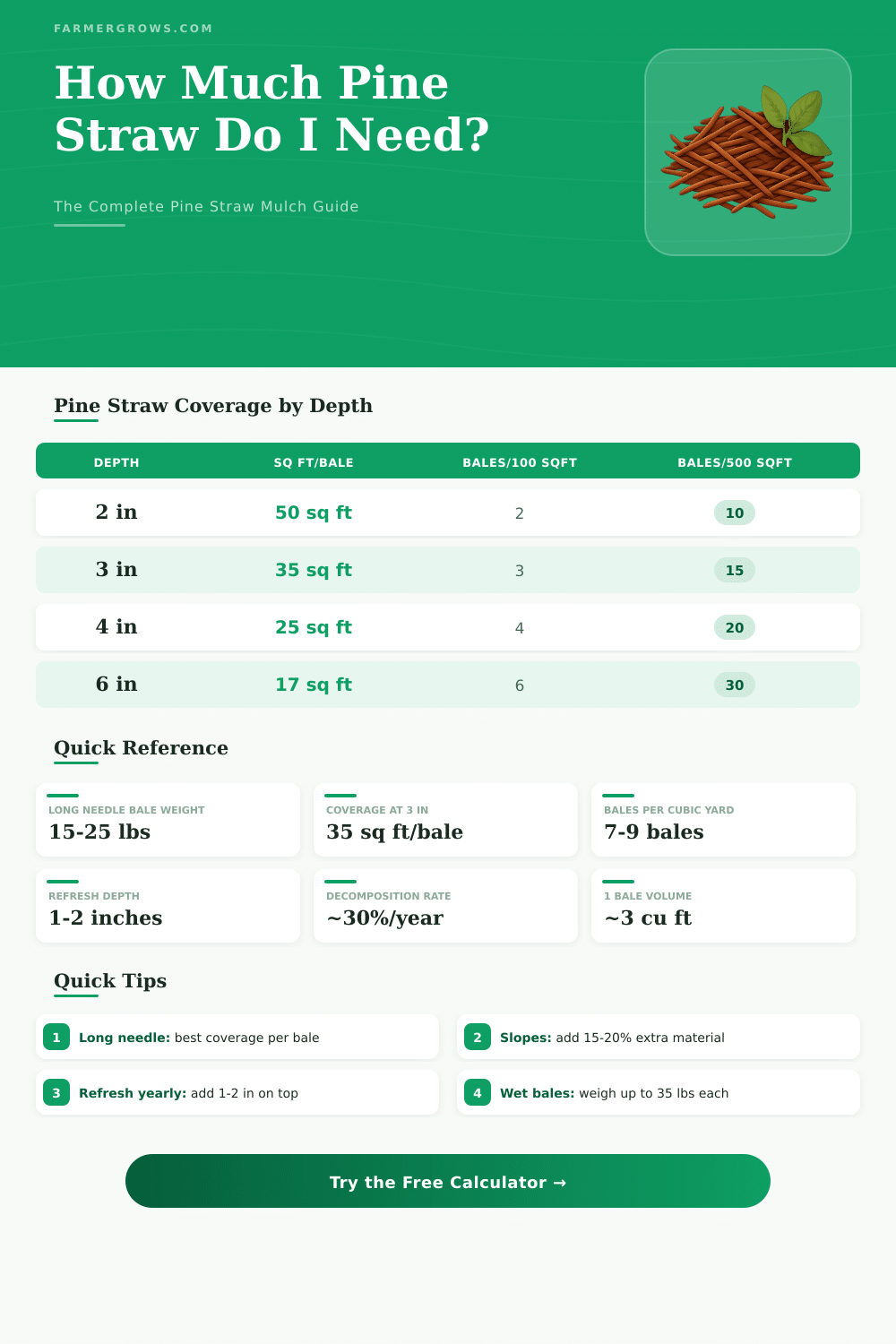
One bag of pine straw with long needles is enough to cover around 30 to 40 square feet at a depth of 3 inches, that I did not expect like this little. The type with short needles covers even more mulch almost 25 square feet. For a bed of 500 square feet, around 15 bags should be enough, more or less exactly.
Those packages weigh 15 to 25 pounds usually, but when they get wet, they rise to almost 35 pounds, what is not funny to carry.
How Much Pine Straw You Need and Easy Tips
The most difficult part is, as the pine straw packs down over time. The fresh, fluffy layer shrinks by 25 to 30 percent only after some months, so that 3-inch depth quickly falls under 2.5 inches. Many landscapers, with that I talked, advise to start with 3.5 inches to make up for that.
For 1000 sqaure feet at that depth, you need almost 30 bags. And on slopes, plan to add 15 to 20 percent more. Simply because of the material, that slips down, without doubt.
Pine straw already long is popular mulch for landscaping in the south United States, for almost a quarter century. From little flower beds to big road projects, it ranks between the most commonly chosen. In the last years, it also gets attention more north.
A big advantage of pine straw is its good fit on slopes. It stays much more flat than wood mulch, that commonly washes down. The linked needles create a mat, that allows water to filter to the ground, but the thickness is enough to slow drying in the heat.
Like this it well helps too preserve moisture in the soil.
The needles have a clear red-brown color and form, that gives landscapes a rustic, united look. It looks especially well around areas with pine trees, because the needles simply gather from those, that naturally fall, without any change to the trees.
Compared to wood mulch, pine straw is much more light and less costly to buy and spread. No wheelbarrows or shovels needed. It is also more friendly to the surroundings, because it breaks down more slowly and does not need frequent reapplying.
On the other hand, it does not last as long as wood mulch, so pine straw beds usually get refreshed once yearly.
A common myth is, that pine straw sours the ground, but reality is different. Only the fresh, green needles have a bit of sourness. When they turn brown and fall, that sourness quickly drops.
So pine straw works well for acid-fans like blueberry and strawberries, without problems for other plants.
As the needles slowly break down, they add nutrients to the soil and improve its structure. Pine straw also stops diseases and funguses from the soil from jumping to bottom leaves of plants during rain or watering. Also, it creates a natural wall against weeds, the seeds simply stay stuck above the dense layer instead of reaching the ground.
One possible downside is, that pine straw burns more easily than other mulch, so avoid it in areas risky for fires. Cleaning around trees can be hard, because the needles mix with the pieces. A good fix is to trim the trees just before thereapplying of mulch.
For comparison, 3 bags of pine straw cover the same area as one cubic yard of hardwood mulch.