🌶️ Pepper Plant Water Calculator
Calculate exactly how much water your pepper plants need per day, week, and season
⚡Quick Presets
📝Plant & Garden Details
📊 Your Pepper Plant Water Results
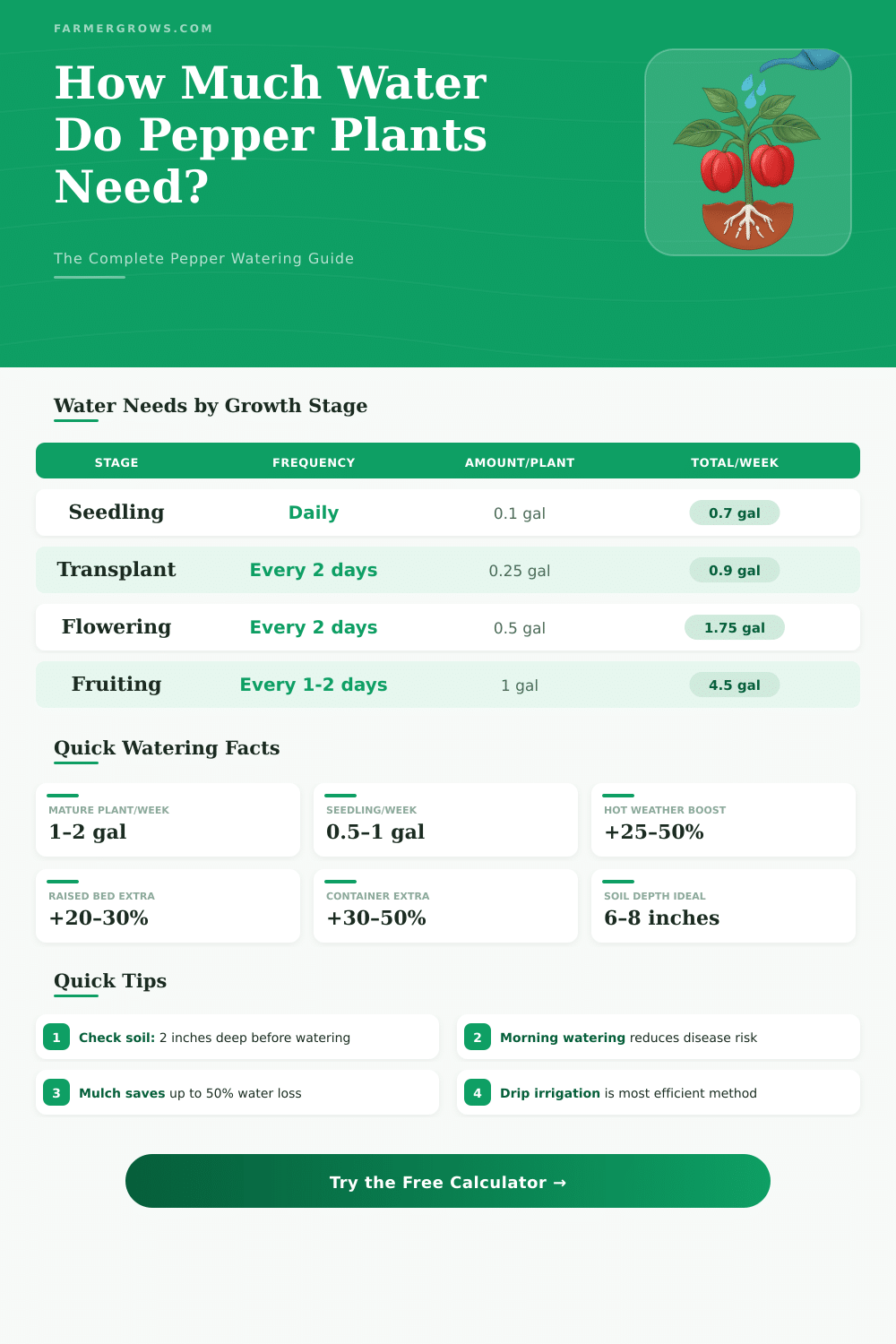
📊Water Needs by Growth Stage
| Growth Stage | Gal / Plant / Day | L / Plant / Day | Frequency | Notes |
|---|---|---|---|---|
| Seedling | 0.05–0.1 | 0.19–0.38 | Daily (light) | Keep moist, not wet |
| Transplant | 0.2–0.35 | 0.76–1.32 | Daily | Critical rooting period |
| Vegetative | 0.3–0.5 | 1.14–1.89 | Every 2 days | Consistent moisture |
| Flowering | 0.4–0.65 | 1.51–2.46 | Every 2 days | Don't stress during bloom |
| Fruiting | 0.5–1.0 | 1.89–3.79 | Every 1–2 days | Peak demand stage |
| Dormant | 0.05–0.1 | 0.19–0.38 | Weekly | Minimal watering |
🌡️Climate Adjustment Factors
🌱Growing Method Adjustments
| Growing Method | Multiplier | Why | Check Moisture |
|---|---|---|---|
| In-Ground Garden | 1.0x (baseline) | Natural soil retention | Top 2 in. dry |
| Raised Bed | 1.2x | Faster drainage | Daily in summer |
| Container / Pot | 1.4x | Limited soil volume | Daily (finger test) |
| Greenhouse | 1.15x | No rain, higher temp | Every 1–2 days |
| Drip Irrigation | 0.85x | Minimal evaporation | System-monitored |
| Indoor / Grow Light | 1.1x | Low humidity typical | Every 2–3 days |
📋Watering by Container Size
| Pot Size | Volume (gal) | Water per Session | Frequency (warm) |
|---|---|---|---|
| 4-inch pot | 0.13 gal | 0.05–0.1 gal (0.2–0.4 L) | Daily |
| 1-gallon pot | 1 gal | 0.15–0.25 gal (0.57–0.95 L) | Daily |
| 3-gallon pot | 3 gal | 0.3–0.5 gal (1.1–1.9 L) | Every 1–2 days |
| 5-gallon pot | 5 gal | 0.5–0.75 gal (1.9–2.8 L) | Every 2 days |
| 7-gallon pot | 7 gal | 0.7–1.0 gal (2.6–3.8 L) | Every 2–3 days |
| 10-gallon pot | 10 gal | 1.0–1.5 gal (3.8–5.7 L) | Every 3 days |
Pepper plants come in all kinds of forms, sizes and levels of spice. There are sweet types, gentle species and really gross warm types. From bell peppers and banana peppers to jalapenos, habaneros, cayenne and even tabasco and Thai peppers, the choices are huge.
More than 115 different species come in various forms colours and tastes.
How to Grow Peppers
Peppers like heat. You should plant them outside one or two weeks after the last cold, when the weather is already stable and warm. The lowest daily temperature should reach at least 55°F before moving them outside.
Pepper plants do not handle cold. If the temperature falls to 30 degrees, the plants need protection. Watering the plants and adding a two-inch layer of mulch help to protect during cold nights.
Peppers also lose flowers under 40°F, so it matters to keep them warm.
Maybe starting seeds inside is a good idea. Seeds can start six to eight weeks before planting outside. Warm mats or grow lights help to reach the right temperature, because peppers do not sprout easily.
The best ground temperautre for sprouting is between 75 and 85°F, with a minimum of 65°F. Some species sprout in seven to ten days, while others need several weeks.
Pepper plants benefit from well drained soil and full sunshine. The planting spot should receive at least six hours of direct sun daily. Watering should be deep but not too common.
If the upper inch of soil feels dry, it is time for Water. Too much Water can drown the plants. Plastic covers or organic coverings help to save Water and reduce drying, but organic mulch you should not use until the soil reaches 75°F.
Small Pepper plants usually last and stay fresh and warm provisions more well then big bell peppers. Planting some little sweet peppers beside bigger ones usually results in better harvest. Growing peppers in jars works well also.
The plants you can move to stay in full sun or catch heat from the house.
Flowers appear first on the plant and they need pollen from bees or other insects. Later the fruits grow from that. Without pollination fruits do not happen.
Light feeding with nitrogen helps to grow a big plant. Peppers should be picked when the fruits are fully colored but still firm. For instance, the Carmen Pepper is ready to pick green at six inches long, or you can leave them on the plant for another twenty days to turn red.
Aphids are common enemies of peppers, that cause yellow and bent leaves. Companion plants like chives, onions and leeks naturally push them away. Filling the spaces around peppers with helpful grasses, flowers and vegetables is a clearsrategy.