🌶️ Pepper Plant Spacing Calculator
Find out exactly how many pepper plants fit your garden bed or row
| Plant Spacing | Grid Pattern | Staggered Pattern | Metric Equiv. |
|---|---|---|---|
| 10 in (25 cm) | 144 plants | 166 plants | 15 plants/m² |
| 12 in (30 cm) | 100 plants | 115 plants | 11 plants/m² |
| 14 in (36 cm) | 74 plants | 85 plants | 8 plants/m² |
| 18 in (46 cm) | 44 plants | 51 plants | 5 plants/m² |
| 24 in (61 cm) | 25 plants | 29 plants | 3 plants/m² |
| 30 in (76 cm) | 16 plants | 18 plants | 2 plants/m² |
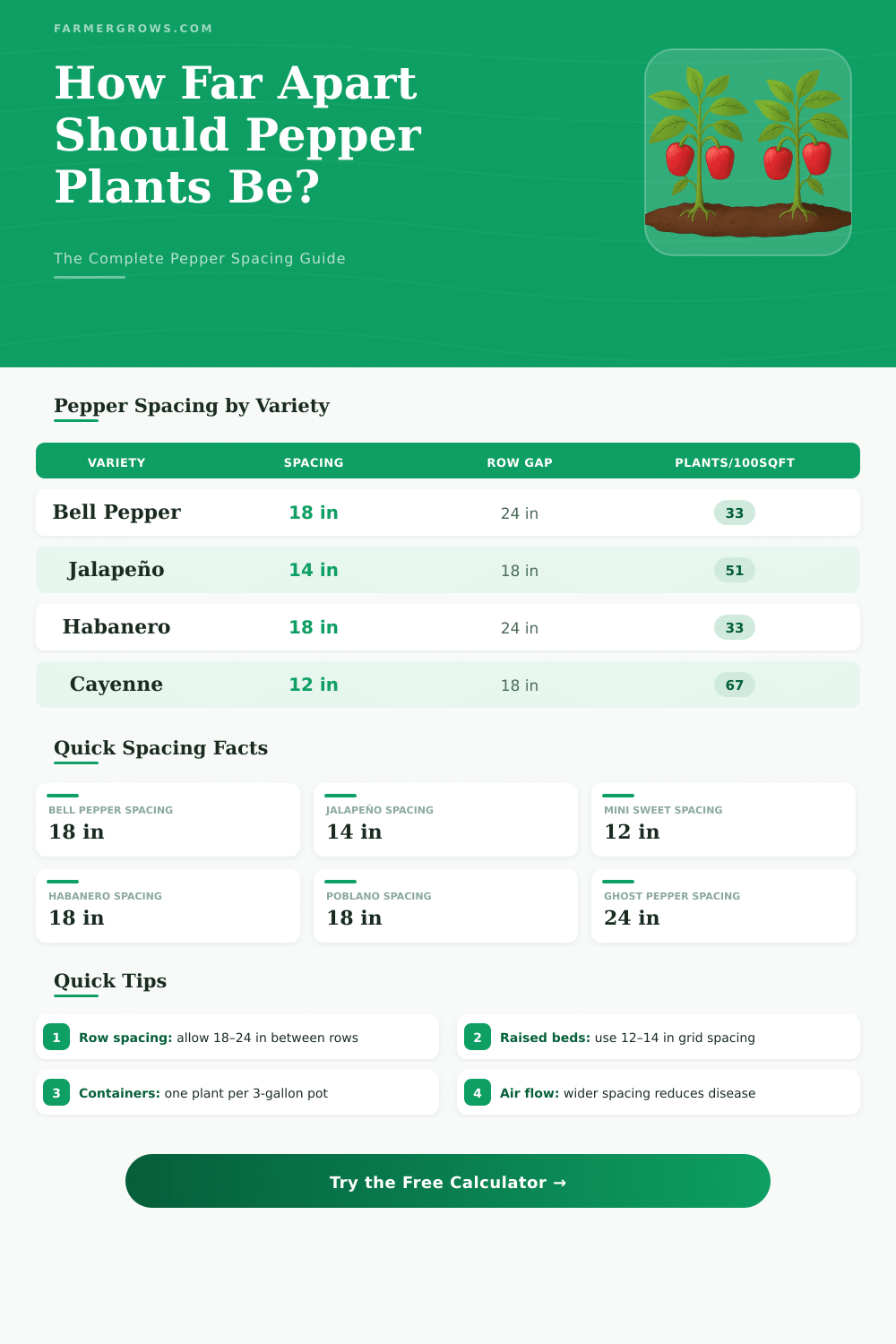
| Variety Type | In-Row Spacing | Row-to-Row | Plants per 10 ft Row |
|---|---|---|---|
| Bell Pepper | 18 in | 24–36 in | 6–7 |
| Jalapeño | 14–16 in | 18–24 in | 7–8 |
| Habanero | 18 in | 24–30 in | 6–7 |
| Cayenne | 12–15 in | 18–24 in | 8–10 |
| Poblano | 18–24 in | 24–36 in | 5–6 |
| Ghost Pepper | 24–36 in | 36–48 in | 3–5 |
| Mini Sweet | 12 in | 18–24 in | 10 |
| Serrano | 12–14 in | 18–24 in | 8–10 |
| Banana Pepper | 18 in | 24 in | 6–7 |
| Bed Size | Area | Bell Pepper (18 in) | Jalapeño (14 in) |
|---|---|---|---|
| 4 x 4 ft | 16 sq ft | 4–6 plants | 6–9 plants |
| 4 x 8 ft | 32 sq ft | 9–12 plants | 13–18 plants |
| 4 x 12 ft | 48 sq ft | 13–17 plants | 19–26 plants |
| 8 x 8 ft | 64 sq ft | 18–24 plants | 25–36 plants |
| 10 x 10 ft | 100 sq ft | 28–36 plants | 40–57 plants |
| 10 x 20 ft | 200 sq ft | 56–72 plants | 80–114 plants |
| 12 x 24 ft | 288 sq ft | 80–100 plants | 115–164 plants |
Note: The information in this article is based on actual gardening experience and general growing experiences.
The spacing of Pepper Plants requires more attention than many folks think. Usually one plants Pepper Plants at 18 inches one from the another. That works for the most many types.
How to Space Pepper Plants
For bigger types one can give a little more Space even so they usually do not need much more than 18 inches. Rows should be split by 30 to 36 inches, which gives enough room to walk between them and gather the fruits.
For typical hot peppers like habaneros, Carolina Reapers and ghost peppers, spacing of 18 to 24 inches works well. The extra distance also eases the picking of fruits. Jalapeno peppers can stand a bit more closely, around 12 to 18 inches between them.
Each Jalapeno plant reaches between 1 and 3 feet of height depending on the type, and one plant gives several dozens of peppers.
One commonly sets three rows along a raised bed with plants at 18 inches spaced. Some gardeners lay 8 plants in one bed, with 4 at every side, and find that the plants still help each other. Two rows work more for small beds.
In a bed of 3 by 6 feet, a plan with 2 rows and 4 columns seems good and fills itself in some weeks.
Closer spacing is possbile, if the ground health, the watering, the nutrition and the pruning everything is great. In commercial pepper fields 12-inch spacing is very usual. But 12-inch spacing does not everywhere succeed.
In regions with long growing seasons Pepper Plants become huge and require at least 24 inches. Plants kept over winter for a second season require 36 inches of Space.
Closeness of peppers is useful, if there leaves touch when they mature. That helps to prevent sunburn on the fruits and keep the moisture in the ground. Even so too close placing of plants causes problems.
The roots of a jar grown pepper plant are at least as broad as the upper growth, sometimes even twice. Plants spaced too far apart compete for nutrients and water. Such stress leads to more flower drop, fewer output, leaf loss and bigger risks of diseases and pests.
Air flow is another spot to recall. Plants spaced at 18 or 24 inches can spread outside and block sunshine from each other. Using 30 inches one settles that problem.
Well drained sandy clay soil is ideal for pepper growing. Because one wants to save seeds, different pepper types should be split by at least 30 feet. Some gardeners lay two Pepper Plants each square foot when using rich ground mix, because good soil allows closer crop.
Spacing at 2 feet for peppers is a safe choice to lower risk of disease andavoid Space waste.