🌱 Peat Moss Calculator
Calculate exactly how much peat moss you need for any garden bed, lawn, or soil amendment project
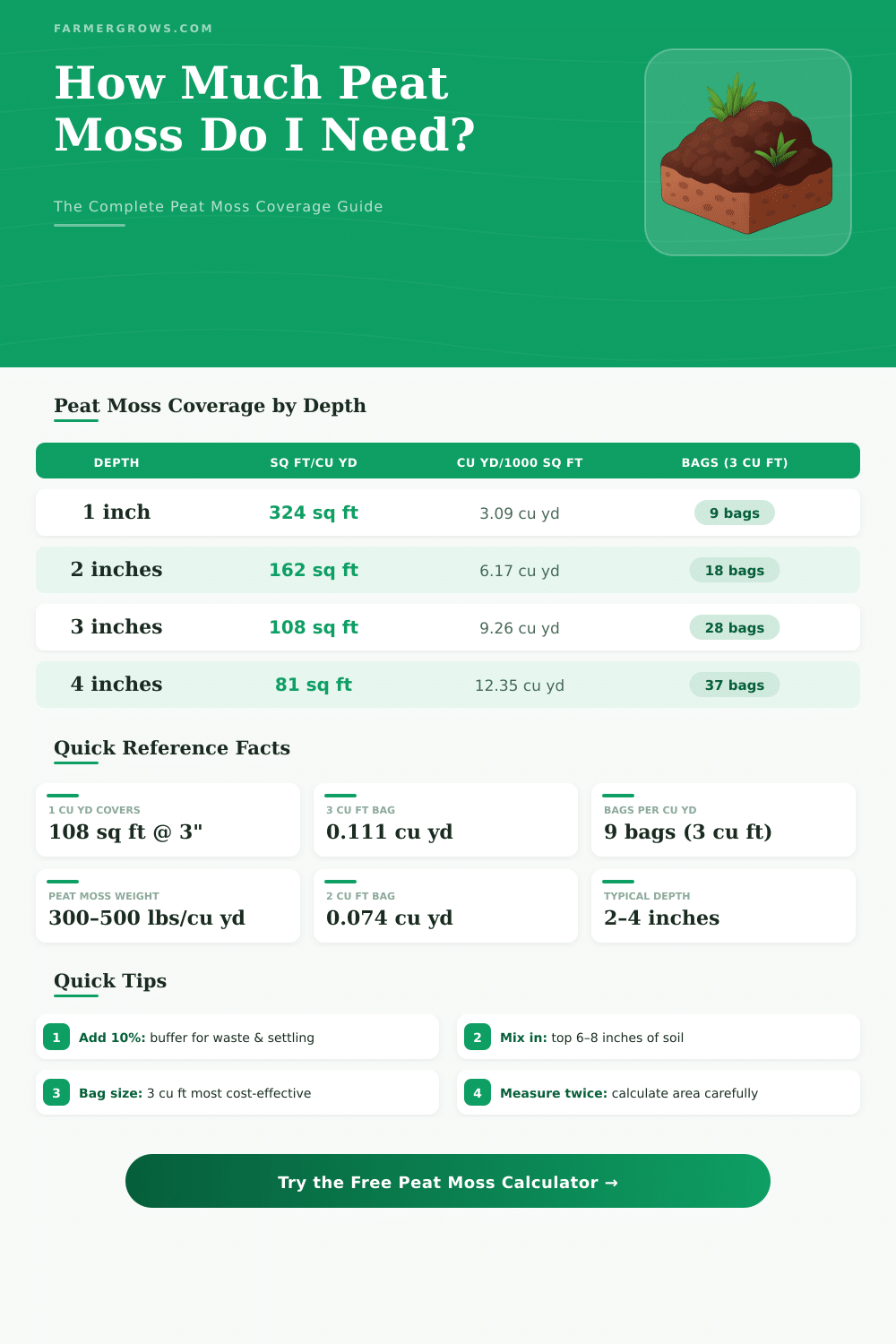
| Depth | Sq Ft per Cu Yd | Sq M per Cu M | Cu Yd per 1,000 Sq Ft | Cu M per 100 Sq M |
|---|---|---|---|---|
| 1 inch (2.5 cm) | 324 sq ft | 40.0 m² | 3.09 cu yd | 0.025 m³ |
| 2 inches (5 cm) | 162 sq ft | 20.0 m² | 6.17 cu yd | 0.05 m³ |
| 3 inches (7.5 cm) — Typical | 108 sq ft | 13.3 m² | 9.26 cu yd | 0.075 m³ |
| 4 inches (10 cm) | 81 sq ft | 10.0 m² | 12.35 cu yd | 0.10 m³ |
| 6 inches (15 cm) | 54 sq ft | 6.67 m² | 18.52 cu yd | 0.15 m³ |
| Bag Size | Volume (Cu Ft) | Cu Yd Equivalent | Bags per Cu Yd | Coverage @ 3 in |
|---|---|---|---|---|
| Small bag | 1 cu ft | 0.037 cu yd | 27 bags | 4 sq ft |
| Standard bag | 2 cu ft | 0.074 cu yd | 13.5 bags | 8 sq ft |
| Large bag | 3 cu ft | 0.111 cu yd | 9 bags | 12 sq ft |
| Compressed bale (expands) | ~3.8 cu ft | ~0.14 cu yd | ~7 bags | ~15 sq ft |
| Bulk yard | 27 cu ft | 1.0 cu yd | — | 108 sq ft |
| Project | Area | Cu Yd @ 3 in | 3 Cu Ft Bags @ 3 in |
|---|---|---|---|
| Small flower bed | 100 sq ft | 0.93 cu yd | 9 bags |
| Medium garden bed | 200 sq ft | 1.85 cu yd | 17 bags |
| Large bed / border | 400 sq ft | 3.70 cu yd | 34 bags |
| Vegetable garden | 150 sq ft | 1.39 cu yd | 13 bags |
| Tree ring (6ft dia) | 28 sq ft | 0.26 cu yd | 3 bags |
| Lawn top dress (1/4 acre) | 2,178 sq ft | 20.2 cu yd | 182 bags |
| Raised bed 4×8 | 32 sq ft | 0.30 cu yd | 3 bags |
| Raised bed 4×16 | 64 sq ft | 0.59 cu yd | 6 bags |
Peat Moss forms naturally in cold, wet places, where the conditions slow the decay of organic materials. It is made up of a mix of dying moss. That particular type of living moss, together with grasses, trees, wooden stubs and various other plant remains that builds up in soggy places.
Many folks mix up the words “moss” and “Peat Moss”, although they really are different. Moss is the living plant that grows in marshes briefly, while Peat Moss is the result when all those plants die and start breaking down, very slowly, over decades. Rather than fully rot, everything simply piles and packs into that what we call Peat Moss.
Peat Moss: What It Is and How to Use It
In gardening it looks like a stringy, dark brown stuff, that one mixes into beds and gardens. The main reason for adding it to the ground is to loosen the structure, improve the airflow and help to control humidity. Surprisingly, moss can absorb even twenty times its own weight in water, so it works like a natural spogne in the soil.
Gardeners like Peat Moss because of good reasons. It protects roots against drying, keeping the moisture more long, and it holds nutrients, so that less of them go to waste. Because it breaks down very slowly, it stays useful more than many other soil additions.
Packed soil simply kills the access of water and nutrients too roots, Peat Moss fixes that, keeping the ground less dense and fluffy, which reduces the need to commonly dig and air out.
It shines especially during making of own mixes for gardens, when one deals with heavy clay ground or creates a solid base for pots and beds. It helps healthy roots and works for almost each planting situation. Products like “Black Gold Peat Moss” are certified organic and come from Canadian moss marshes.
They can lower high pH soil by adding a bit of sourness. Peat Moss itself has a pH between 3.5 and 4.5, so quite a lot sour, simply said.
Even so, that acid level can bother some gardeners. To reach a pH around 5.4 to 6.0, better for many plants, one mixes limestone into the planting mix. On its own Peat Moss does not feed your plants.
It has almost no nutrient value, compost is a much better choice as real fertilizer.
Here is another reason to remember: after Peat Moss fully dries, it resists soaking up water easily. In that state it even pushes away moisture, so it works badly for surface cover. You can mix it with perlite, limestone, fertilizer, coconut fiber or sand to make your own soilless mixes.
Regrowth of peat after harvest takes around seven years, so one must use it carefully. After harvest the material dries, gets cleaned and gets packed in packages or bags for sale. Sun Gro Horticulture controlsthe most of the production of garden peat in North America.