🪨 Pea Gravel Calculator
Find exactly how much pea gravel you need — cubic yards, bags & weight for any project
lbs / cu yd
lbs / cu yd
lbs / cu yd
lbs / cu yd
lbs / cu yd
lbs / cu yd
Granite lbs/yd
Base lbs / cu yd
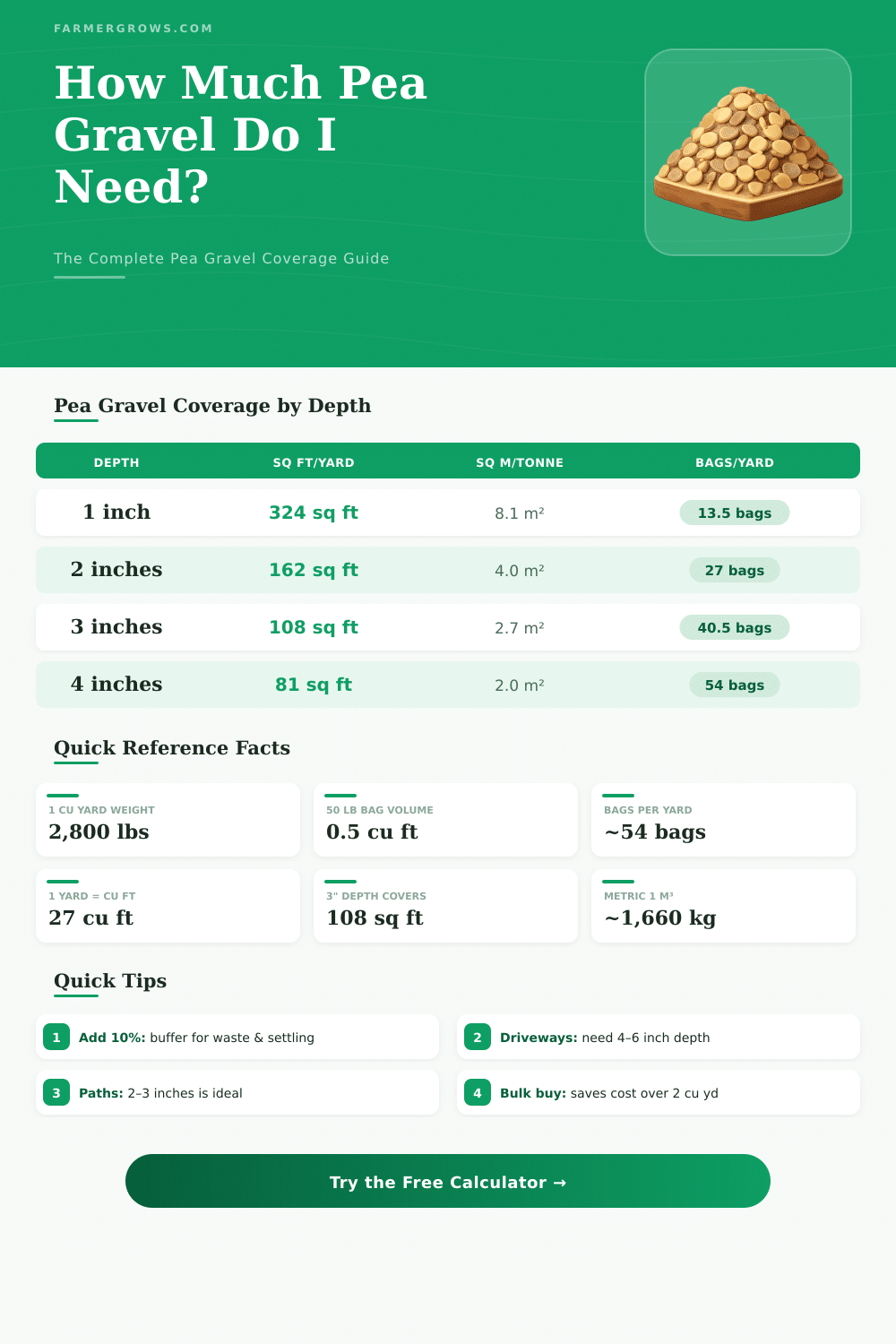
| Depth | Sq Ft Covered | Sq Meters Covered | Cubic Feet | Best Use |
|---|---|---|---|---|
| 1 inch (2.5 cm) | 324 sq ft | 30.1 m² | 27 cu ft | Top dressing, decorative |
| 2 inches (5 cm) | 162 sq ft | 15.1 m² | 27 cu ft | Paths, light walkways |
| 3 inches (7.6 cm) | 108 sq ft | 10.0 m² | 27 cu ft | Beds, patios, playgrounds |
| 4 inches (10 cm) | 81 sq ft | 7.5 m² | 27 cu ft | Driveways, drainage |
| 6 inches (15 cm) | 54 sq ft | 5.0 m² | 27 cu ft | French drains, heavy use |
| Bag Size | Volume per Bag | Bags per Cubic Yard | Coverage at 3" Depth |
|---|---|---|---|
| 0.5 cu ft (50 lb bag) | 0.5 cu ft | 54 bags | 2 sq ft |
| 1 cu ft (small bag) | 1.0 cu ft | 27 bags | 4 sq ft |
| 2 cu ft (standard) | 2.0 cu ft | 13.5 bags | 8 sq ft |
| 3 cu ft (large) | 3.0 cu ft | 9 bags | 12 sq ft |
| Bulk / Ton bag | ~27 cu ft | 1 cubic yard | 108 sq ft |
| Project | Area (sq ft) | Cubic Yards Needed | 2 cu ft Bags Needed |
|---|---|---|---|
| Small flower bed 5x10 | 50 sq ft | 0.46 yd³ | ~7 bags |
| Garden bed 10x20 | 200 sq ft | 1.85 yd³ | ~25 bags |
| Patio 12x12 | 144 sq ft | 1.33 yd³ | ~18 bags |
| Playground 15x15 | 225 sq ft | 2.08 yd³ | ~28 bags |
| Driveway 10x30 (4") | 300 sq ft | 3.70 yd³ | ~50 bags |
| Large yard 50x50 | 2,500 sq ft | 23.1 yd³ | ~313 bags |
Pea Gravel sits right in that nice range of landscape materials. Tiny round shaped stones in the size of a pea that measures around 3/8 inches in diameter. What makes them such a pleasant use, is their smooth, polished surface.
One finds them in many shades: browns, greys, bronzes, cream, pinks, reds and violet blues. Some granite kinds add white and more strong blues. That wealth of colours truly helps, one can match them with the surrounding landscape or clearly choose strong contrast to the plants.
Pea Gravel: Uses, Benefits and Problems
Uses for Pea Gravel are quite various. They work for paths, patios, garden beds, driveways, playgrounds, dog runs, tiny pools, everywhere they work well. Also around pots and garden plants they serve as good option for mulch.
Here the main bonus: rather than wooden mulch or other organic coverings, that breaks down over time, Pea Gravel simply stays here, always nice yearly after yearly. Wooden mulch can invite unwanted grasses, but stones stay stable.
Drainage probably is the strongest argument for there use. Water slips freely through those rounded stones without building up, what protects plants and the base of the house against humidity damage. Also, it well stops erosion on paths.
One can use it also as filling around drain tubes, especially for French drains, where it leads the water exactly over there, where it needs to go.
Damp layers in the ground below can hide unwanted grasses, that then get held back, and here a bonus that no one commonly mentions: rodents hate it. Mice and moles can not easily dig through it, so spreading a bit around the house base, one indeed stops them.
Naturally, some downsides exist. When damp, it becomes slippery, and feet shift as if one walks in sand. Stones scatter everywhere, end in shoes and insides, and paths indoorpermanently get dirty.
Removing sheets of Pea Gravel is a difficult task, and a leaf blower only crushes them more. It does not pack well, so do not use it as base for pavings. Even with landscape fabric below, casual unwanted grasses yet push through.
To stabilize it, requires a bit of effort. In areas with a lot of foot traffic, one lays first rough stones, later adds packed sand or filler between the Pea Gravel, what locks everything together. The secret is leave the top layer thin; only one inch on top of flatly packed base.
Deeper layers feel as if one walks through sandy hills.
From a cost viewpoint, you can hardly beat it compared to bluestone or similar. Enclosed areas like patios are ideal, because the limited space keeps it in place. It is basically the little brother of river stones, sometimes called number seven Pea Gravel or number seven river stones.
The low price, that nice texture, the easily handled size and the color range available make it a popular choice for nearly every outdoor project.