🏗️ Paver Sand Calculator
Calculate exactly how much paver sand you need for any project
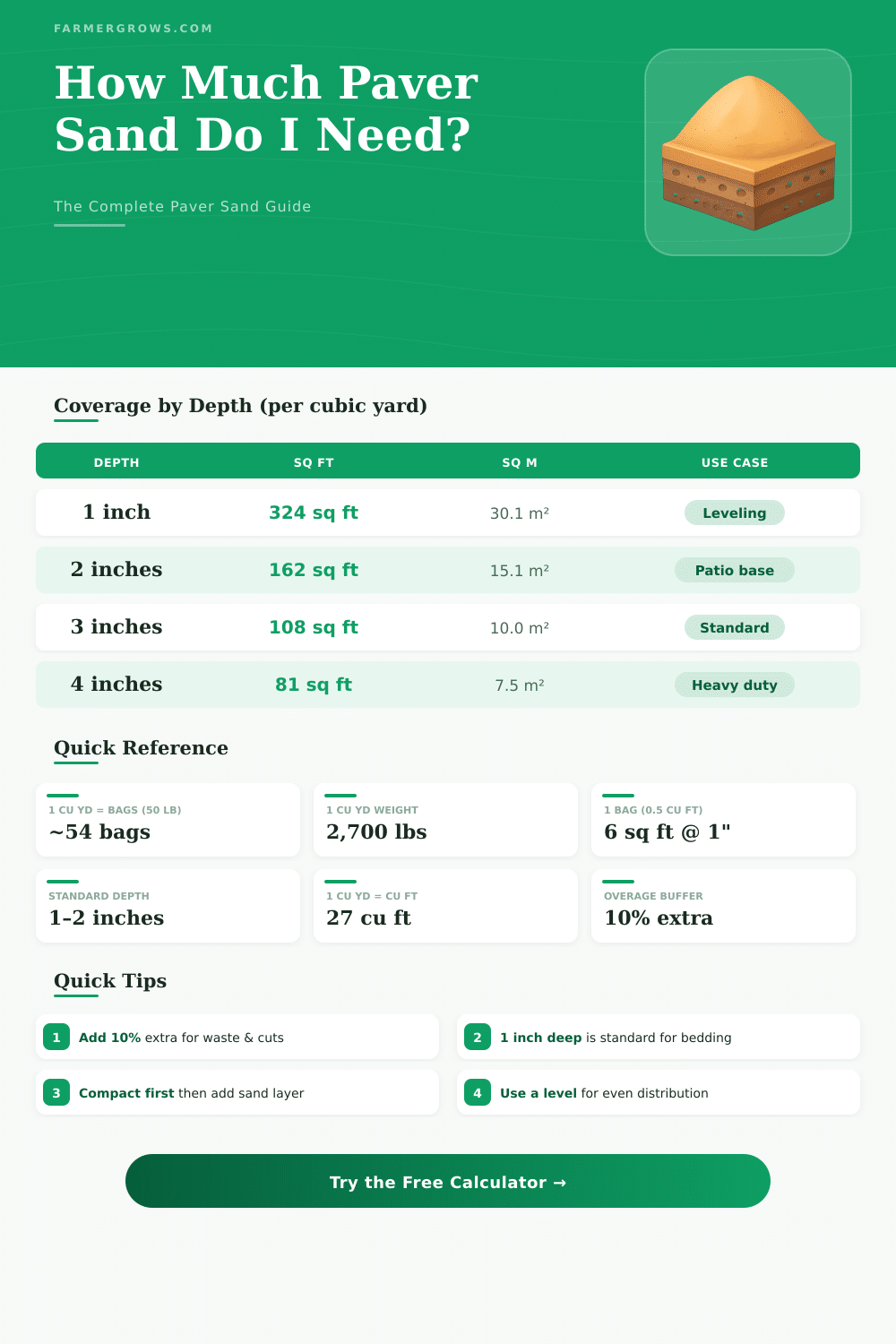
| Depth | Coverage (sq ft) | Coverage (m²) | Cubic Feet | Common Use |
|---|---|---|---|---|
| 0.5 in (1.3 cm) | 648 sq ft | 60.2 m² | 27 cu ft | Light leveling |
| 1 in (2.54 cm) | 324 sq ft | 30.1 m² | 27 cu ft | Standard bedding |
| 1.5 in (3.8 cm) | 216 sq ft | 20.1 m² | 27 cu ft | Thick bedding |
| 2 in (5.1 cm) | 162 sq ft | 15.1 m² | 27 cu ft | Base layer |
| 3 in (7.6 cm) | 108 sq ft | 10.0 m² | 27 cu ft | Deep base |
| 4 in (10.2 cm) | 81 sq ft | 7.5 m² | 27 cu ft | Heavy duty base |
| Bag Size | Volume (cu ft) | Bags per Cu Yd | Coverage @ 1 in | Coverage @ 2 in |
|---|---|---|---|---|
| 50 lb bag | 0.5 cu ft | 54 bags | 6 sq ft | 3 sq ft |
| 60 lb bag | 0.6 cu ft | 45 bags | 7.2 sq ft | 3.6 sq ft |
| 0.5 cu ft bag | 0.5 cu ft | 54 bags | 6 sq ft | 3 sq ft |
| 1 cu ft bag | 1 cu ft | 27 bags | 12 sq ft | 6 sq ft |
| 2 cu ft bag | 2 cu ft | 13.5 bags | 24 sq ft | 12 sq ft |
| Bulk (1 cu yd) | 27 cu ft | 1 yard | 324 sq ft | 162 sq ft |
| Project | Area (sq ft) | Cu Yds @ 1 in | Cu Yds @ 2 in | 50 lb Bags @ 1 in |
|---|---|---|---|---|
| Small Patio 10x10 | 100 sq ft | 0.31 yds | 0.62 yds | 17 bags |
| Standard Patio 12x16 | 192 sq ft | 0.59 yds | 1.19 yds | 32 bags |
| Large Patio 20x20 | 400 sq ft | 1.23 yds | 2.47 yds | 67 bags |
| Walkway 4x20 | 80 sq ft | 0.25 yds | 0.49 yds | 13 bags |
| Driveway 20x40 | 800 sq ft | 2.47 yds | 4.94 yds | 133 bags |
| Pool Surround 25x25 | 625 sq ft | 1.93 yds | 3.86 yds | 104 bags |
Paver Sand plays an important role when one builds patios, pavements and driveways. It helps to make flat surfaces and give lasting results. The main task of Paver Sand is to create a stable base for stones or Pavers.
It spreads the weight equally, stops sinking and gives a smooth layer on which the Pavers rest well.
Paver Sand: What It Is and How to Use It
Paver Sand is sharp Sand. Under a microscope the grains look rough not round or smooth. Common Paver Sand usually carries pebbles and mixed crushed rock, what differs from play Sand.
Play Sand is very fine and dusty while Paver Sand is much more coarse. Mostly “Paver Sand” simply means a certain grade, so a set grain size.
In Paver work one uses several Sand layers. First comes a layer of coarse Paver Sand as base material under the Pavers. That layer gives stability and helps “lock” the Pavers in place, so that they do not move or sink with time.
Later is a thin layer of Sand under the Pavers, to cushion them and give a level base. Even so that Sand is not the same as the Sand that one lays in the gaps between the Pavers. It also matters to hold the Sand at outer edges by means of concrete or some other kind of corner support.
For the gaps between Pavers, polymer Sand is a very good choice. Polymer Sand is a mix of coarse Sand, polymers and binding agents. One sweeps it dry into the gaps and later starts it by means of water.
When it gets wet, it hardens, what makes it strong and resistant against washing out. It also creates bad conditions for weeds and pests, for instance ants. Polymer Sand works best when it fills the whole depth of the Paver gap.
Joining Sand is another option. It usually is well graded Sand, whose bigger grains are a bit angled or partly angled. Such grains help to stop washing out, yet it can wash away slowly and more easily allow weeds then polymer Sand.
One can apply a gap sealer to set the joining Sand in place. The downside is, that the seal needs re-application each three to five years.
Regular Sand with seal can serve a similar goal to polymer Sand. Some also use graded mason Sand, that was cleaned to remove stones, pebbles and natural material. Paver Sand very well works for placing Pavers, flagstones and bricks.
One can also add it to concrete mix. Leveling Sand is useful for interlocking Pavers, borders around flowerbeds, retaining walls andpatio stones. Fresh Sand should be spread above the Pavers and often swept in the gaps to keep everything tight.