🧱 Paver Edging Calculator
Calculate exactly how much paver edging you need for any project — patios, walkways, garden beds & more
| Perimeter (ft) | Perimeter (m) | 6 ft Sections | 8 ft Sections | 10 ft Sections |
|---|---|---|---|---|
| 20 ft | 6.1 m | 4 pcs | 3 pcs | 2 pcs |
| 40 ft | 12.2 m | 7 pcs | 5 pcs | 4 pcs |
| 60 ft | 18.3 m | 11 pcs | 8 pcs | 7 pcs |
| 80 ft | 24.4 m | 15 pcs | 10 pcs | 8 pcs |
| 100 ft | 30.5 m | 17 pcs | 13 pcs | 11 pcs |
| 150 ft | 45.7 m | 25 pcs | 19 pcs | 15 pcs |
| 200 ft | 61.0 m | 34 pcs | 25 pcs | 20 pcs |
| 300 ft | 91.4 m | 50 pcs | 38 pcs | 30 pcs |
Note: Sections include 10% overage. Round up to nearest whole piece.
| Perimeter (ft) | Spike @ 6 in | Spike @ 12 in | Spike @ 18 in | Spike @ 24 in |
|---|---|---|---|---|
| 20 ft | 40 spikes | 20 spikes | 14 spikes | 10 spikes |
| 40 ft | 80 spikes | 40 spikes | 27 spikes | 20 spikes |
| 60 ft | 120 spikes | 60 spikes | 40 spikes | 30 spikes |
| 100 ft | 200 spikes | 100 spikes | 67 spikes | 50 spikes |
| 150 ft | 300 spikes | 150 spikes | 100 spikes | 75 spikes |
| 200 ft | 400 spikes | 200 spikes | 134 spikes | 100 spikes |
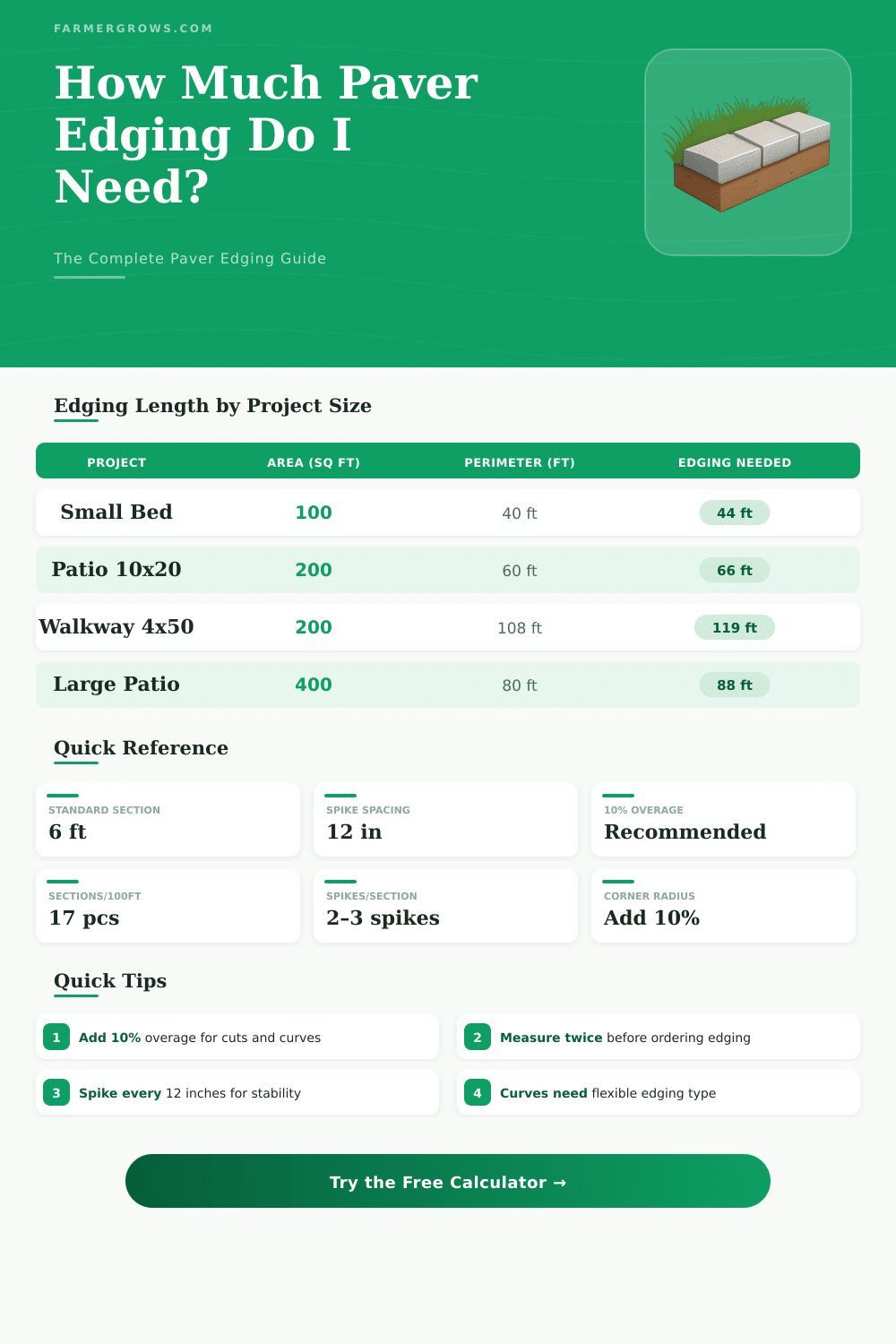
| Project | Dimensions | Perimeter (ft) | 6ft Sections (10% buf) | Spikes @ 12in |
|---|---|---|---|---|
| Small Patio | 10 x 10 ft | 40 ft | 7 pcs | 44 spikes |
| Medium Patio | 12 x 16 ft | 56 ft | 11 pcs | 62 spikes |
| Large Patio | 20 x 30 ft | 100 ft | 19 pcs | 110 spikes |
| Narrow Walkway | 3 x 30 ft | 66 ft | 13 pcs | 73 spikes |
| Standard Walkway | 4 x 50 ft | 108 ft | 20 pcs | 119 spikes |
| Garden Bed | 8 x 12 ft | 40 ft | 8 pcs | 44 spikes |
| Tree Ring | 6 ft dia circle | 19 ft | 4 pcs | 21 spikes |
| Driveway Edge | 2 sides x 40 ft | 80 ft | 15 pcs | 88 spikes |
| Material | Weight (lbs/ft) | Weight (kg/m) | Flexibility | Best Use |
|---|---|---|---|---|
| Plastic / Poly | 0.3 lbs/ft | 0.45 kg/m | High | Garden beds, curves |
| Steel | 1.2 lbs/ft | 1.79 kg/m | Low | Straight edges, patios |
| Aluminum | 0.6 lbs/ft | 0.89 kg/m | Medium | Curved paths, borders |
| Rubber | 0.8 lbs/ft | 1.19 kg/m | High | Playgrounds, curves |
| Concrete | 8.0 lbs/ft | 11.9 kg/m | None | Permanent borders |
| Timber / Wood | 2.5 lbs/ft | 3.72 kg/m | Low | Natural look beds |
| Composite | 1.0 lbs/ft | 1.49 kg/m | Medium | All-purpose use |
| Cobblestone | 12.0 lbs/ft | 17.9 kg/m | None | Decorative permanent |
Paver Edging uses edging to set concrete or brick pavers in patios and pavements. Without that, the pavers can spread outside and form little gaps over time. That will damage them over a long period.
Using Paver Edging one keeps everything flat in position, and most specialists advise that.
Types of Paver Edging
One can choose between several kinds of Paver Edging for pavers. Between them, the plastic type is one of the most popular. Strong plastic has enough flexibility to shape it straight or adapt to curves.
To form curves, one cuts the linking tabs at the edge. Later, nylon spikes are pushed through openings in the material to anchor it to the soil. Some plastic pieces come in stiff lengths of eight feet, that helps to keep nice straight lines.
The Paver Edging must sit well above the outer pavers, and only the most upper edge line shows. It creates a clean, smooth look. When one adds sand and grit, the Paver Edging hides underground to give an elegant, clean sight.
Even so, plastic Paver Edging has some downsides. It can swell, bend and rise, especially in flower beds. Plastic is not porous, so it does not absorb water.
If the ground freezes, the material does not stick to the soil. It splits and raises itself elsewhere, then does not go back the same way in spring. Some snap-style edges also brake during bad weather and break easily.
Concrete Paver Edging is another option for pavers. Concrete resists moisture and forms the strongest edging that one finds. It joins flat to the soil, because it absorbs water, and moves together with the ground.
A bag of concrete costs around four dollars and covers area equal to a thirty-dollar piece of plastic. Some contractors lay concrete not only at the edge of the pavers, but also under them. The only downside of concrete Paver Edging is that it stops grass from growing right up to the limit.
Metal or aluminum Paver Edging comes in commercial grades. Metal or plastic edging usually installs more simply and quickly than concrete. Pavers that sit right beside a wall or concrete slab do not need Paver Edging on that side.
In designs with stepping stones, Paver Edging is not needed, unless every step holds several pieces.
Stone pavers work well with Paver Edging, especially for curves along steps or perfectly straight lines. Pavers with rounded edges, that slip one on the other, add a bit of extra linked strength. Most stone pavers weigh quite a lot, so they donot move if one installs them right by means of a trench.