🧱 Paver Base Calculator
Calculate exactly how much gravel, crushed stone, or sand you need for your paver base project
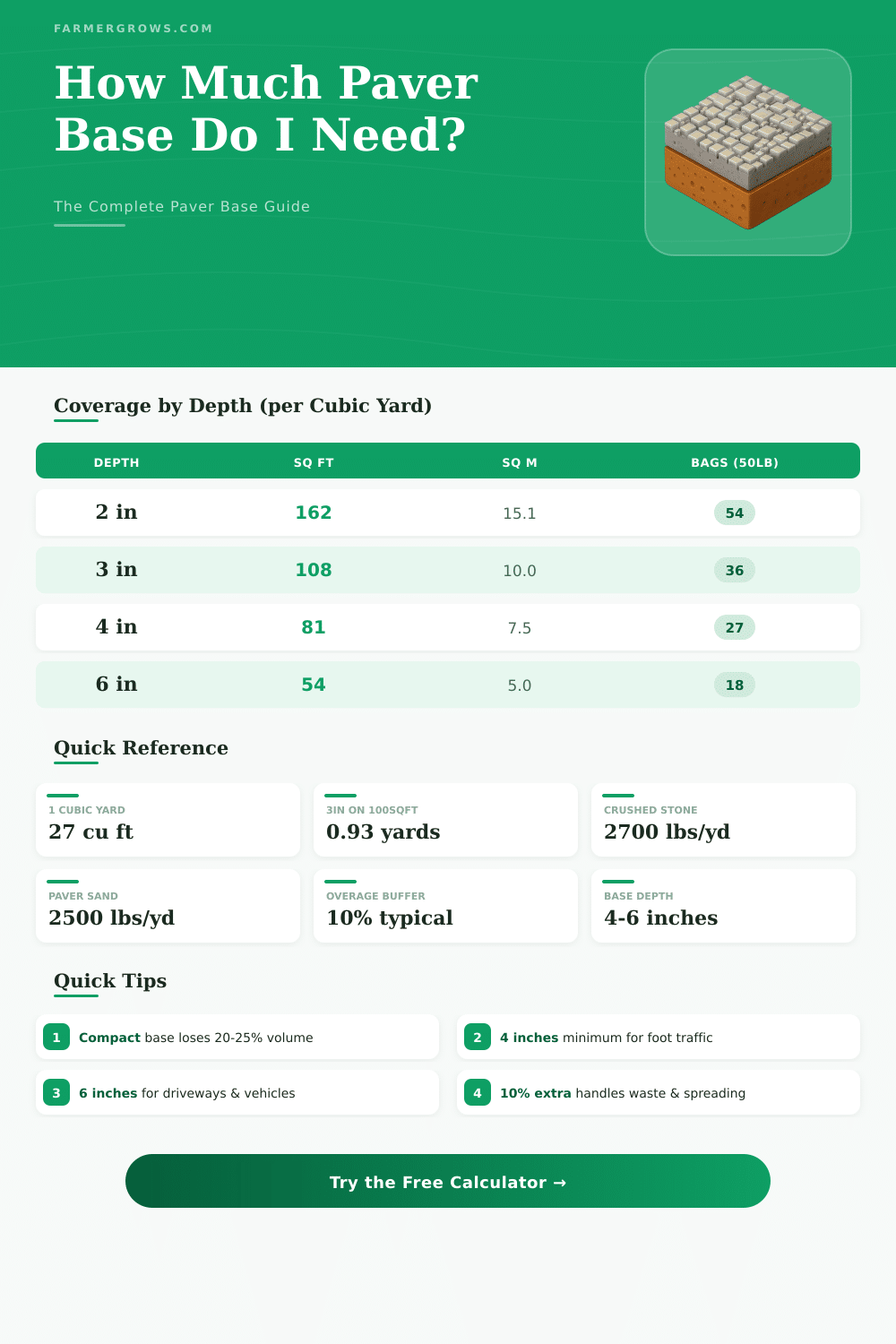
| Depth | Sq Ft / Cubic Yard | Sq M / Cubic Meter | Cubic Yards per 100 sq ft |
|---|---|---|---|
| 1 in (2.5 cm) | 324 | 32.4 | 0.31 |
| 2 in (5 cm) | 162 | 16.2 | 0.62 |
| 3 in (7.6 cm) | 108 | 10.8 | 0.93 |
| 4 in (10 cm) | 81 | 8.1 | 1.23 |
| 5 in (12.7 cm) | 64.8 | 6.5 | 1.54 |
| 6 in (15 cm) | 54 | 5.4 | 1.85 |
| 8 in (20 cm) | 40.5 | 4.1 | 2.47 |
| 12 in (30 cm) | 27 | 2.7 | 3.70 |
| Bag Size | Volume per Bag | Bags per Cubic Yard | Coverage at 3 in Deep |
|---|---|---|---|
| 50 lb bag | ~0.5 cu ft | 54 bags | 2.0 sq ft |
| 0.5 cu ft bag | 0.5 cu ft | 54 bags | 2.0 sq ft |
| 1 cu ft bag | 1.0 cu ft | 27 bags | 4.0 sq ft |
| 2 cu ft bag | 2.0 cu ft | 13.5 bags | 8.0 sq ft |
| 3 cu ft bag | 3.0 cu ft | 9 bags | 12.0 sq ft |
| Project | Area (sq ft) | Cubic Yards at 4 in | Bags Needed (0.5 cu ft) |
|---|---|---|---|
| Small Walkway (3×15) | 45 | 0.56 | 30 |
| Small Patio (10×10) | 100 | 1.23 | 67 |
| Medium Patio (12×16) | 192 | 2.37 | 128 |
| Large Patio (20×20) | 400 | 4.94 | 267 |
| Single Driveway (12×30) | 360 | 4.44 | 240 |
| Double Driveway (20×30) | 600 | 7.41 | 400 |
| Pool Deck (15×25) | 375 | 4.63 | 250 |
| Fire Pit Circle (10 ft dia) | 78.5 | 0.97 | 52 |
When one lays paver stones, the base that you prepare under them matters everything. Paver base forms that basic layer of material that sits under your stones and ensures stability and firmness. Look at it as the main first stage for building something that truly will last.
The most common bases are made up of crushed stone, grit or sand. Substances with bits of various sizes and fine edges that pack down very well.
How to Make a Strong Base for Paver Stones
Honestly that basic layer is the main reason. If you skip it or do it only half, you prepare for yourself big troubles more down the line. Paver stones start to sit unevenly in some places, the surface becomes bumpy and unwanted grasses grow upward through the spaces.
Here the kind of mess that turns into a heavy task to fix later.
What separates paver base from simple throwing of just any grit down, that is the mix. The blend of particles of different sizes makes the way much more dense and safe than if one would use only big grit alone. Big grit alone does not pack pretty flatly or stay quite solid.
Something like three-quarter minus works much better, because those more little pieces fit together and attach one to the another. Pure grit without dust simply does not stay together as well, but if you take stone with dust in it? It packs surprisingly well and truly stops motion over time.
You have many possible materials to choose. Limestone chips, crushed material, three-quarter minus, half-inch minus, crushed concrete and screenings, everything works for paver base. Above that basic layer, you need inches of sand, up to one and half.
Those sand cushions support the paver stones while still allowing water to drain through without buildup. For paver stones that receive heavy foot traffic or use four driveways, crushed stone lasts especially well.
About depth, dig at least four inches down is the standard, but six inches give better results to you. The math becomes a bit extra, you must consider the thickness of the paver stones themselves, the rough inches of laid sand and the amount of grit-depth that you add. One cubic yard of base material covers around 135 square feet, when one spreads it two inches thick.
There is also the panel method, if you want something else. Systems like Brock PaverBase panels serve as alternative to the usual bag base, and they match to four inches of compacted material. Because they do not absorb water, lifting is not a problem and they usually cost less at first.
You only dig four to five inches down, instead. Lay landscape fabric first, then grit, then stack the panels up to make a truly firm setup.
Woven landscape fabric usually sits between the paver base grit and the soil below to add firmness, although it does not truly block unwanted grasses. At the edges where everything is exposed, use concrete or other type of angled border toprevent everything from moving and spreading.