🌿 N-P-K Fertilizer Calculator
Calculate exactly how much fertilizer you need for any garden, lawn, or landscape project
lbs/yd³
lbs/yd³
lbs/yd³
lbs/yd³
lbs/yd³
lbs/yd³
lbs/yd³
lbs/yd³
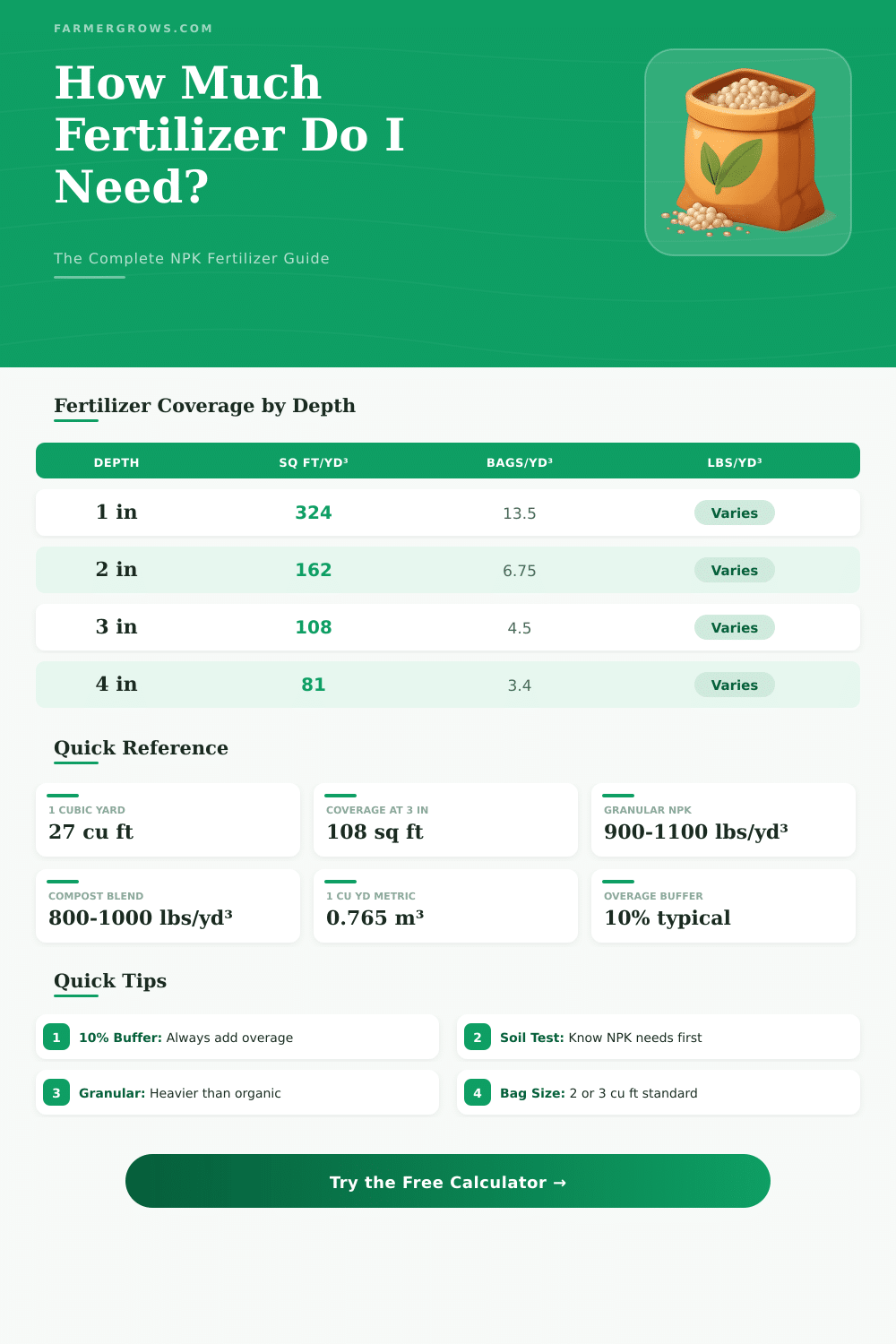
| Depth | Sq Ft / Yd³ | Sq M / Yd³ | Sq M / M³ |
|---|---|---|---|
| 1 in (2.5 cm) | 324 | 30.1 | 39.4 |
| 2 in (5.1 cm) | 162 | 15.1 | 19.7 |
| 3 in (7.6 cm) | 108 | 10.0 | 13.1 |
| 4 in (10.2 cm) | 81 | 7.5 | 9.8 |
| 6 in (15.2 cm) | 54 | 5.0 | 6.6 |
| Bag Size | Volume / Bag | Bags / Yard | Coverage at 3 in |
|---|---|---|---|
| Small Bag | 2 cu ft (0.057 m³) | 13.5 | 8 sq ft (0.74 m²) |
| Large Bag | 3 cu ft (0.085 m³) | 9 | 12 sq ft (1.11 m²) |
| 1/2 Yard Bulk | 13.5 cu ft (0.38 m³) | 2 | 54 sq ft (5.0 m²) |
| 1 Yard Bulk | 27 cu ft (0.76 m³) | 1 | 108 sq ft (10.0 m²) |
| Project | Area | Cu Yards | Bags (2 cu ft) |
|---|---|---|---|
| Small Garden Bed | 100 sq ft (9.3 m²) | 0.93 | 13 |
| Medium Flower Bed | 250 sq ft (23.2 m²) | 2.31 | 32 |
| Large Garden Bed | 500 sq ft (46.5 m²) | 4.63 | 63 |
| Half Lawn | 1,000 sq ft (92.9 m²) | 9.26 | 125 |
| Full Front Yard | 2,500 sq ft (232.3 m²) | 23.15 | 313 |
| Large Property | 5,000 sq ft (464.5 m²) | 46.30 | 625 |
Granular 10-10-10 fertilizer weighs roughly 1,000 pounds per cubic yard, and at 3 inches deep one yard only covers about 108 square feet.
The information that you will find below does not come from a made up count. It is put together from actual books, messages in forums and the experiences that folks truly lived in the community of gardeners.
10-10-10 Fertilizer Explained
NPK (so nitrogen), phosphorus and potassium, forms the main trio for feeding of plants. Those big nutrients do the heavy work, when dealing with how plants grow and stay healthy. Many folks use the word Fertilizer as short for products with NPK, because just those three chemicals are the needs of plants in big amounts, so that they grow strong and healthy.
Every bag of commercial Fertilizer that you will buy, must show three numbers, split by dashes. Here is your NPK ratio, also called the grade of Fertilizer. Those big figures are not simply decoration.
They truly decide, whether your tomatoes benefit or your climbing grape seizes the sky. In most lands the law requires, that those numbers stand clearly on the package.
Those numbers for NPK? They show percentages. Take a bag of 33.6 pounds of lawn Fertilizer with label 32-0-5, that wants to say 32 percent of nitrogen, zero percent of phosphorus and 5 percent of potassium, together with some fillers and extras.
Bigger numbers point to stronger focus. Inorganic Fertilizer can reach higher percentages, because the materials (for example calcium nitrate or monopotassium phosphate) already are rich in nutrients. Hence 15-15-15 is more hadrly available than formula 5-5-5.
In the end everything is only percentages.
How many nutrients a plant truly receives, depends on the dose. The NPK ratio tells you the proportion, naturally, but application involves more factors. If you double the dose of 10-10-10 Fertilizer, you do not magically create 20-20-20.
You simply give to the plant twice more the same ratio.
Plants are picky. They require different ratios according too the phase of their life cycle. When a plant is young and busy with leaf growth, it wants nitrogen.
After it blooms and fruits, phosphorus becomes the main one, because flower and fruits are hungry for it. Balanced Fertilizer works well as a start, later you can switch to something fit for the next needs of the plant. For instance, tomato pulp surprisingly helps for peppers and potatoes, when they start to flower.
Balanced Fertilizer, ratios like 4-1-2 or 3-1-2… Come most near that, what many plants truly want. For lawns, formula 20-5-10 usually beats 10-20-10.
If you grow fig trees, something like 3-1-2 or 2-1-3 gives good results. Growers of citrus commonly favor a ratio around 5-1-3.
Products with NPK come in various forms and sizes. You find liquid version, for instance 10-10-10 plant food, together with granular options for different tastes. Some are made for a particular growth phase, like liquid with 2-8-4, that boosts flower, fruit and seed spreading.
Leaf sprays work also, if you want to quickly fix lack of nutrients. There are also mixes like 6-24-6, that combine NPK with tiny nutrients like copper, manganese and zinc.
For phosphorus, bone meal and fish meal are your main sources. Potassium commonly comes from potash. Every garden centre keeps them.
Here is something good to recall: nitrogen moves freely in the ground and easily spills by means of washing, so 10 out of 10 for mobility. Potassium is less mobile, at 3. Phosphorus?
It almost does not move. One rates it at 1.
Less Fertilizer at first works more well. You always can add more, but plants, burned by too much, do not recover easily. For young plants, that already have at least two full sets of leaves, diluting NPK Fertilizer to half strength gives a safe start.
Testing of the soil before spreading anything truly matters; it shows, what truly lacks in your ground. Skip the test, and you risk burning the soil, what leads to pollution of drainage later. Healthy soil has those nutrients in hundreds of parts per million, so Fertilizer one dilutes quickly.
Worm castings offer an earthy option instead ofsynthetic NPK, avoiding problems with drainage and ground pollution.