🍄 Mushroom Compost Calculator
Calculate exactly how much mushroom compost you need for your garden beds, lawn, or landscape project
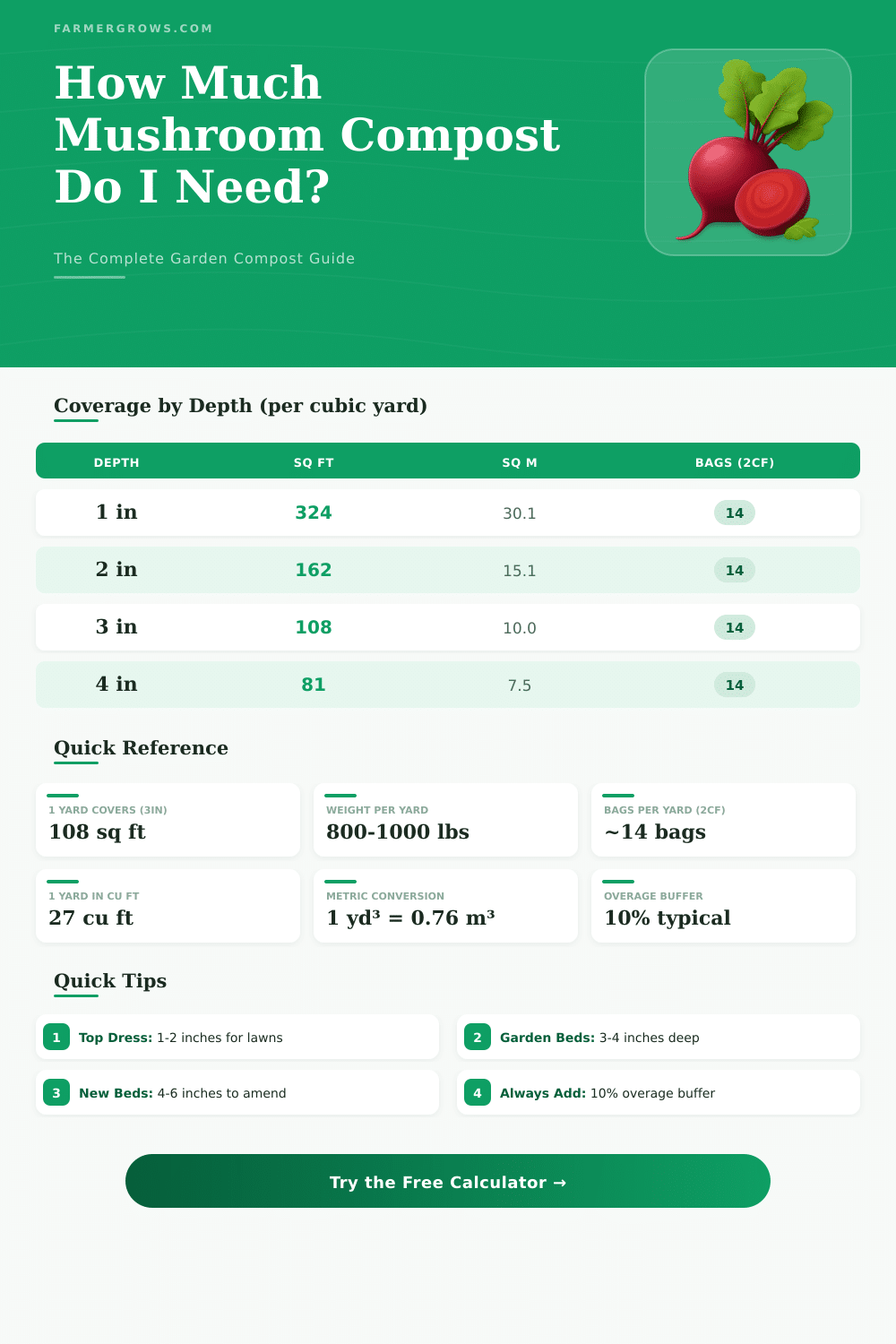
| Depth | Sq Ft / Yard | Sq M / Yard | Depth (cm) |
|---|---|---|---|
| 1 in | 324 | 30.1 | 2.54 |
| 2 in | 162 | 15.1 | 5.08 |
| 3 in | 108 | 10.0 | 7.62 |
| 4 in | 81 | 7.5 | 10.16 |
| 6 in | 54 | 5.0 | 15.24 |
| Bag Size | Volume | Bags per Yard | Coverage at 3 in |
|---|---|---|---|
| 1 cu ft bag | 1.0 cu ft (0.028 m³) | 27 | 4.0 sq ft |
| 1.5 cu ft bag | 1.5 cu ft (0.042 m³) | 18 | 6.0 sq ft |
| 2 cu ft bag | 2.0 cu ft (0.057 m³) | 13.5 | 8.0 sq ft |
| 3 cu ft bag | 3.0 cu ft (0.085 m³) | 9 | 12.0 sq ft |
| Project | Area (sq ft) | Cu Yards (3 in) | 2 cu ft Bags |
|---|---|---|---|
| Small Raised Bed | 40 | 0.37 | 5 |
| Medium Garden Bed | 200 | 1.85 | 25 |
| Large Flower Bed | 500 | 4.63 | 63 |
| Lawn Top Dress (1 in) | 1,000 | 3.09 | 42 |
| Full Garden (3 in) | 1,000 | 9.26 | 125 |
| Half-Acre Spread (2 in) | 2,500 | 15.43 | 208 |
| Large Landscape | 5,000 | 46.30 | 625 |
**fast note:** The info in this article is based on real experiences of gardening and details about products from various sources.
compost of mushrooms is a byproduct from the farming of mushrooms. It is made up of the used base material, on which one grew the mushrooms. After the mushrooms stopped growing one sells that old material as organic dressing or soil mix.
Using Mushroom Compost in Your Garden
What marks that compost is that it already served for mushrooms and now is spent. It can carry various ingredients, a bit of dressing, or straw with other elements.
Between the most used business mixes for base material of mushrooms is that from straw of wheat, plaster and dressing of chicken or horse. Usually one prepares it from aged dressing of chicken or horse, together with straw, that one heats and sterilises. One commonly adds limestone and peat moss, so that the mushrooms grow better.
Button mushrooms best thrive in compost from straw, horse manure, droppings of birds and plaster. One heats that compost to destory dangerous germs or fungi, that could compete with the farming of mushrooms.
Fancy mushrooms, on the other hand, one grows on sawdust with a small amount of grains added. That used base material works well as ground cover, but alone it does not provide nutrients.
compost of mushrooms works for plant vegetables, grasses and flowers. One can use it also with trees and bushes. It serves as soil mix for meadows, gardens and pots with plants.
It improves the structure of the ground, so that the plants grow better. If one mixes it in the soil, it can loosen clay or add organic matter too sandy soil. It grows the number of helpful fungi in the ground, and those fungi help the plants take more nutrients and water from the soil.
That compost usually does not carry weeds, which is a big plus. By contrast, dressing of cows or sheep can cause, that clover grows everywhere. When one mixes mushroom compost in mix for jars based on pine barks, it gives results better than expected for growing vegetables.
Even so, there are some spots, that one must consider. Mushroom compost is a soil mix, not real soil. One should not grow plants only in it.
It lacks some minerals, that one needs. The best way is to mix it with natural soil. If one laid a raised bed directly on the ground, that mix from local soil and mushroom compost gives everything needed.
Adding three to six inches of compost in the soil is a good amount, depending on the already available organic matter there.
One should use mushroom compost carefully, because of its high level of soluble salts. Mushrooms handle salty surroundings well, but many vegetables, especially beans and squash; do not. Letting the compost rest one season before use helps against that.
Fresh used base material can be too rich in nitrates, potassium and phosphorus, so that one must mix it with soil or let it age. Otherwise it caninjure the plants.
The ratio of carbon to nitrogen in mushroom compost is around 13:1, which is excellent. Ideal compost should have 30:1 or less. Because mushrooms consume mainly lignin and carbohydrates during growth, the other nutrients stay unaffected.
The nutrient balance ends roughly 1-1-1 for nitrogen, phosphorus and potassium. Even so, some types of used mushroom compost have nitrogen, but lack potassium or phosphorus.
There are issues about possible residues of pesticides and chemicals from the farming of mushrooms. It is worth knowing also, that sometimes white threads yet can appear in the compost, although it should be sterile. And a few mushrooms can quickly grow as a surprise gift.
Local farms even can leave used mushroom compost outside, so that gardeners take it for free, so it is worth checking nearby. One can buy it in bags or by the cubic yard, sometimes mixed with topsoil.