🥬 Lettuce Sun Requirements Calculator
Calculate ideal daily sunlight hours for your lettuce garden based on variety, plot size & season
hrs/day
hrs/day
hrs/day
hrs/day
hrs/day
hrs/day
hrs/day
(not ideal)
| Sun Hours/Day | Light Category | Lettuce Suitability | Bolting Risk | Expected Yield |
|---|---|---|---|---|
| 1–2 hrs | Deep Shade | Poor — not recommended | Very Low | Very Poor |
| 3–4 hrs | Partial Shade | Good for loose-leaf only | Low | Moderate |
| 4–5 hrs | Part Sun | Good for most varieties | Low–Moderate | Good |
| 5–6 hrs | Part–Full Sun | Excellent for all varieties | Moderate | Very Good |
| 6–8 hrs | Full Sun | Ideal in cool seasons | Moderate–High | Excellent |
| 8+ hrs | Intense Sun | Risk of bolting in summer | Very High | Good with shade cloth |
| Season | Ideal Sun Hours | Temp Range | Shade Cloth Needed | Bolt Risk |
|---|---|---|---|---|
| Spring | 5–8 hrs/day | 45–65°F (7–18°C) | None needed | Low |
| Summer | 4–6 hrs/day | 65–80°F (18–27°C) | 30–50% recommended | High |
| Fall | 5–8 hrs/day | 45–65°F (7–18°C) | None needed | Low |
| Winter/Indoor | 10–14 hrs grow light | 55–65°F (13–18°C) | N/A — supplement light | Very Low |
| Plot Size | Area (sq ft) | Area (m²) | Plants @ 6 in | Plants @ 12 in |
|---|---|---|---|---|
| 2 x 4 ft | 8 sq ft | 0.74 m² | 32 plants | 8 plants |
| 4 x 4 ft | 16 sq ft | 1.49 m² | 64 plants | 16 plants |
| 4 x 8 ft | 32 sq ft | 2.97 m² | 128 plants | 32 plants |
| 5 ft dia circle | 19.6 sq ft | 1.82 m² | 78 plants | 20 plants |
| 6 x 10 ft | 60 sq ft | 5.57 m² | 240 plants | 60 plants |
| 10 x 20 ft | 200 sq ft | 18.6 m² | 800 plants | 200 plants |
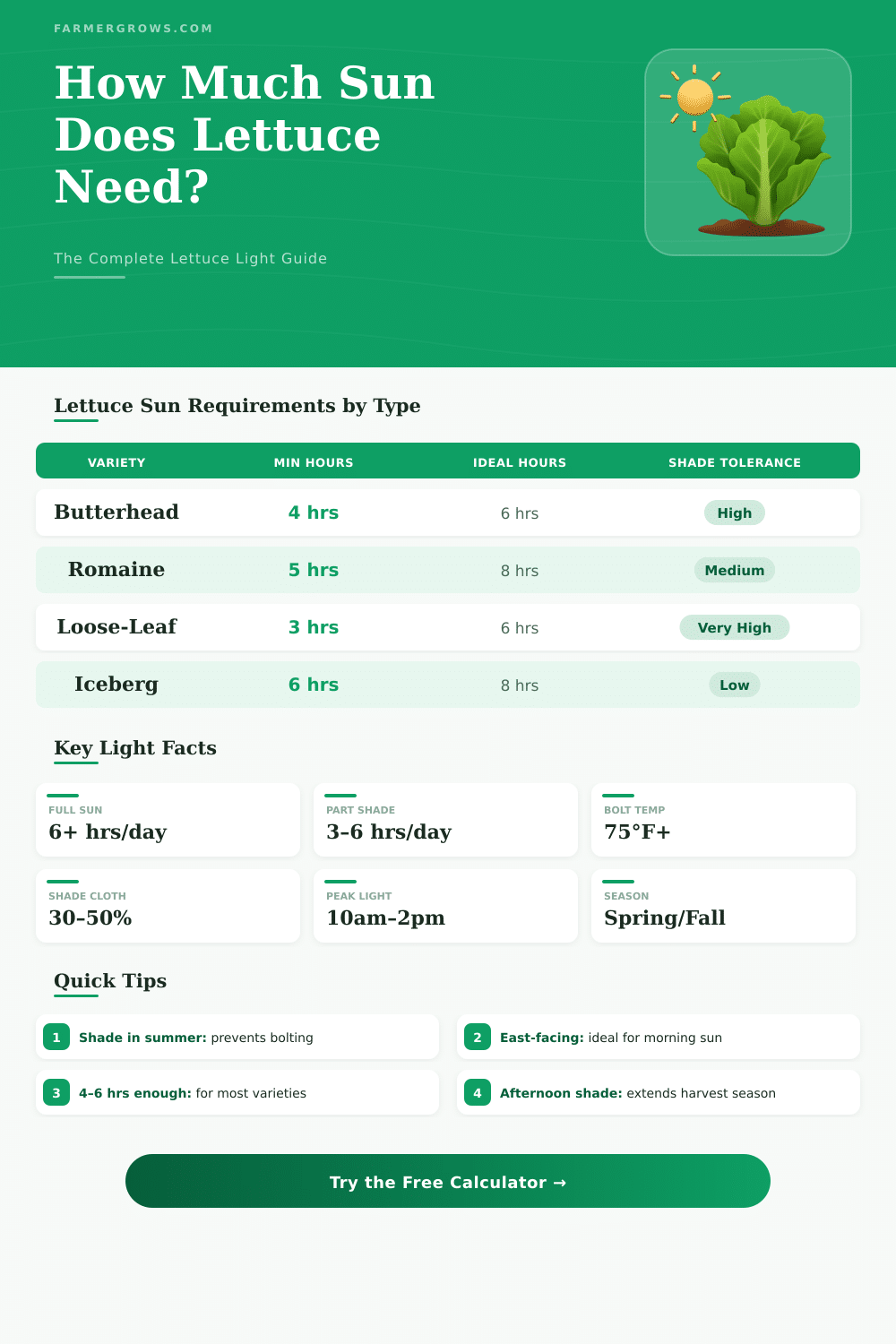
Lettuce grows best if it gets around four to six hours of direct sunshine daily, mixed with enough shade. Like this you mostly reach good results. During spring and autumn on the other hand, the situation changes a bit; in those seasons Lettuce likes full Sun, best six to eight hours.
Here the plant truly thrives under full light.
How Much Sun and Shade Does Lettuce Need
In summer things become tricky During the warm months, Lettuce most likes only one or two hours of Sun, with a lot of shade for the rest of the day. It maybe sounds weird, but spring species want all light that they can get, while summer types start to favor shade in the afternoon to escape the heat. Well operate six hours of morning Sun, followed by protection against afternoon rays.
The intensity of midday and evening can simply burn the leaves directly on the plant.
Here the challenge: direct Sun helps the growth quickly, but too much of it craetes troubles. If you pass eight hours daily, the leaves commonly become bitter, and bolting becomes a big danger. Bolting is that moment when the plant suddenly grows flowers, bad thing, because after that the Lettuce has quite a bad taste.
The right amount of light must range according to the species of Lettuce that you work with.
More dark types of Lettuce absorb more Sun than light ones, what makes them wilt more quickly. Although, dark lettuces are clearly more pleasing for the eyes.
Temperature matters just as much as light. Leaves of Lettuce consist mostly of water, so strong Sun together with dry ground pushes them to shrink and wilt very soon. Keeping the ground always damp helps a lot.
Sometimes enough too water daily during the warmest periods. If you plan to grow in summer, try to search warm tolerant species. Escape normal lettuces entirely, if you struggle with bad summer heat.
Shade helps to remove the weight of the Sun. Even with such protection even so, bitterness and bolting can happen according to your climate. Partial shade of covers, tall plants beside it or natural filtered light all work to reduce the warm stress.
Also, shaded places keep the ground heat lower, what quite a lot slows bolting.
Lettuce can manage itself in shade, but a bit of light certainly is useful, especially for young plants. The output depends on the species and place. Online you will find disagreements…
Some pages call certain types shade-friendly, while others require full Sun for them. For instance, mesclun-lettuce grows surprisingly well with only some hours of sunshine, whether filtered or direct.
Dense crop with ongoing harvest works well, because little leaves then receive more light and grow bigger before the next slice. Harvesting early in the morning, before the sugar in theplant climbs, you also help to escape bitterness.