🌿 Lawn Lime Calculator
Calculate exactly how much lime your lawn needs based on area, soil pH, and lime type
per 1,000 sq ft
per 1,000 sq ft
per 1,000 sq ft
per 1,000 sq ft
per 1,000 sq ft
per 1,000 sq ft
Application
pH Range
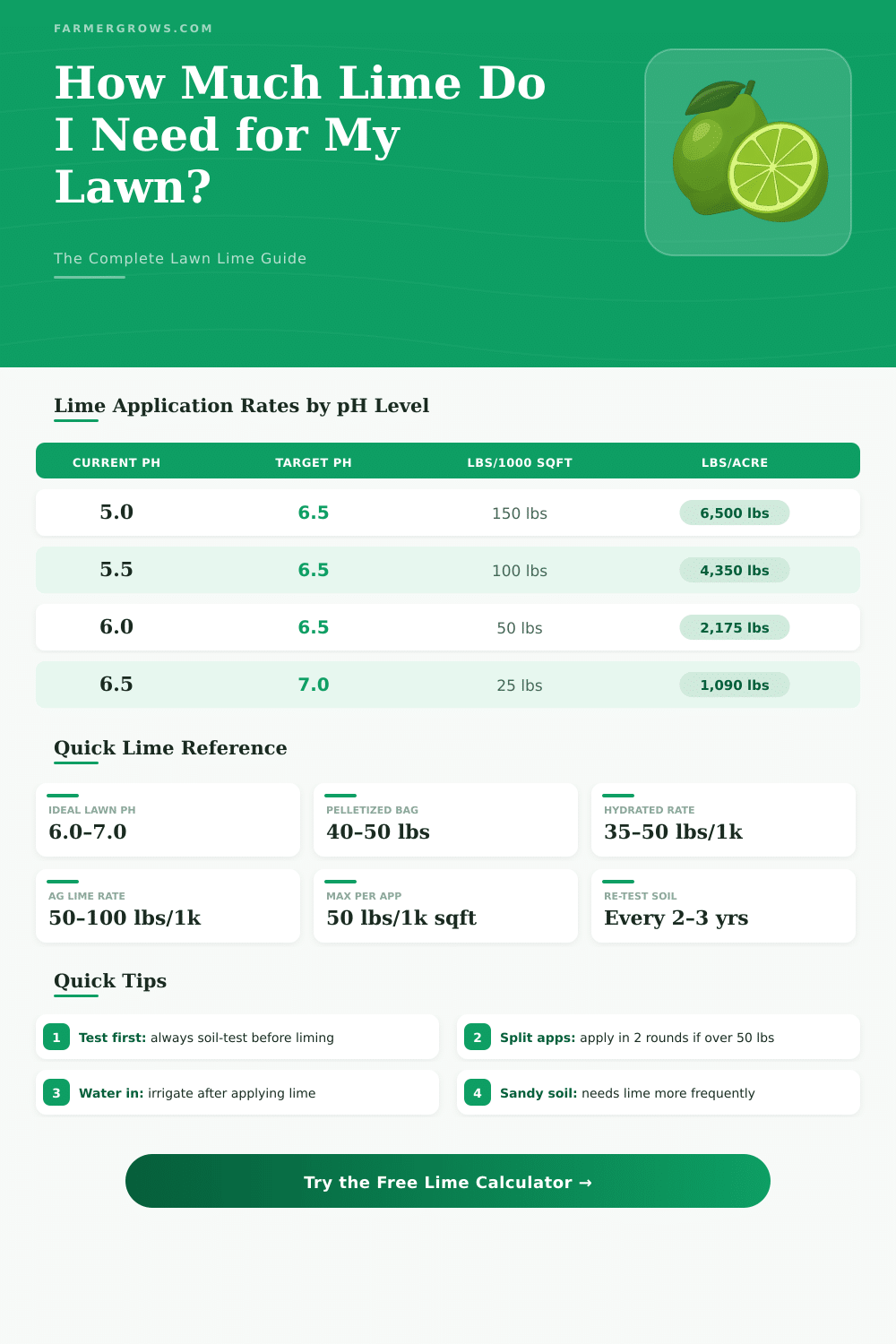
| Current pH | Target pH | Rate (lbs/1,000 sq ft) | Rate (kg/100 m²) | Soil Type Note |
|---|---|---|---|---|
| 4.5 | 6.5 | 200–250 lbs | 98–122 kg | Heavy clay needs upper range |
| 5.0 | 6.5 | 150–200 lbs | 73–98 kg | Apply in 2 seasons |
| 5.5 | 6.5 | 100–150 lbs | 49–73 kg | Single season typical |
| 6.0 | 6.5 | 50–100 lbs | 24–49 kg | Light maintenance dose |
| 6.0 | 7.0 | 100–150 lbs | 49–73 kg | Vegetable garden ideal |
| 6.2 | 6.5 | 25–50 lbs | 12–24 kg | Minor correction |
| 6.5 | 7.0 | 50–75 lbs | 24–37 kg | Neutral to slightly alkaline |
| Bag Size | Weight | Covers at Std Rate | Metric Weight |
|---|---|---|---|
| Small Bag | 25 lbs | 500 sq ft | 11.3 kg |
| Standard Bag | 40 lbs | 800 sq ft | 18.1 kg |
| Large Bag | 50 lbs | 1,000 sq ft | 22.7 kg |
| Pallet (bulk) | 1 ton | 40,000 sq ft | 907 kg |
| Mini-bulk bag | 2,000 lbs | 40,000 sq ft | 907 kg |
| Project | Area (sq ft) | Lbs Needed (pH 5.5→6.5) | Bags (50 lb) |
|---|---|---|---|
| Small Yard | 600 sq ft | 60–90 lbs | 1–2 bags |
| Typical Suburban Lawn | 2,000 sq ft | 200–300 lbs | 4–6 bags |
| Medium Lawn | 5,000 sq ft | 500–750 lbs | 10–15 bags |
| Large Lawn | 10,000 sq ft | 1,000–1,500 lbs | 20–30 bags |
| Half Acre | 21,780 sq ft | 2,178–3,267 lbs | 44–65 bags |
| One Acre | 43,560 sq ft | 4,356–6,534 lbs | 87–131 bags |
Lawn Lime are made up of powder limestone or chalk mixed with soil, for act surprisingly on the pH-swing and the bitterness. Mainstream element here is calcium carbonate, that indeed neutralizes bitter situations and push nourishments accessible for your Lawn. If the soil becomes too bitter, the grasses have trouble absorb that, what they require, here Lime help and settle that problem.
Most many Lawns benefit when the soil rests a bit between bitter and neutral, in the range of 5.8 until 7.0. Grasses for fresh seasons, as Kentucky blue grass, red fescue and fescue, like something more basic than that. If it falls under that right level, your Lawn starts to show signs of trouble (the colour fades), the growth slows and the grass no more can recover after heat, drought or foot pressure.
How and When to Use Lime on Your Lawn
Here this calcium carbonate shows his value. Except neutralizing bitterness, it adds calcium and magnesium to the soil. Both nourishments help for keep the grass dense, healthy and strong.
Improved access of nourishments cause dnese growth and bigger resistance everywhere.
Before you even think to scatter Lime, do a test of the soil first. That step genuinely matters, because too much Lime alter the pH to the opposite extreme, sharply it becomes too basic and the roots of grasses can not take the minerals required for health. Lime belongs in your garden only when the soil genuinely requires it, and in the right amount.
Do not find a way to escape that, simply shed a thin deposit up without mix it inside will not solve your pH-problem.
Granular Lime became the usual choice for many home owners. One species mixes finely ground limestone with natural syrup, later press it in pellets for easy spreading and uniform provision of the Lawn. You apply it by means of rotary spreader, and the pellets well feed between the grass.
After sufficient rain, they naturally dissolve in the soil.
When you scatter Lime, water it for escape possible burns on the surface. Even more well, do the application correctly before rains, the humidity helps too dissolve the pellets more quickly and push them more deeply in the ground. The autumn is the mainstream time for that task.
Lay Lime one occasion in slow growth allows, that it dissolve in the soil during the winter months, especially benefit of the cycles of cold and thaw.
The chemical makeup of every garden soil differs, occasionally a lot. Some places require to add Lime all two years, so that the grasses not fade. Even little doses can give good results, although big amounts usually give faster change.
Application of limestone stay one of the best ways for raise the pH of the soil and genuinely alter the quality of the Lawn. Real issue aboutlawn goes more than only cut the grass and remove unwanted grasses.