🌿 Lawn Leveling Calculator
Calculate exactly how much topdressing material you need to level your lawn
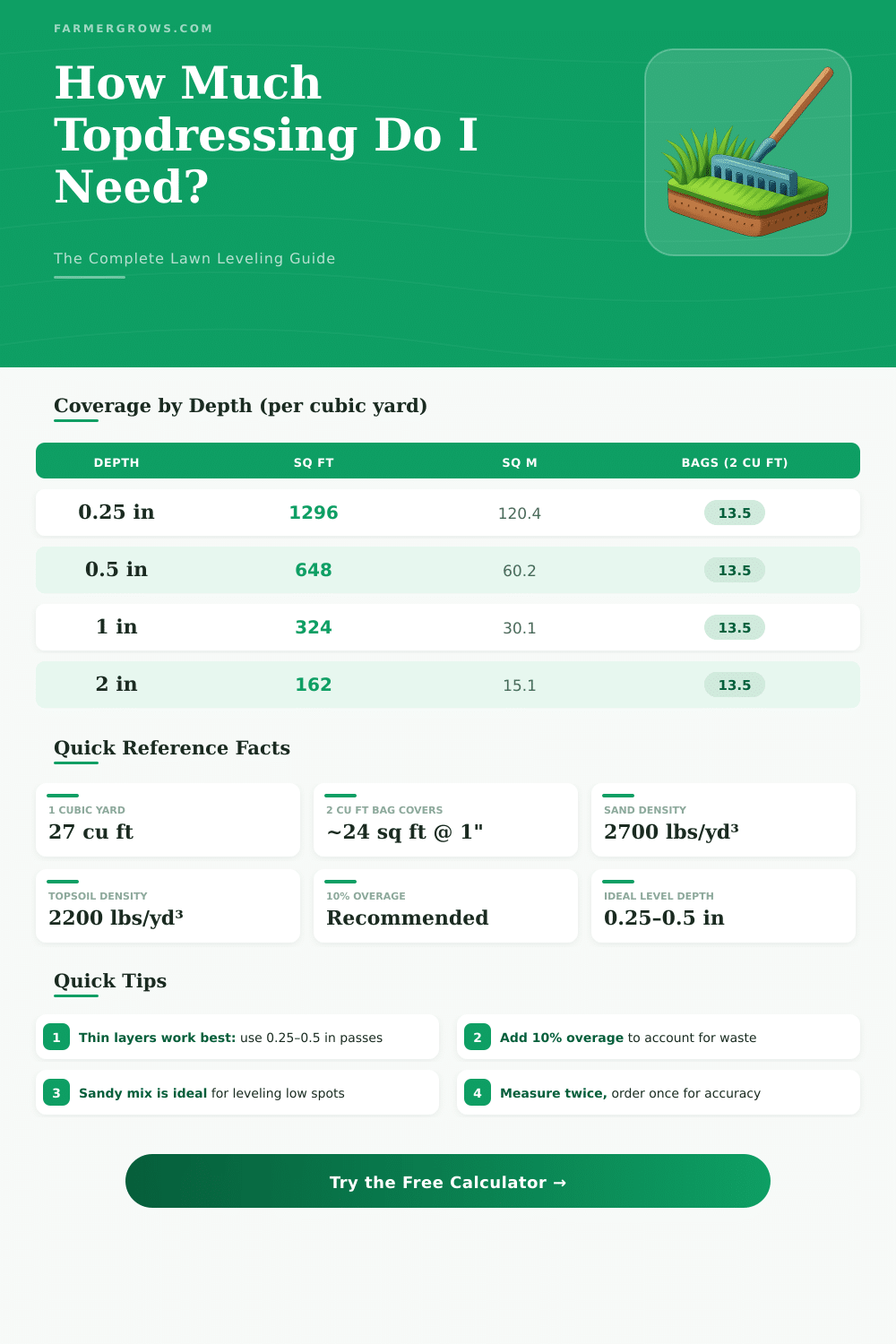
| Depth (in) | Depth (cm) | Coverage (sq ft) | Coverage (m²) | Use Case |
|---|---|---|---|---|
| 0.25 in | 0.64 cm | 1,296 sq ft | 120.4 m² | Light annual topdress |
| 0.5 in | 1.27 cm | 648 sq ft | 60.2 m² | Standard leveling |
| 1 in | 2.54 cm | 324 sq ft | 30.1 m² | Moderate low spots |
| 2 in | 5.08 cm | 162 sq ft | 15.1 m² | Deep depressions |
| 3 in | 7.62 cm | 108 sq ft | 10.0 m² | Full regrading |
| 4 in | 10.16 cm | 81 sq ft | 7.5 m² | Major renovation |
| Bag Size | Volume (cu ft) | Bags per Cu Yd | Coverage @ 0.5 in | Weight (approx) |
|---|---|---|---|---|
| Small bag | 0.5 cu ft | 54 bags | 12 sq ft | ~30–45 lbs |
| Standard bag | 1 cu ft | 27 bags | 24 sq ft | ~50–80 lbs |
| Large bag | 2 cu ft | 13.5 bags | 48 sq ft | ~80–150 lbs |
| XL bag | 3 cu ft | 9 bags | 72 sq ft | ~100–200 lbs |
| Mini bulk | 9 cu ft | 3 bags | 216 sq ft | ~500–900 lbs |
| Bulk yard | 27 cu ft | 1 yard | 648 sq ft | 1,100–2,700 lbs |
| Project | Area (sq ft) | Cu Yds @ 0.5 in | Cu Yds @ 1 in | 2 cu ft Bags @ 0.5 in |
|---|---|---|---|---|
| Small yard 10x20 | 200 sq ft | 0.31 yd³ | 0.62 yd³ | 5 bags |
| Medium yard 30x40 | 1,200 sq ft | 1.85 yd³ | 3.70 yd³ | 25 bags |
| Large yard 50x60 | 3,000 sq ft | 4.63 yd³ | 9.26 yd³ | 63 bags |
| Backyard 40x60 | 2,400 sq ft | 3.70 yd³ | 7.41 yd³ | 50 bags |
| Low spot 8x8 | 64 sq ft | 0.10 yd³ | 0.20 yd³ | 2 bags |
| Full acre lawn | 43,560 sq ft | 67.2 yd³ | 134.4 yd³ | 907 bags |
lawn leveling ranks between those tasks that seems easy, but require actual effort. Through time lawns become uneven because of settling of the ground, problems with drainage, death of grass at the edges or even because of heavy trucks that some drive through the garden and leave deep marks. When mowing on rough surface, the work becomes sad, because the machine always jumps everywhere.
The ideal moment for lawn leveling one finds in the dry season. If you do that during rain, it can cause erosion of the soil. For grasses of warm season, as bermuda grass, the middle of summer works well, because the grass then grows fast.
How to Level Your Lawn
The soil always should slightly slope away from the house, so that the water drains well. It does not require big slope, but enough tilt to remove the water.
Before starting, you mow the lawn as short as possible, without pulling the grass from roots. Remove the clippings. Carefully avoid cutting too short, because then will show the stem, what can dry the grass.
Aeration is a good step, especially for grasses of warm season. When cores come out during that process, break them during the lawn leveling.
For the material used to fill, sand works well for shallow lawn leveling, because it does not create clumps that block things. Commonly one chooses a mix from around seventy percent sand and thirty percent topsoil. On clay soil, fifty-fifty mix maybe works better for deeper repair.
Too much sand spread can warm the ground so much that it burns the grass, so do not apply more then one inch deep. Soil and compost alone tend to settle over time, what leaves everything as before. Lawn leveling with sand is not a one time fix.
It must repeat yearly.
You fill holes and low places to two until three inches under the surrounding lawn level, later stamp it down, so that it does not sink later. The low parts should end slightly flush with the rest of the grass. A rake for lawn leveling with broad teeth helps to spread the material much more easily than normal rakes or brooms.
After filling, a big heavy drum can smooth everything.
When after top dressing the grasses do not show, too much material was used. Fertilizer and overseeding can help the grass recover. Keep the soil damp with gentle runs of sprinklers every some days.
Renting the gear, like a top dresser or smooth rake, saves a lot of time, especially on big gardens. Manually loading a little truck for a big lawn takesforever, and the results not always turn out great. Top dressing is between the most difficult tasks for care of lawn, but the reward is worth it.