💧 Lawn Irrigation Water Usage Calculator
Calculate exactly how much water your lawn needs per week or per watering session
per week
per week
per week
per week
per week
per week
per week
per week
| Water Depth | Gallons / 1,000 ft² | Liters / 100 m² | Cubic Feet |
|---|---|---|---|
| 0.25 in (0.6 cm) | 156 | 636 | 20.8 |
| 0.5 in (1.3 cm) | 312 | 1,271 | 41.7 |
| 0.75 in (1.9 cm) | 468 | 1,907 | 62.5 |
| 1.0 in (2.5 cm) | 623 | 2,540 | 83.3 |
| 1.25 in (3.2 cm) | 779 | 3,175 | 104.2 |
| 1.5 in (3.8 cm) | 935 | 3,811 | 125.0 |
| 2.0 in (5.1 cm) | 1,247 | 5,080 | 166.7 |
| Lawn Size | Area | Gallons / Week | Liters / Week |
|---|---|---|---|
| Small Front Yard | 500 ft² (46 m²) | 312 | 1,181 |
| Medium Lawn | 1,000 ft² (93 m²) | 623 | 2,358 |
| Average Suburban | 2,500 ft² (232 m²) | 1,558 | 5,896 |
| Large Yard | 5,000 ft² (465 m²) | 3,117 | 11,798 |
| Half Acre | 10,890 ft² (1,012 m²) | 6,784 | 25,681 |
| Full Acre | 43,560 ft² (4,047 m²) | 27,137 | 102,724 |
| Sprinkler Type | Efficiency | Typical Rate | Buffer Needed |
|---|---|---|---|
| Drip / Soaker Hose | 90–95% | 0.5–1 GPH per emitter | 5% |
| MP Rotator | 80–90% | 0.5–1 in/hr | 10% |
| Rotor / Gear‑driven | 75–85% | 0.4–0.8 in/hr | 10–15% |
| Fixed Spray Head | 60–75% | 1.2–2 in/hr | 15–20% |
| Oscillating Portable | 50–70% | 0.6–1.5 in/hr | 20% |
| Impact Sprinkler | 65–80% | 0.5–1.5 in/hr | 15% |
| Sprinkler Rate | Time for 0.5 in | Time for 1 in | Time for 1.5 in |
|---|---|---|---|
| 0.5 in/hr | 60 min | 120 min | 180 min |
| 0.75 in/hr | 40 min | 80 min | 120 min |
| 1.0 in/hr | 30 min | 60 min | 90 min |
| 1.5 in/hr | 20 min | 40 min | 60 min |
| 2.0 in/hr | 15 min | 30 min | 45 min |
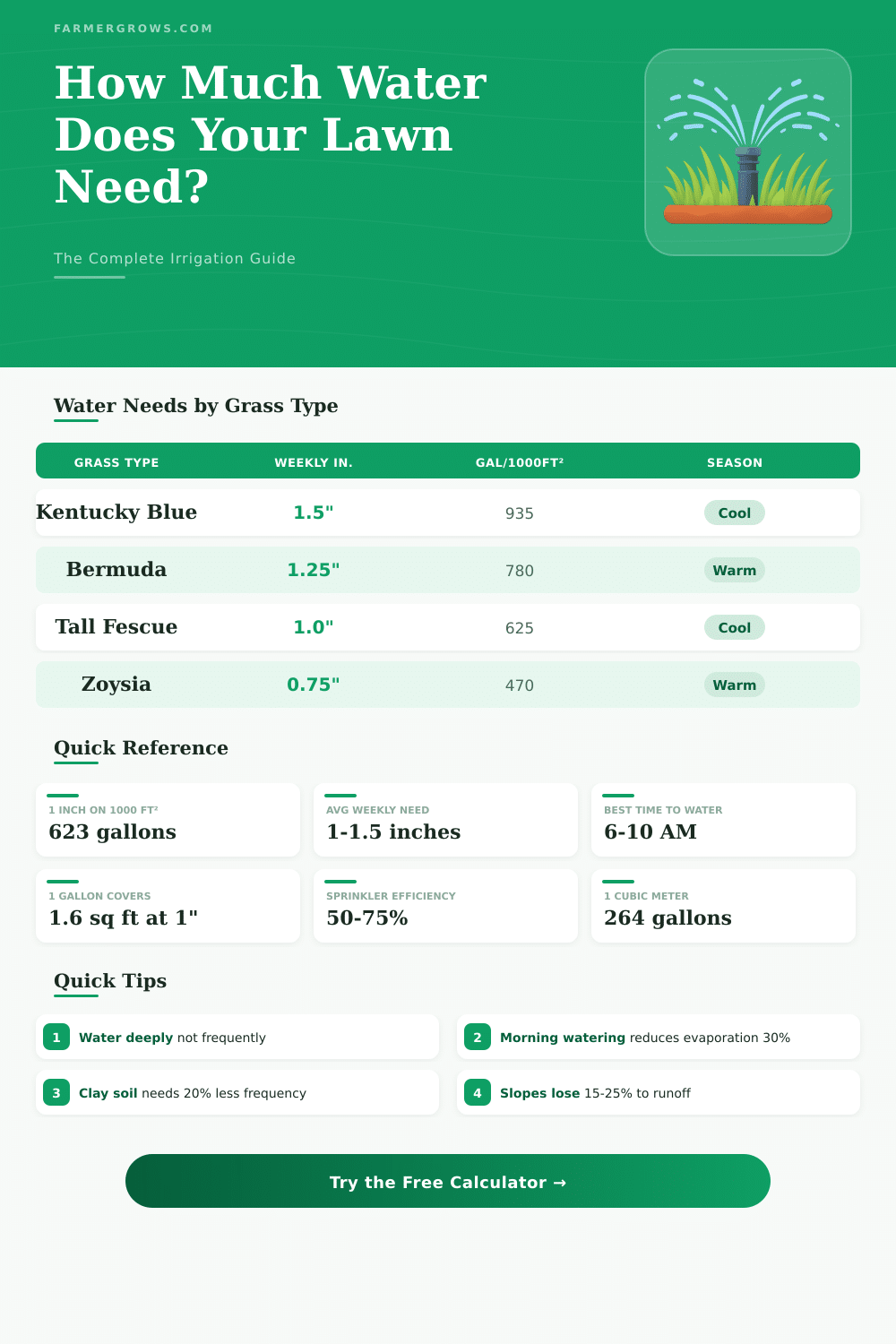
The numbers are big when one looks at the needs of water for lawn. I wondered to learn that one inch of water for thousand square feet of ground needs more than 600 gallons. For lawn of around 5,000 square feet, that wants to say more than 3,100 gallons one time…
Around 11,800 liters for those that use metric units. The contrast between hungry Kentucky blue grass (1.5 inches weekly) and very dry buffalo grass (half inch weekly) is huge regarding whole amount. One must mind that.
How Much Water Does Your Lawn Need
How well sprinklers work affects a lot also. Drip systems lose only around 5 percent of water, while cheap swinging sprinklers waste 25-30 percent. One must think about type of soil, on clay, it is possible not enter more than 0.4 inches in hour without runoff, so repeated watering is needed.
Sandy soil grips until 1.5 inches in hour without any problem. When one thinks about whole acre amount, more than 27,000 gallons for one inch depth, that really shows the size of it.
Still, the info below does not come from the calculator itself, but from real world review and experiences shared by users in forums and discussions.
For start, own fully automatic underground sprinkler system helps to spare a lot of time compared with the always moved tubes and sprinklers everywhere. That allows more time to really enjoy the lawn, than always care about it. There are many kinds of irrigation, sprinkler, surface, reel, swinging, rotary, underground, moving, mist, micro and pivotal.
Right system depends on the size, form and water pressure of the lawn. For instance, big garden would not work well with little mist heads, because one would need too many of them.
One mode that does not work for lawns is drip watering. It suits more for landscape plants and gardens. For grass, normal sprinkler irrigation is clearly the best choice.
Drip watering keeps moisture on leaves, which can cause problems like wilting and moisture, but it is not ideal for vast areas as lawn.
Time and frequency matter also. Experts advise to water early in the morning, then one reaches the best soaking before the sun and wind start and cause drying. Most lawns need irrigation each 4-8 days, with 1-1.5 inches of water weekly in warm dry months.
After reaching that target, none needs to water until signs of stress show. And if it rains, skip irrigation until the lawn really needs it, aiming for no more than 3/4 until 1 inch twice weekly at most.
Talking about waste, wind and changes in pressure can really upset things. Heads of sprinklers brake, which causes uneven covering, brown marks and maybe waste of until half of used water. One must watch those factors.
Installing a homemade sprinkler system is not that hard, but it needs learning the details so that it works right. Many home installers end with problems later, because they do not fully understand irrigation. And fixing a neglected system?
That can easily cost some thousands.
Whether one even needs an irrigation system depends much on the place. In Florida, it is almost required. In northeast, not so much.
Soil conditions and mix of plants against lawn also matter. In cities as Durham, extra water meters from the city can add around 5,000 dollars to the total install cost, passing 10,000 dollars.
The best mode to lower needs of irrigation is adding native, dry-tough plants. That wants to say less hungry area to careabout watering. Balanced design of garden with smartly placed greens can help long.