🌿 Lawn Area Calculator
Calculate your lawn area and grass seed, sod, or topdressing needs instantly
📊 Your Lawn Calculation Results
Grass Seed (New)
Overseeding
Sod / Turf
Topdressing (1")
Granular Fertilizer
Pelletized Lime
Sod (45 rolls)
per sq ft area
| Depth | Sq Ft per Cu Yd | Sq M per Cu M | Common Use |
|---|---|---|---|
| 0.25 in / 6mm | 1,296 sq ft | 120.4 m² | Light topdress |
| 0.5 in / 13mm | 648 sq ft | 60.2 m² | Overseeding prep |
| 1 in / 25mm | 324 sq ft | 30.1 m² | Standard topdress |
| 2 in / 50mm | 162 sq ft | 15.1 m² | Renovation topdress |
| 3 in / 75mm | 108 sq ft | 10.0 m² | Leveling / fill |
| 4 in / 100mm | 81 sq ft | 7.5 m² | New lawn base |
| Roll / Unit | Dimensions | Area per Unit | Units per 1,000 sq ft |
|---|---|---|---|
| Standard roll | 2 ft x 5 ft | 10 sq ft | 100 rolls |
| Large roll (slab) | 2 ft x 9 ft | 18 sq ft | 56 rolls |
| Pallet (50 rolls) | 2x5 standard | 500 sq ft | 2 pallets |
| Pallet (45 rolls) | 2x5 standard | 450 sq ft | 2.2 pallets |
| Big roll (machine) | 4 ft x 100 ft | 400 sq ft | 2.5 big rolls |
| Project | Area | Grass Seed (lbs) | Sod Rolls Needed |
|---|---|---|---|
| Small front lawn | 200 sq ft | 0.8 lbs | 20 rolls |
| Typical front lawn | 600 sq ft | 2.4 lbs | 60 rolls |
| Standard back yard | 1,500 sq ft | 6 lbs | 150 rolls |
| Large back yard | 3,000 sq ft | 12 lbs | 300 rolls |
| Quarter acre lawn | 10,890 sq ft | 44 lbs | 1,089 rolls |
| Half acre lawn | 21,780 sq ft | 87 lbs | 2,178 rolls |
Get precise measures directly on your lawn area is one of the most important first steps that lays everything else in its place. When you set right dimensions, you find yourself in a much better situation to use the ground well, escape expensive mistakes and spare yourself tons of time and money further down the way. Here is the cause: it is not always easy.
Add uneven soil, spreading garden or simply lack of idea about how to start, and soon the whole process seems much more difficult than needed.
How to Measure Your Lawn Area
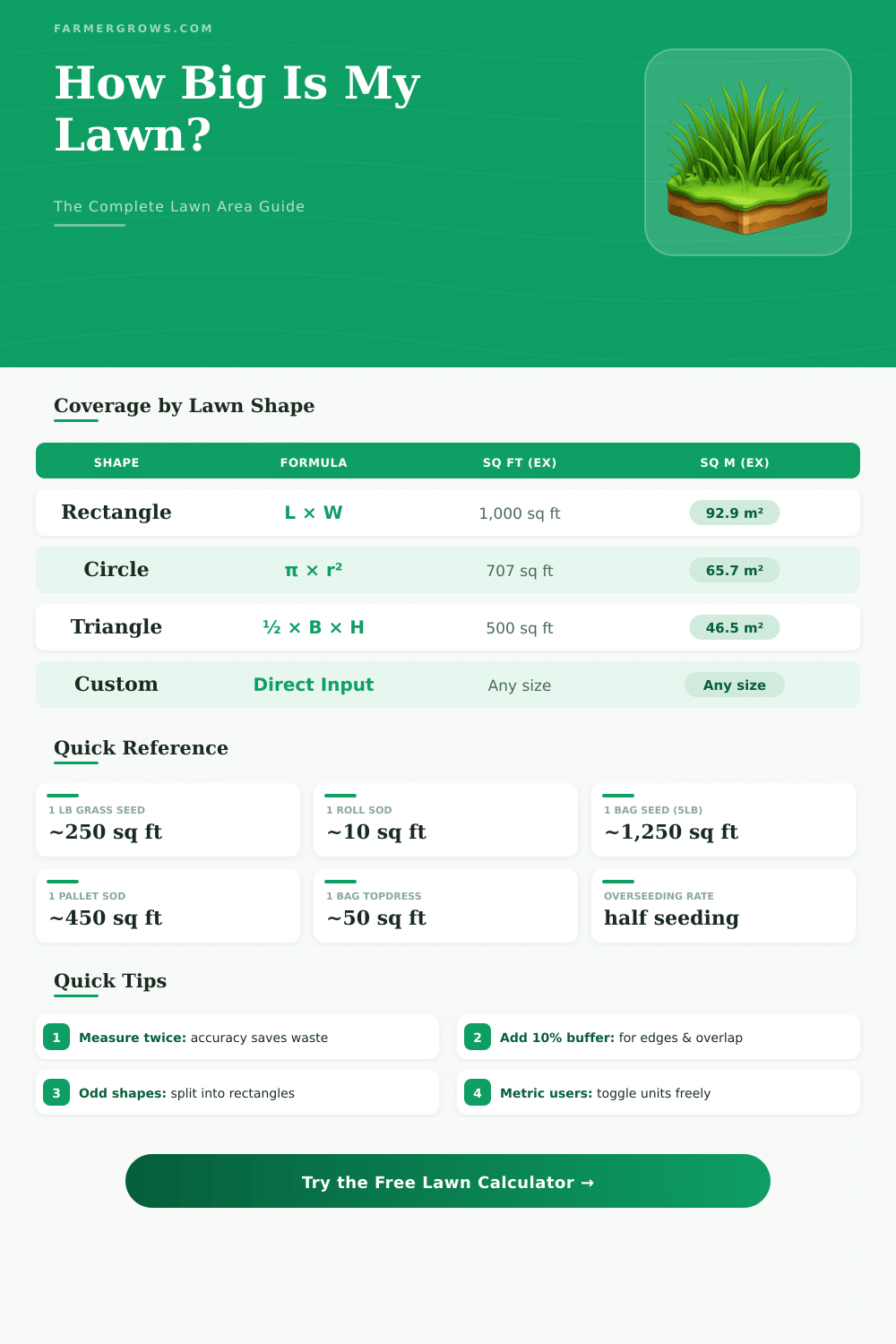
Start by means of the calculation of what you truly have, the general form and the plan. Focus on the width and the length, that you mark down. Once you have those values in feet, simply multiply them together, and you receive the square surface.
Assume that you measure various parts of way until the amount reach around 1 000 square feet, or any other amount according to your plan.
If your lawn does not form a perfect rectangle, chart-paper quickly becomes your helper. Note the measures at the most important spots, think about the broadest and longest places. Lay them on the paper, where every square shows one foot, later draw the general shape of the lawn.
From that, we count the whole number of squares, do a rough rating for the partial areas and add evrything for a general guess.
Number tools truly ease this task. Satellite charts from Google allow you to guess the surface of the lawn without leaving home. There are websites that help you guess the whole area in square feet and the edge in feet directly from a satellite image.
You can enter an address, receive an overhead site of your farm and simply draw a line around the grasses for a fast result.
Other option? Enter your zip code, and the chart automatically centers itself to your place. Later, follow the shape of the lawn, and you receive the number almost right away.
Use a calculator for lawn area truly is one of the fastest and simplest ways too no what materials you need and how many they sort.
A lawn, at its base, is only area covered by grass. The word itself implies that, so that “grassy lawn” sounds extra. This sets it apart from “green space”, that could cover almost everything, trees, bushes, whatever.
Gardens with good lawn outside are great for children and dogs to race. Front gardens, that open directly to the way? They less work for play, and here maybe more well to add local trees and bushes instead.
A little grassy bit in the back garden works for outdoor fun, as long as you mix it well. Check what your local authority or city requires for gardens, to know about the legal minimums. Before you create a biglawn area surface, it is worth thinking about how much grass you truly want.