🌿 Landscape Edging Calculator
Calculate exactly how much edging you need for any garden bed, border, or pathway
| Material | Typical Unit | Unit Length | Approx Weight per Unit |
|---|---|---|---|
| Steel Edging | Section | 8 ft (2.4 m) | 3–5 lbs (1.4–2.3 kg) |
| Aluminum Edging | Section | 8–16 ft | 1.5–3 lbs (0.7–1.4 kg) |
| Plastic / Vinyl | Roll | 20–50 ft | 2–5 lbs (0.9–2.3 kg) |
| Rubber Edging | Roll | 20–50 ft | 4–8 lbs (1.8–3.6 kg) |
| Brick Edging | Piece (4 in) | 0.33 ft each | 4–6 lbs (1.8–2.7 kg) |
| Concrete Edging | Section | 4–6 ft | 15–25 lbs (6.8–11.3 kg) |
| Wood Edging | Board | 8 ft (2.4 m) | 5–10 lbs (2.3–4.5 kg) |
| Cobblestone | Piece (4 in) | 0.33 ft each | 6–10 lbs (2.7–4.5 kg) |
| Shape | Dimensions | Perimeter (ft) | Perimeter (m) |
|---|---|---|---|
| Rectangle | 10×5 ft | 30 ft | 9.1 m |
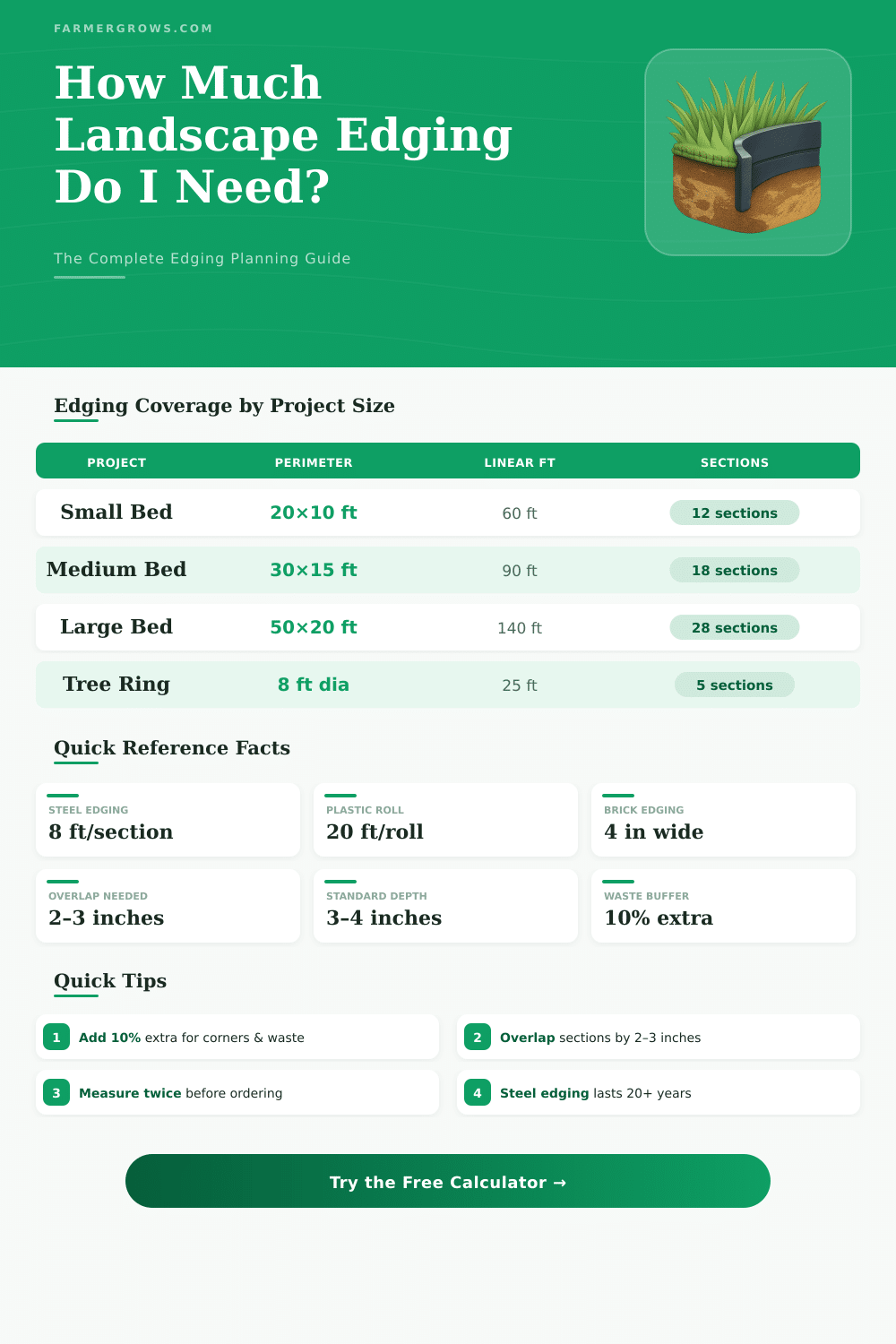
| Rectangle | 20×10 ft | 60 ft | 18.3 m |
| Rectangle | 30×15 ft | 90 ft | 27.4 m |
| Rectangle | 50×20 ft | 140 ft | 42.7 m |
| Circle | 6 ft dia | 18.8 ft | 5.7 m |
| Circle | 8 ft dia | 25.1 ft | 7.7 m |
| Circle | 12 ft dia | 37.7 ft | 11.5 m |
| Triangle (equil.) | 10 ft sides | 30 ft | 9.1 m |
| Project Type | Perimeter | 8-ft Sections (+10%) | 20-ft Rolls (+10%) |
|---|---|---|---|
| Small Flower Bed | 30 ft | 5 sections | 2 rolls |
| Medium Garden Bed | 60 ft | 9 sections | 4 rolls |
| Large Border | 120 ft | 17 sections | 7 rolls |
| Tree Ring (8 ft dia) | 25 ft | 4 sections | 2 rolls |
| Pathway Edge (100 ft) | 100 ft | 14 sections | 6 rolls |
| Driveway Edge (200 ft) | 200 ft | 28 sections | 11 rolls |
Landscape Edging ranks between the most simple methods for giving the yard order and flow. One uses it mainly for dividing the lawn from flower beds or plants. It forms clear lines and prevents the content from spilling out of the beds.
Beyond that it directs the water to the right places.
Types of Landscape Edging
One can choose from various materials. The plastic Landscape Edging shows up as the more cheap solution. It sells in rolls up to 100 feet.
On the other hand, the plastic kind almost always looks wavy and amateur after a bit of time. Even if one buys it fresh, it quickly loses its form. Some plastic kinds are flexible and include stakes for keeping them fixed.
The steel Landscape Edging one considers quality when one thinks about cost. It requires a bit of work to install it right, but it looks well, works good and lasts years. The corten-steel Landscape Edging sets mulch and garden parts in place.
It separates teh grass from ways to reach precise, sorted edges. Usually one requires three stakes for one bit. Over time, the corten-steel develops a rustic coating, that actually improves the look while it lasts.
The aluminum Landscape Edging costs more, but it lasts much more long. It allows nice straight lines and curves, and one finds it at special landscape stores. It works especially for yards with modern style.
The concrete or stone Landscape Edging costs more then the steel, but it belongs to the most quality options. Stones, bricks or blocks are useful for the designs, although small grasses can grow into the joints without good prep. Natural materials like stone, brick or old wood fit ideally with home gardens and rustic setups.
The metal or concrete Landscape Edging fits more modern areas by means of its elegant lines.
The mixed Landscape Edging is made up of a mix of wooden fibers and recycled plastic. It showed itself strong and easily taken care of. It comes in different colours to match with the rest of the yard.
The no-stake Landscape Edging installs easily, even for large surfaces. One does not need to dig or do slices. One can cut it to the needed length and it follows curves or straight lines.
When one lays the Landscape Edging, one fills behind it with ground to press it against the wall. Pressure of the soil by means of feet or adding water helps to fill all spaces.
Another option forms a natural cut edge without any product. If the grass stays cut higher than the garden bed, that works well. A tool with half moon or flat shovel can follow the edge once yearly, when it becomes messy.
A string trimmer, turned on the side at a 90-degree corner, cleansthe edges quite well between bigger sections.
Landscape Edging helps to keep the lawn away from growing into the garden parts and guides the look to the next close spot in the yard.