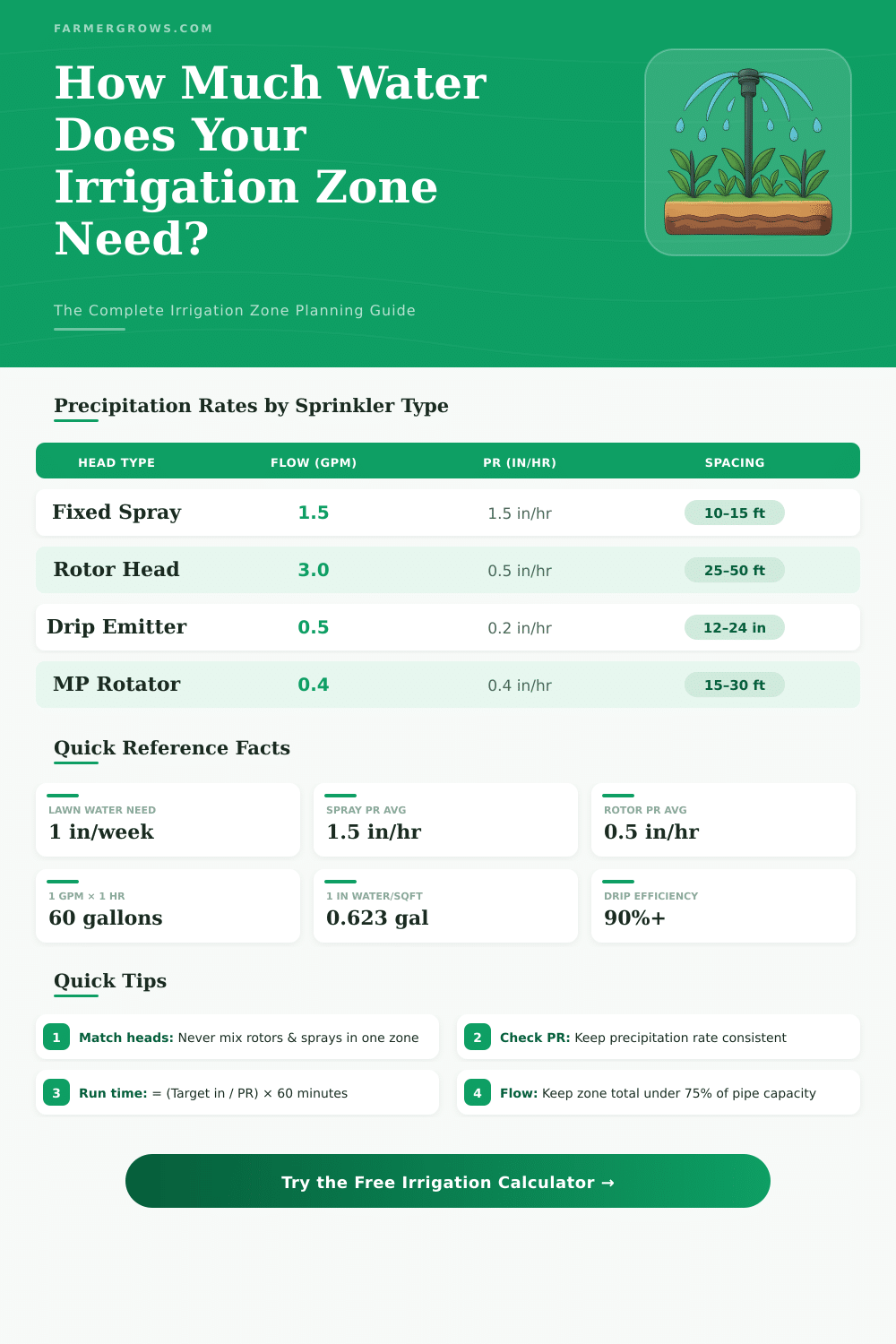
💧 Irrigation Zone Calculator
Calculate flow rate, run time, and water volume for each irrigation zone
in/hr avg PR
in/hr avg PR
in/hr avg PR
in/hr avg PR
GPM avg
in/hr avg PR
GPM avg
in/hr avg PR
| Target Depth | PR 0.5 in/hr (Rotor) | PR 1.0 in/hr | PR 1.5 in/hr (Spray) | PR 2.0 in/hr (Impact) |
|---|---|---|---|---|
| 0.25 in (6 mm) | 30 min | 15 min | 10 min | 8 min |
| 0.5 in (13 mm) | 60 min | 30 min | 20 min | 15 min |
| 0.75 in (19 mm) | 90 min | 45 min | 30 min | 23 min |
| 1.0 in (25 mm) | 120 min | 60 min | 40 min | 30 min |
| 1.5 in (38 mm) | 180 min | 90 min | 60 min | 45 min |
| 2.0 in (51 mm) | 240 min | 120 min | 80 min | 60 min |
| Zone Area | 1 in water (gal) | 1 in water (L) | At 1.5 in/hr — 40 min run (gal) | At 0.5 in/hr — 2hr run (gal) |
|---|---|---|---|---|
| 500 sq ft (46 m²) | 311 gal | 1,178 L | 311 gal | 311 gal |
| 1,000 sq ft (93 m²) | 623 gal | 2,358 L | 623 gal | 623 gal |
| 2,000 sq ft (186 m²) | 1,246 gal | 4,716 L | 1,246 gal | 1,246 gal |
| 3,000 sq ft (279 m²) | 1,869 gal | 7,074 L | 1,869 gal | 1,869 gal |
| 5,000 sq ft (465 m²) | 3,115 gal | 11,790 L | 3,115 gal | 3,115 gal |
| 10,000 sq ft (929 m²) | 6,230 gal | 23,581 L | 6,230 gal | 6,230 gal |
| Zone Type | Typical Area | Recommended Head | Flow (GPM) Total | Run Time / Week |
|---|---|---|---|---|
| Small Front Lawn | 600–1,000 sq ft | Fixed Spray (4–6 heads) | 6–9 GPM | 40–60 min |
| Medium Backyard | 1,500–2,500 sq ft | Rotor (4–6 heads) | 12–18 GPM | 90–150 min |
| Large Turf Zone | 3,000–6,000 sq ft | Gear Rotor (6–8 heads) | 18–30 GPM | 2–4 hrs |
| Garden / Shrub Bed | 200–500 sq ft | Drip / MP Rotator | 2–5 GPM | 30–60 min |
| Narrow Strip | 50–200 sq ft | MP Rotator / Strip Spray | 1–3 GPM | 20–40 min |
| Tree / Shrub Ring | 50–150 sq ft | Bubbler / Drip | 1–2 GPM | 20–30 min |
Irrigation zone consists of sprinklers that operates together as one system. Here the main point: many water sources simply do not fit to back the action of every sprinkler in the whole yard. Because of that one shared the whole setup in smaller sets or sections, where each receives only that, what the water supply truly can give.
Every valve in the valve device cares about his own lid, that opens to allow water flow to a set Irrigation zone or sector in the yard. Every sector has his own electronically controlled lid. To add a fresh zone, you must lay a new lid, bind to it wiring for power and tie tube of the water source to feed it.
How Irrigation Zones Work
The zones help, that various parts of the yard receive water according to their real needs, without guesses, without too much expense.
Professional designers start by mapping of the ground and rating of the needs of every space. They consider difference between plants, the sun strength on various places, the tpye of soil, the slope, and many other things. Everything affects, how quickly the water soaks in or dries up.
One zone can serve lawn, while another cares about beds with mulch and bushes. Each requires his own mode of watering. Humid valley does not require almost as much water as dry flower beds under direct sunlight, they belong too different zones clearly.
Yearly plants lay in separate group also, because their crop requires precise care.
Good zoning give to you the chance to control exactly the water spread through various parts of the yard. If you lay different times for different plants, you reach right accuracy. Every plant receives exactly that, what it requires.
Well arranged and balanced system usually reduce the water use strongly, spare cost in the bills and help the plants stay much more healthy.
The most many setups limit to nine zones or less. Six to nine zones is very common range. Your water source matter: a lake pump can give bigger amount than a city drain.
The first important stage is to find the top pressure, that your system fits to last. Such value commonly shows directly on the body of your main water shutvalve.
Here is easy mode to count your weekly water use. Assume, that you have six zones, that operates twice weekly during 15 minutes each. Multiply the time for one zone by the total number of zones, to have the whole work.
Valve devices come in 4-, 8- and 16-zone models, and many work with typical internal wiring. Smart valves use data specific for zone and adapt the watering according to the real needs of every part. Fresh lawn in full sun on flat area does not deserve thesame time as shady sloping flower garden; that is only logical thought.