💧 Irrigation Wire Size Calculator
Find the correct wire gauge for your sprinkler or drip irrigation system based on distance, valve current, and zone count.
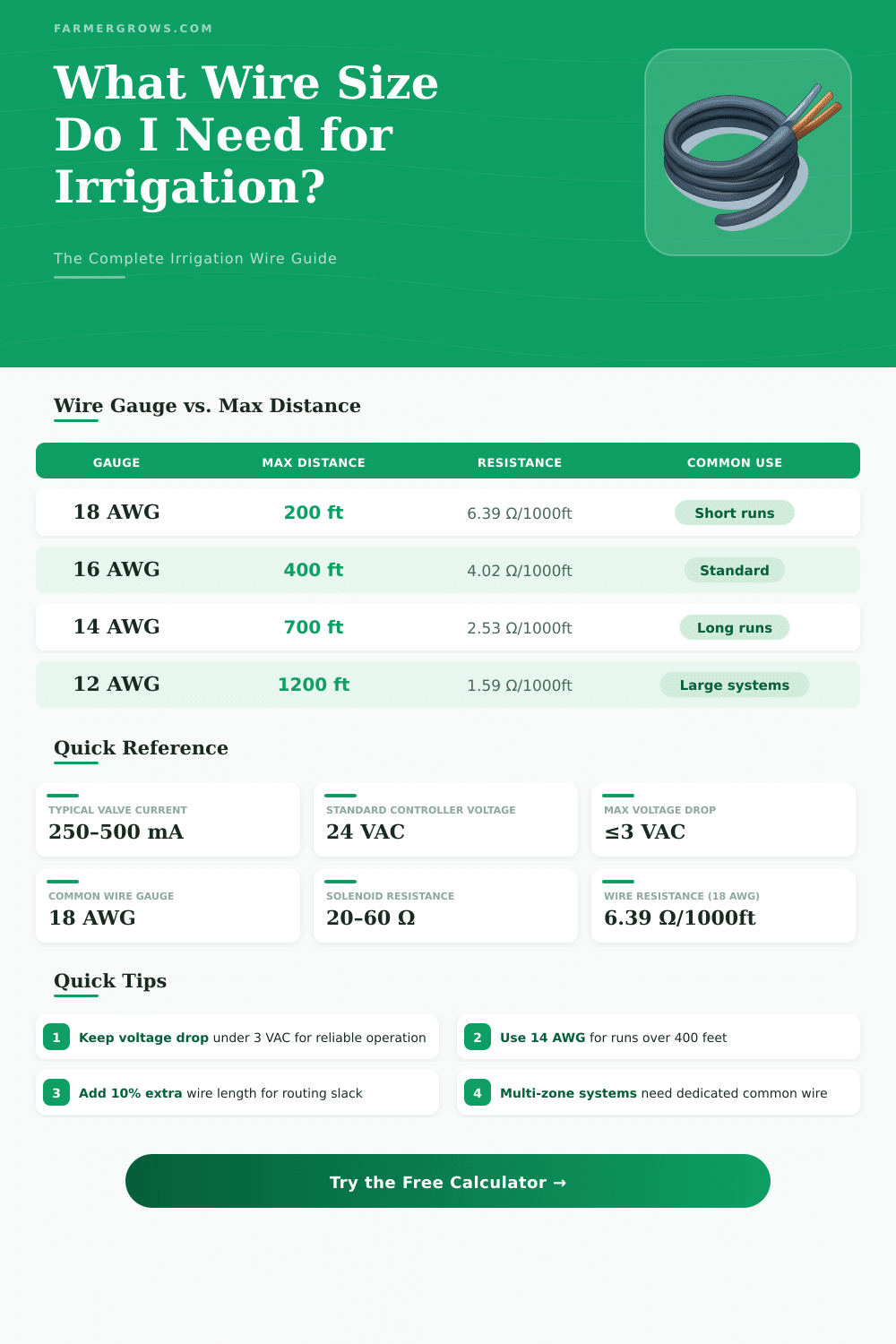
| AWG Gauge | Resistance (Ω/1000ft) | Resistance (Ω/1000m) | Max Distance @ 3V Drop, 300mA | Wire Dia. (in) | Common Use |
|---|---|---|---|---|---|
| 18 AWG | 6.385 | 20.95 | ~196 ft (60 m) | 0.0403 | Short residential runs |
| 16 AWG | 4.016 | 13.17 | ~312 ft (95 m) | 0.0508 | Standard residential |
| 14 AWG | 2.525 | 8.28 | ~497 ft (151 m) | 0.0641 | Long residential runs |
| 12 AWG | 1.588 | 5.21 | ~790 ft (241 m) | 0.0808 | Commercial, long runs |
| 10 AWG | 0.999 | 3.28 | ~1255 ft (383 m) | 0.1019 | Large commercial |
| 8 AWG | 0.628 | 2.06 | ~1997 ft (609 m) | 0.1285 | Very long runs |
| Distance (ft) | 18 AWG Drop | 16 AWG Drop | 14 AWG Drop | 12 AWG Drop | Status @ 300mA |
|---|---|---|---|---|---|
| 100 ft (30 m) | 1.28 VAC | 0.80 VAC | 0.51 VAC | 0.32 VAC | ✅ All OK |
| 200 ft (61 m) | 2.55 VAC | 1.61 VAC | 1.01 VAC | 0.64 VAC | ⚠️ 18 borderline |
| 300 ft (91 m) | 3.83 VAC | 2.41 VAC | 1.52 VAC | 0.95 VAC | ❌ 18 too high |
| 400 ft (122 m) | 5.11 VAC | 3.21 VAC | 2.02 VAC | 1.27 VAC | ❌ 18&16 too high |
| 500 ft (152 m) | 6.39 VAC | 4.02 VAC | 2.53 VAC | 1.59 VAC | ⚠️ Use 14+ |
| 700 ft (213 m) | 8.94 VAC | 5.62 VAC | 3.54 VAC | 2.22 VAC | ❌ Use 12+ |
| 1000 ft (305 m) | 12.77 VAC | 8.03 VAC | 5.05 VAC | 3.18 VAC | ❌ Use 10+ |
| Solenoid Type | Typical Current (mA) | Inrush Current (mA) | Solenoid Resistance (Ω) | Operating Voltage |
|---|---|---|---|---|
| Standard 24VAC | 250–350 mA | 700–900 mA | 25–40 Ω | 22–28 VAC |
| Low-power 24VAC | 150–200 mA | 400–600 mA | 40–60 Ω | 22–28 VAC |
| High-flow 24VAC | 400–550 mA | 900–1200 mA | 15–25 Ω | 22–28 VAC |
| DC Latching | 20–60 mA | 100–200 mA | 50–100 Ω | 9–12 VDC |
| Drip/Micro zone | 200–280 mA | 500–700 mA | 30–50 Ω | 22–28 VAC |
Choosing the right Irrigation wire size is important so that sprinkler systems work without problems. In domestic sprinkler setups one commonly chooses 18 AWG. With multi-strand 18 AWG irrigation control cable one can reach up to 800 feet without notable loss of voltage.
Makers usually give advice about the needed wire thickness for their valves. Usually 18-gauge wire works if the whole distance from the controller to the valve does not pass 200 feet.
How to Choose Sprinkler Wire Size
One finds sprinkler wires in various thicknesses, like 16 AWG or 18 AWG. For domestic setups, where the most distant valve sits around 200 feet away from the controller, 14-gauge and 18-gauge wires are easily found in local stores. Some specialists favor only 16-gauge single-strand cable or even 14-gauge for big domestic or business systems.
Those thikcer cables last almost forever in the soil.
Irrigation wire carries 24 VAC from the controller to the valves. It is made up of 18-gauge insulated copper cable with UV-resistant PVC coating. That type works for underground input and designed for protection against water and cold.
Usually the sprinkler cable has white main color, while additional control cables are in different shades.
Between solid-core and multi-strand wire exists a difference. Actually irrigation multi-strand cable is solid-core, but the word commonly points to several wires in one cover. Specialists most use directly buried 18-gauge multi-strand wire.
On the other hand some choose single-strand 16-gauge type. Multi-strand type costs more money. For instance, 18-gauge 13-strand cable can cost around 75 to 80 cents each foot in local irrigation stores.
Even so in big stores like Lowe’s one finds 18/4 solid irrigation wire for only 12 cents each foot.
Wires come in different roll sizes. A popular option is 18 AWG five-strand roll of 250 feet. Commercial 14 AWG single-strand cable comes in 500-foot rolls with high visibility yellow color four direct underground valve hookup.
If one needs only 150 feet, but rolls are of 50, 100 or 250 feet, one can buy 100-foot and 50-foot and join them with a splice.
Using good 18/2 wire from every valve directly to the controller one acts wisely. Also matter to recall, that the common and ground return cables must have low resistance. With two cables alongside one halves the resistance.
PVC tubes can protect the wire, but it doubles the cost and seems too much for low voltage and flow. Some folks lead theirlow-voltage cable through ABS pipes to avoid casual cuts with a shovel.