💧 Hunter Irrigation Calculator
Calculate sprinkler runtime, water volume, precipitation rates, and zone schedules for Hunter sprinkler systems
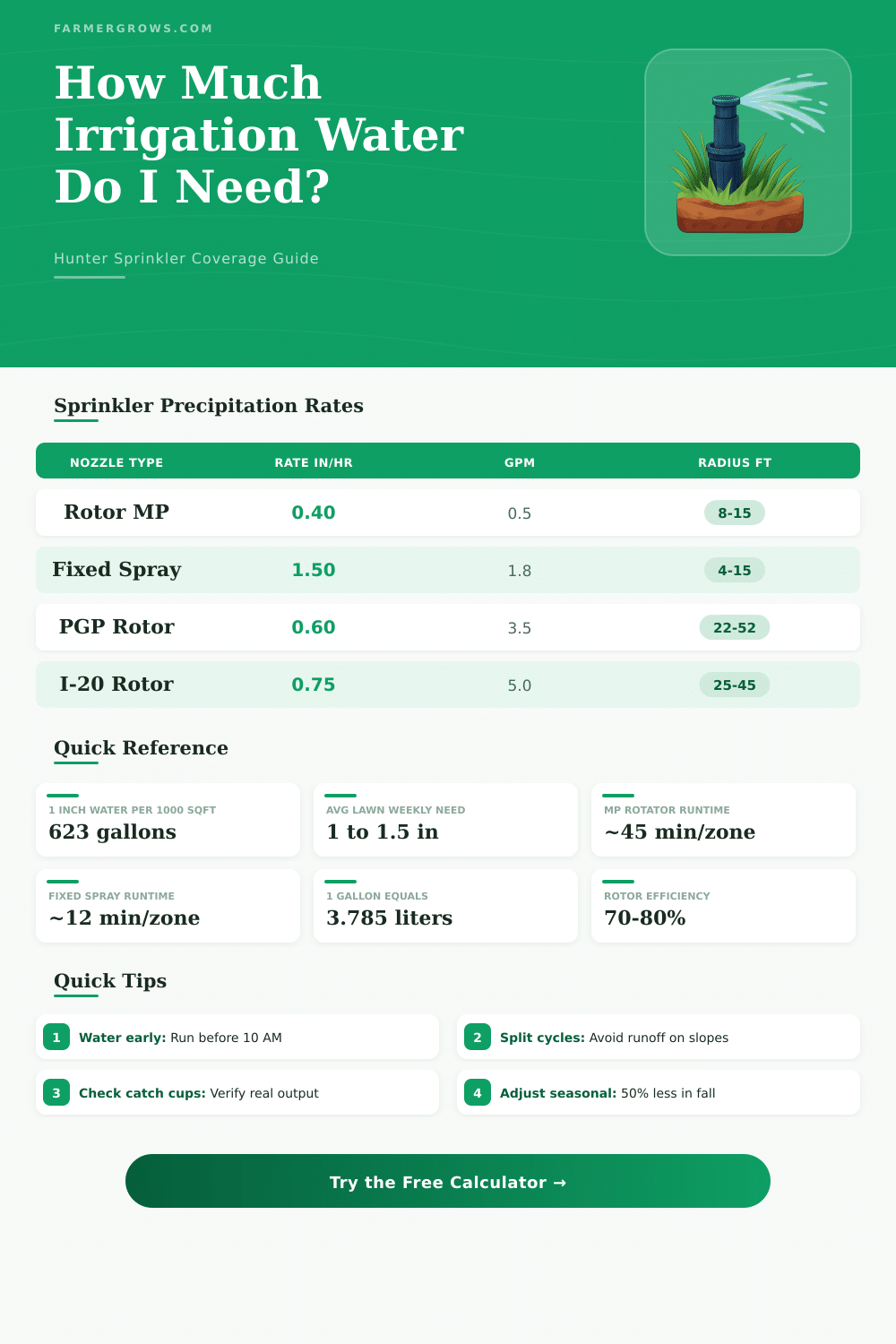
| Nozzle Type | Precip Rate | 0.5 in | 1.0 in | 1.5 in | 2.0 in |
|---|---|---|---|---|---|
| MP Rotator | 0.40 in/hr | 75 min | 150 min | 225 min | 300 min |
| MP Strip | 0.40 in/hr | 75 min | 150 min | 225 min | 300 min |
| Pro-Spray Fixed | 1.50 in/hr | 20 min | 40 min | 60 min | 80 min |
| PGP Ultra | 0.60 in/hr | 50 min | 100 min | 150 min | 200 min |
| PGJ Rotor | 0.55 in/hr | 55 min | 109 min | 164 min | 218 min |
| I-20 Rotor | 0.75 in/hr | 40 min | 80 min | 120 min | 160 min |
| I-25 Rotor | 0.65 in/hr | 46 min | 92 min | 138 min | 185 min |
| PGP-ADJ | 0.50 in/hr | 60 min | 120 min | 180 min | 240 min |
| Water Depth | Gallons / 1,000 sqft | Liters / 100 m² | Cubic Feet / 1,000 sqft |
|---|---|---|---|
| 0.25 in (6.4 mm) | 156 gal | 590 L | 20.8 ft³ |
| 0.50 in (12.7 mm) | 312 gal | 1,180 L | 41.7 ft³ |
| 0.75 in (19.1 mm) | 468 gal | 1,771 L | 62.5 ft³ |
| 1.00 in (25.4 mm) | 623 gal | 2,359 L | 83.3 ft³ |
| 1.25 in (31.8 mm) | 779 gal | 2,949 L | 104.2 ft³ |
| 1.50 in (38.1 mm) | 935 gal | 3,540 L | 125.0 ft³ |
| 2.00 in (50.8 mm) | 1,247 gal | 4,719 L | 166.7 ft³ |
| Project | Area | Gallons / Week | Runtime (MP Rotator) |
|---|---|---|---|
| Small Side Yard | 500 sq ft | 312 gal | 150 min (2 cycles) |
| Front Lawn | 1,200 sq ft | 748 gal | 150 min (2 cycles) |
| Average Yard | 2,500 sq ft | 1,558 gal | 150 min (3 cycles) |
| Large Yard | 5,000 sq ft | 3,115 gal | 150 min (5 cycles) |
| Half Acre Lot | 10,000 sq ft | 6,230 gal | 150 min (10 cycles) |
| Athletic Field | 50,000 sq ft | 31,150 gal | 150 min (50 cycles) |
| Model | Type | Radius Range | Flow (GPM) | Spacing |
|---|---|---|---|---|
| MP Rotator 1000 | Rotary Nozzle | 8–15 ft | 0.15–0.53 | 8–15 ft |
| MP Rotator 2000 | Rotary Nozzle | 13–21 ft | 0.26–0.92 | 13–21 ft |
| MP Rotator 3000 | Rotary Nozzle | 22–30 ft | 0.42–1.50 | 22–30 ft |
| Pro-Spray PRS40 | Fixed Spray | 4–15 ft | 0.50–3.50 | 4–15 ft |
| PGP Ultra | Gear Rotor | 22–52 ft | 1.60–11.50 | 22–52 ft |
| PGJ | Gear Rotor | 15–30 ft | 0.90–4.90 | 15–30 ft |
| I-20 | Gear Rotor | 25–45 ft | 2.00–11.80 | 25–45 ft |
| I-25 | Gear Rotor | 38–71 ft | 4.50–22.00 | 38–71 ft |
Irrigation is made up of the use of precise amounts of water to help grow crops, landscapes in gardens and meadows. It forms a basic element of farm work for more than 5 000 years and spread through various cultures globally. Basically Irrigation means to carry water to the plants by means of tubes, channels, sprinklers or other handmade ways, instead of depending only on natural rain.
In the whole world Irrigation is the mainstream use of water except drinking. The water for Irrigation helps to grow fruits, vegetables and cereals for feeding the world population. That stays true for thousands of years.
Irrigation: How We Water Plants and Save Water
Some lands truly require Irrigation for any farming. In other areas it most simply adds to the rain when that lacks.
Farming uses a lot of ground and surface water in United States. Irrigation matches about 47 percent of the whole national freshwater pulling between 2010 and 2020. By means of Irrigation one can produce crops in dry parts and add moisture to the soil in wet zones, when the seasonal rain declines.
In regions where the yearly rain falls below 250 to 300 mm, one must use full Irrigation to grow plnats.
Water care is about the deciding and control of the amount, timing and use of Irrigation water in a careful way. Giving water to crops at the right moment is key for there whole growth and development. Water is a needed resource for the forming of crops, flowers, fruits and seeds.
Various kinds of Irrigation exist. Drip Irrigation is one of the most common and practical methods. One can design drip systems even for pots in gardens, including hanging plants.
Underground drip setups one installs for meadows, even though they cost much more and need more attention. Except that, another popular method directs water in the fields by means of channels, for instance mainstream pivotal devices, that one uses in United States and western lands.
Automatic Irrigation devices distribute water by means of electrical valves, that a timer controls. The timer, usually called control, operates by means of low voltage to open and close the valves on a fixed schedule. Smart Irrigation methods can lower the underground water use.
Those devices improve the efficiency by means of saving water, while they keep the health of the plants. They work for little home landscapes just as for big professional areas.
The mainstream goal of water-smart landscape is to lower the need of extra Irrigation, while one keeps everything healthy and good-looking. The water needs of landscape depend on the local climate, kind of plants, year season and wanted quality. In the state Washington Irrigationdoes not lack for good crop production east of the Cascading Mountains, and extra Irrigation helps in parts of West Washington during the warm summer months.