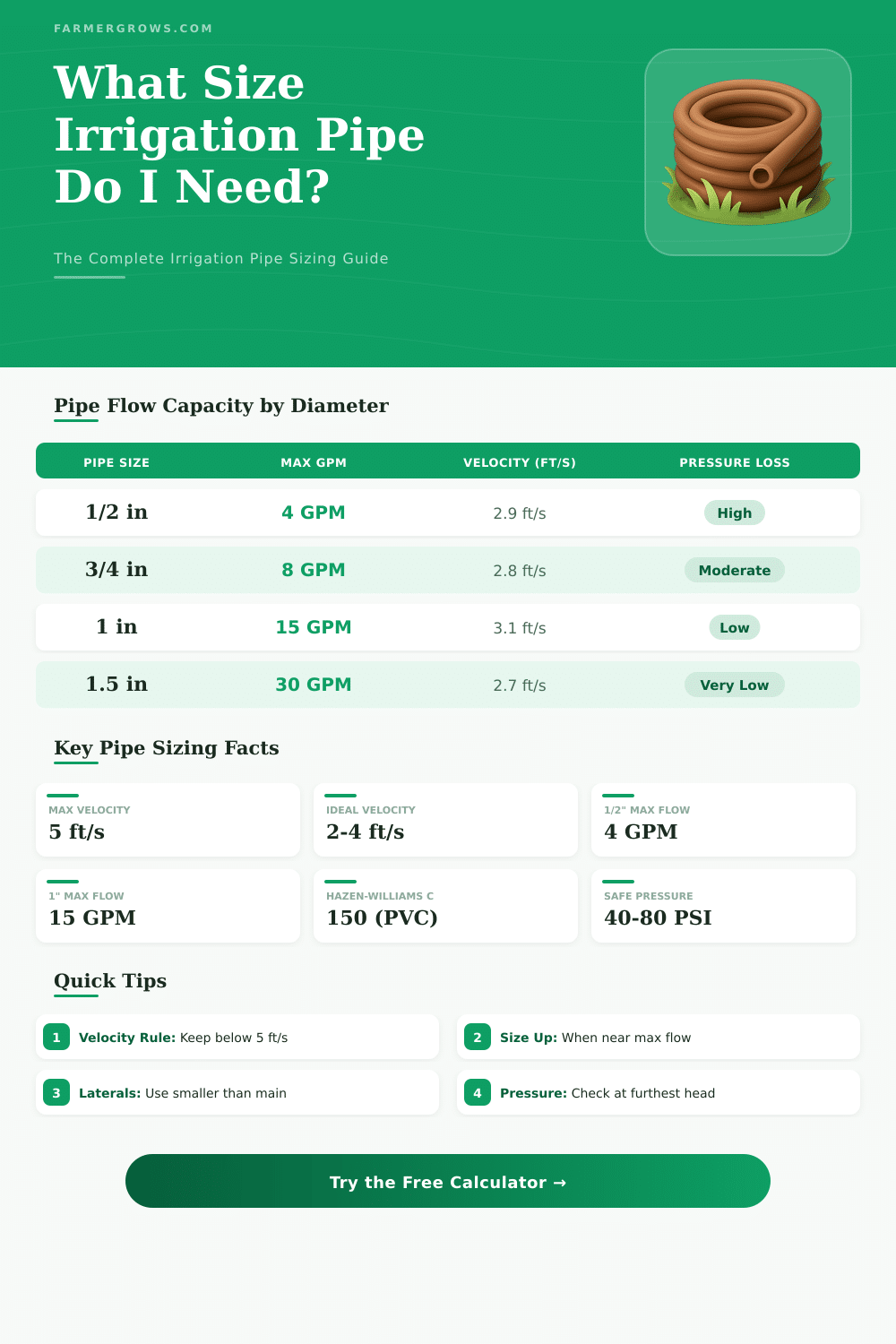
💧 Irrigation Pipe Size Calculator
Find the right pipe diameter for your irrigation system based on flow rate, pipe length, and pressure requirements
| Nominal Size | Inner Dia (in) | Max GPM | Max L/min | Velocity at Max (ft/s) | Typical Use |
|---|---|---|---|---|---|
| 1/2 in | 0.622 | 4 | 15 | 4.2 | Drip laterals |
| 3/4 in | 0.824 | 8 | 30 | 3.8 | Zone laterals |
| 1 in | 1.049 | 15 | 57 | 4.4 | Zone mains |
| 1-1/4 in | 1.380 | 22 | 83 | 3.8 | Sub-mains |
| 1-1/2 in | 1.610 | 30 | 114 | 3.7 | Sub-mains |
| 2 in | 2.067 | 50 | 189 | 3.8 | Main lines |
| 2-1/2 in | 2.469 | 80 | 303 | 4.2 | Main lines |
| 3 in | 3.068 | 130 | 492 | 4.4 | Large mains |
| 4 in | 4.026 | 250 | 946 | 4.9 | Supply mains |
| Pipe Material | C Value | Relative Friction | Common Application |
|---|---|---|---|
| PVC (new) | 150 | Very Low | Residential & commercial irrigation |
| HDPE | 150 | Very Low | Drip & subsurface systems |
| Polyethylene | 140 | Low | Drip irrigation tubing |
| Copper | 140 | Low | Service connections |
| ABS Plastic | 148 | Very Low | Gravity-fed systems |
| Ductile Iron | 130 | Moderate | Municipal mains |
| Galvanized Steel | 120 | Moderate-High | Legacy systems |
| Cast Iron (old) | 100 | High | Older infrastructure |
| Flow Velocity | Status | Water Hammer Risk | Recommendation |
|---|---|---|---|
| Below 2 ft/s | Too Slow | None | Consider smaller pipe |
| 2–3 ft/s | Ideal | Very Low | Optimal for drip systems |
| 3–5 ft/s | Acceptable | Low | Good for most systems |
| 5–7 ft/s | Marginal | Moderate | Size up if possible |
| Above 7 ft/s | Excessive | High | Must use larger pipe |
| Project Type | Typical Flow | Recommended Main | Recommended Lateral |
|---|---|---|---|
| Small residential lawn | 4–8 GPM | 3/4 in | 1/2 in |
| Medium residential yard | 8–15 GPM | 1 in | 3/4 in |
| Large residential property | 15–30 GPM | 1.5 in | 1 in |
| Commercial landscape | 30–60 GPM | 2 in | 1.5 in |
| Sports field | 60–100 GPM | 2.5 in | 2 in |
| Agricultural field | 100–200 GPM | 3–4 in | 2–2.5 in |
| Drip garden zone | 0.5–4 GPM | 1/2 in | 1/4–3/8 in |
| Greenhouse system | 2–8 GPM | 3/4 in | 1/2 in |
The Irrigation pipe size of tubes commonly confuses at first because the numbers marked on them not always match the actual size. Two elements define tube size: the nominal NPS (for diameter in inches) and the schedule (for thickness of the wall). Nominal size simply serves as a label, not as a precise measure.
At tubes under NPS 12, the real outer diameter beats the nominal value. When tube sizes reach 14 inches or more, the outer diameter matches the nominal tube size.
Simple Guide to Pipe and Tube Sizes
Tubes of schedule 40 are the most common. For the sake of extra strength, one can choose schedule 80. Usually one uses schedule 40 in homes, while schedule 80 come to use where stronger pressure is needed.
The choice of tube schedule points the nominal thickness of the wall and relates to several key factors. For those sizes one applies the standard ASME B 36.10M.
Also the sizing of copper tubes can confuse folks. Copper tube of 3/4 inch truly has 7/8 inch for outer diameter. Plumbers and cooling workers measure tubes differently.
Tube size of 1 inch for a plumber matches 1-1/8 inch for a cooling worker. In cabinets one usually uses the plumber sizing by internal diameter. Copper tubes do not have one standard, they range from 1/8 inch outside to 6 inches inside, with everything in between.
For home water supply, tubes of half-inch size is usual for separate devices. The main supply line commonly has 3/4 inch to 1 inch. A practical solution is the main line of 3/4 inch with branches of 1/2 inch too the fixtures.
The entry and exit of the water heater usually are 3/4-inch, what shows a clear reason for that size in the main trunk.
Change of 3/4-inch to 1-inch tube does not expand the pressure. The static pressure stays the same anywhere. It does expand the amount of water that can flow, thus lowering the pressure drop along the line.
Homes far from the main water line can have troubles, when one opens two devices at the same time, if the tubes are too small.
For drain tubes, 3-inch tube works for three toilets in a typical drain. Indeed, in a 3-inch tube one needs less water to move solid parts than in a 4-inch tube. Cities use sewer tubes of 4 inches to 8 feet in diameter.
For a three-bedroom home one usually builds a 4-inch drain. A conversion chart helps to bridge the gap between imperial and metric tubesizes, listing nominal sizes with fractions, inches, millimeters and DN matches.