💧 Irrigation Friction Loss Calculator
Calculate head loss & pressure drop in irrigation pipes using the Hazen-Williams formula
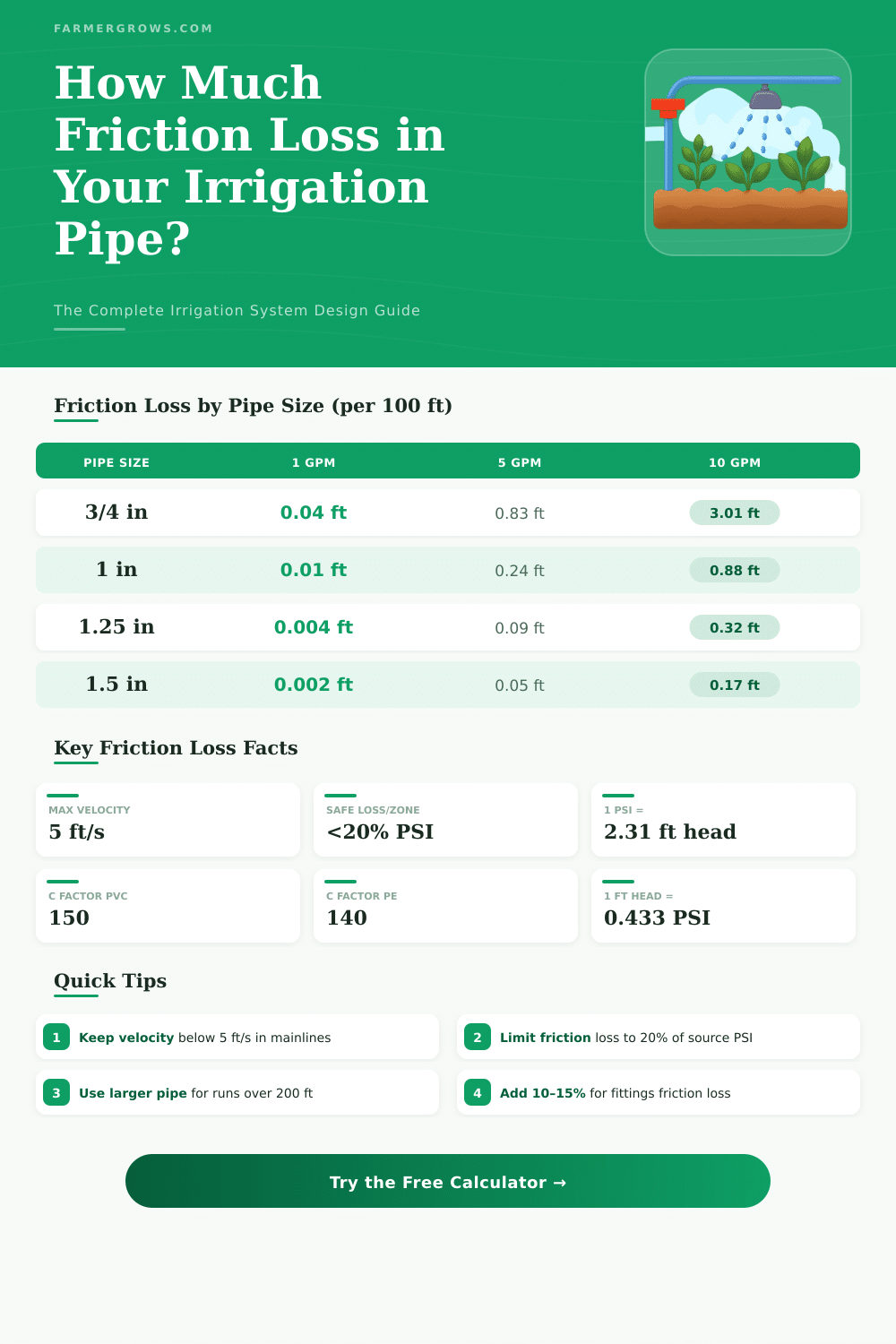
| Pipe Size | 2 GPM | 5 GPM | 10 GPM | 15 GPM | 20 GPM | 30 GPM |
|---|---|---|---|---|---|---|
| 1/2 in (0.622 ID) | 0.46 ft | 2.60 ft | 9.49 ft | 20.1 ft | 34.2 ft | 72.5 ft |
| 3/4 in (0.824 ID) | 0.12 ft | 0.68 ft | 2.47 ft | 5.24 ft | 8.92 ft | 18.9 ft |
| 1 in (1.049 ID) | 0.04 ft | 0.22 ft | 0.79 ft | 1.68 ft | 2.85 ft | 6.04 ft |
| 1-1/4 in (1.380 ID) | 0.01 ft | 0.07 ft | 0.25 ft | 0.53 ft | 0.90 ft | 1.90 ft |
| 1-1/2 in (1.610 ID) | 0.006 ft | 0.03 ft | 0.13 ft | 0.27 ft | 0.46 ft | 0.97 ft |
| 2 in (2.067 ID) | 0.002 ft | 0.01 ft | 0.05 ft | 0.10 ft | 0.17 ft | 0.36 ft |
| 3 in (3.068 ID) | — | 0.003 ft | 0.01 ft | 0.02 ft | 0.04 ft | 0.08 ft |
| Pipe ID (in) | 5 GPM (ft/s) | 10 GPM (ft/s) | 15 GPM (ft/s) | 20 GPM (ft/s) | Max Rec. Flow |
|---|---|---|---|---|---|
| 0.622 (1/2 in) | 5.29 | 10.6 | — | — | 4.7 GPM |
| 0.824 (3/4 in) | 3.01 | 6.03 | — | — | 8.3 GPM |
| 1.049 (1 in) | 1.86 | 3.72 | 5.58 | — | 13.4 GPM |
| 1.380 (1-1/4 in) | 1.07 | 2.15 | 3.22 | 4.29 | 23.3 GPM |
| 1.610 (1-1/2 in) | 0.79 | 1.58 | 2.37 | 3.17 | 31.7 GPM |
| 2.067 (2 in) | 0.48 | 0.96 | 1.44 | 1.92 | 52.2 GPM |
| 3.068 (3 in) | 0.22 | 0.43 | 0.65 | 0.87 | 118 GPM |
| PSI | Feet of Head | kPa | Bar | m of Head |
|---|---|---|---|---|
| 5 PSI | 11.55 ft | 34.5 kPa | 0.345 bar | 3.52 m |
| 10 PSI | 23.1 ft | 68.9 kPa | 0.689 bar | 7.03 m |
| 20 PSI | 46.2 ft | 137.9 kPa | 1.379 bar | 14.07 m |
| 30 PSI | 69.3 ft | 206.8 kPa | 2.068 bar | 21.10 m |
| 40 PSI | 92.4 ft | 275.8 kPa | 2.758 bar | 28.14 m |
| 60 PSI | 138.6 ft | 413.7 kPa | 4.137 bar | 42.21 m |
| 80 PSI | 184.8 ft | 551.6 kPa | 5.516 bar | 56.27 m |
| 100 PSI | 231.0 ft | 689.5 kPa | 6.895 bar | 70.34 m |
| Zone Type | Typical Flow | Rec. Pipe Size | Max Run Length | Design Pressure |
|---|---|---|---|---|
| Residential Lawn (small) | 5–10 GPM | 3/4 in – 1 in | 150 ft | 30–50 PSI |
| Residential Lawn (large) | 10–20 GPM | 1 in – 1-1/2 in | 200 ft | 40–60 PSI |
| Drip / Micro Irrigation | 1–5 GPM | 1/2 in – 3/4 in | 200 ft | 15–30 PSI |
| Commercial Landscape | 20–40 GPM | 1-1/2 in – 2 in | 300 ft | 50–80 PSI |
| Sports / Athletic Field | 30–60 GPM | 2 in – 3 in | 400 ft | 60–80 PSI |
| Agricultural / Farm | 50–150 GPM | 3 in – 4 in | 600 ft | 40–80 PSI |
When water flows through irrigation tubes and keys, friction exist between the water and the internal surface. That friction contact generates resistance that slows the flow of the water. Therefore a pressure drop happens as the water moves along the line.
One calls that simply Irrigation friction loss.
What is Irrigation Friction Loss
What determines the grade of Irrigation friction loss that one observes? The flow rate is key. If one pushes more gallons each minute through a tube of certain size, the Irrigation friction loss grows quickly.
Also the material of the tubes affects that. The diameter of the pipes matters too, a connection of 3/4 inch delivers only that, what this size fits. Charts about Irrigation friction loss shows all details for counting it yourself.
Here the hard part: even tiny friction does not seem big, until one adds it over long distance. Little resistance each foot becomes big pressure loss along a long line. Imagine that as a bike trip with half pressed brakes during the whole time.
This constant obstacle slows you, and similarly happens with water pressure in long tubes.
For choosing the right tube size, one must keep the water speed around 5 feet each second, helping yourself by using easy charts. Start with bigger tube beside the sprinkler, to beat friction soon. Later shrink the diameter as you go from the source.
For instance, use tube of 1.25 or 1.5 inch at first, later pass to 1 inch as you arrive to the valves. Then go to 3/4 inch for the final feed lines, without problem.
Even so there is more than only tube friction, that causes pressure loss. Valves and fittings absorb pressure also. In most systems, one loses around 10 percent of pressure because of these parts.
Some design standards estimate more, between 10 and 25 percent of extra loss, when one considers everything. Curves also add loss, their K-value matches 7. All those losses grow with the water speed, and they grow quickly.
Good news: calculators help too settle those complex tasks. The Hazen-Williams formula offers a way to estimate Irrigation friction loss in tubes. One enters the diameter and length of the tube, and the tool gives the pressure drop.
Some calculators focus on total Irrigation friction loss directly, for the last feed line. Others research sprinkler side lines, considering whole flow, tube length and friction together. Tubes with evenly spaced releases, like distributors or sprinkler side lines, require there own special calculations.
Do not forget the height. Slope down helps to make up for Irrigation friction loss. One wins around half PSI of water pressure for every foot of height drop.
On the other hand, to do all those easy parts right, one needs experience. Best to call a trained irrigation specialist for the design andinstallation, let them care about these details, and your system will work well. Ignore them, and you will struggle during the whole season.