🌿 Hydroponic Fertilizer Calculator
Calculate exact nutrient concentrations, solution volumes, and mixing ratios for your hydroponic system
PPM (veg)
PPM (flower)
PPM (veg)
PPM (flower)
PPM (veg)
PPM (flower)
PPM (flower)
PPM Target
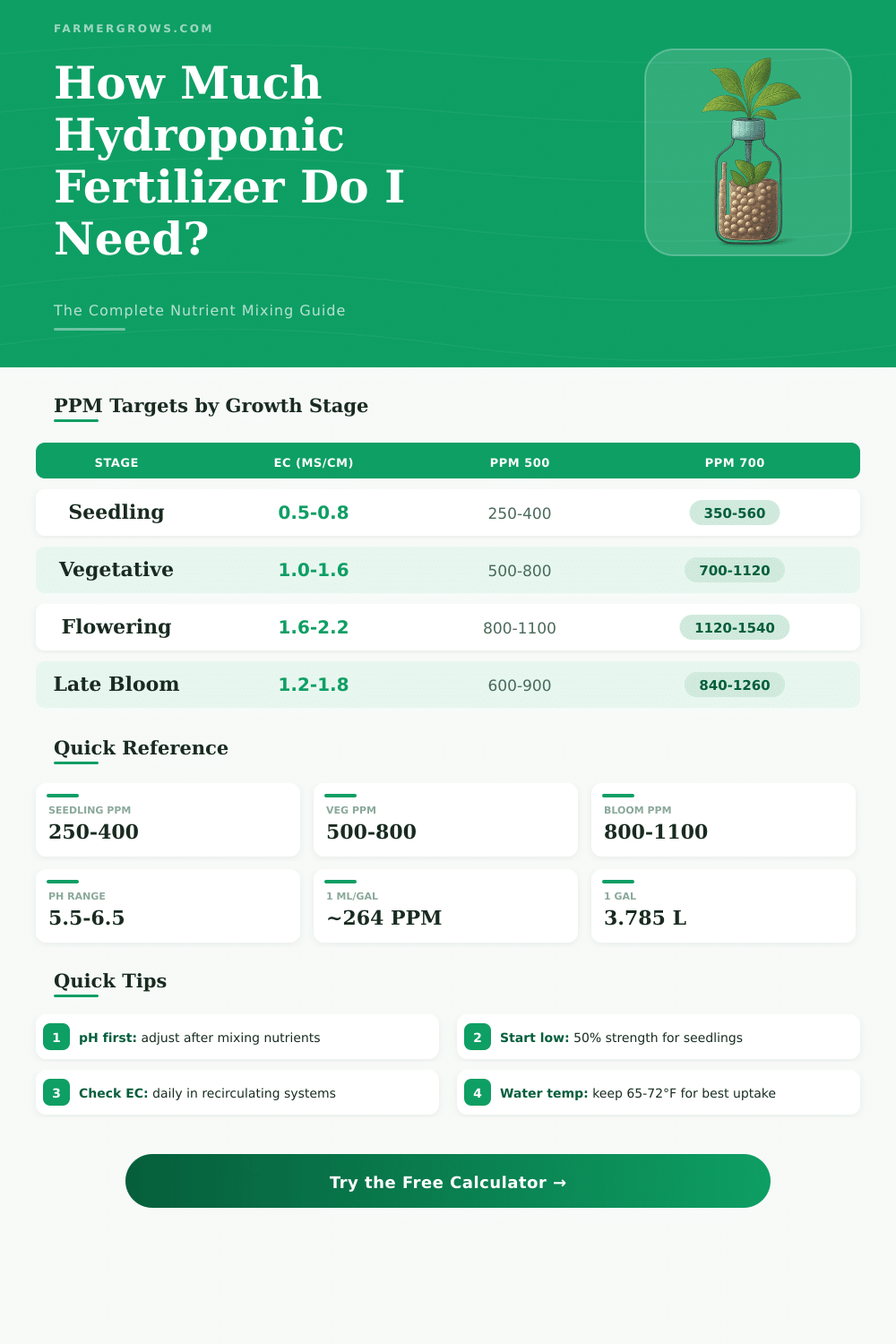
| Growth Stage | EC (mS/cm) | PPM 500 Scale | PPM 700 Scale |
|---|---|---|---|
| Seedling / Clone | 0.5 – 0.8 | 250 – 400 | 350 – 560 |
| Early Vegetative | 0.8 – 1.2 | 400 – 600 | 560 – 840 |
| Late Vegetative | 1.2 – 1.6 | 600 – 800 | 840 – 1120 |
| Early Flowering | 1.6 – 2.0 | 800 – 1000 | 1120 – 1400 |
| Peak Flowering | 2.0 – 2.4 | 1000 – 1200 | 1400 – 1680 |
| Late Bloom / Ripen | 1.2 – 1.8 | 600 – 900 | 840 – 1260 |
| Flush (pre-harvest) | 0.0 – 0.2 | 0 – 100 | 0 – 140 |
| Concentration Level | mL / Gallon | mL / Liter | Approx PPM Add |
|---|---|---|---|
| Very Light (seedlings) | 1.0 – 2.0 | 0.25 – 0.5 | 130 – 265 |
| Light (early veg) | 2.0 – 3.0 | 0.5 – 0.8 | 265 – 400 |
| Medium (full veg) | 3.0 – 4.0 | 0.8 – 1.05 | 400 – 530 |
| Standard (transition) | 4.0 – 5.0 | 1.05 – 1.3 | 530 – 660 |
| Full Strength (bloom) | 5.0 – 6.5 | 1.3 – 1.7 | 660 – 860 |
| Aggressive (heavy feed) | 6.5 – 8.0 | 1.7 – 2.1 | 860 – 1060 |
| System Description | Area (sq ft / m²) | Volume (gal) | Volume (L) |
|---|---|---|---|
| Single DWC Bucket | 0.8 / 0.07 | 5 | 18.9 |
| Small NFT Channel (4 ft) | 4 / 0.37 | 10 | 37.9 |
| Ebb & Flow Table 4x4 ft | 16 / 1.49 | 20 – 30 | 76 – 114 |
| Ebb & Flow Table 4x8 ft | 32 / 2.97 | 40 – 60 | 151 – 227 |
| Large NFT System (12 ft) | 36 / 3.34 | 50 – 75 | 189 – 284 |
| Commercial Rack 10x20 ft | 200 / 18.6 | 150 – 250 | 568 – 946 |
| Crop Type | N Ratio | P Ratio | K Ratio |
|---|---|---|---|
| Leafy Greens (lettuce, spinach) | 3 | 1 | 2 |
| Herbs (basil, cilantro) | 2 | 1 | 2 |
| Tomatoes (vegetative) | 3 | 1 | 2 |
| Tomatoes (fruiting) | 1 | 2 | 3 |
| Peppers (all stages) | 2 | 1 | 3 |
| Strawberries (fruiting) | 1 | 1.5 | 3 |
| General Purpose | 2 | 1 | 2 |
5-gallon DWC system in full force during flowering requires around 25 ml from every nutrient part, that is about 5 ml per gallon. I did not expect that the jump in dose for seedlings will be like this big but from 1.5 ml/gallon until 5 ml results triple growth. The change in PPM is truly wild: seedlings stay in 250-400 on the scale of 500, during the peak in flowering reach 1000-1200.
That is big contrast.
How to Feed Plants in Hydroponics
For typical 4×8 flood table with 50 gallons of water (about 189 liters), I found that one uses around 250 ml of Fertilizer for change of the reservoir during vegetative stage. During the shift to flowering, it grows to around 350 ml. I always add 10% more, because evaporation removes 5-8% between the changes, and topping off with pure water lowers the EC by 0.1 until 0.3 mS/cm, depending on the surrounding tmeperature.
The info below does not come from any calculator or converter. It is based on actual experience, forum chats and community knowledge from various websites.
Hydroponic Fertilizer differs from usual plant food in some key ways. Because hydroponic systems grow plants without soil, the Fertilizer must deliver every nutrient that the plants require. Soil naturally has germs and processes that break things into forms that plants can use.
Without soil, all ingredients of hydroponic Fertilizer must be water-soluble, so that plants absorb them easily.
Those three numbers on Fertilizer cans are really important. Numbers like “10-5-10” or “7-9-5” show the percentages of nitrogen, phosphorus and potassium by weight. They represent the main nutrients that plants require, commonly called NPK.
Besides NPK, trace elements also must be in the mix for good growth. Some Fertilizer products carry extra calcium and magnesium, so reading the label one can guess weather additional supplements are needed.
Brands like General Hydroponics Flora Series and Masterblend are popular for vegetables. General Hydroponics MaxiGro, MaxiBloom and CALiMAGic are good options that work well for lettuce, peppers, tomatoes, basil and strawberries. Masterblend originally was for soil farming, but later it found use in hydroponics.
Common mix is Masterblend 4-18-38 with calcium nitrate and Epsom salt. The base one can swap with brands like Greenway Biotech or Yara.
Water-soluble Fertilizer products deliver rich nutrients for home hydroponic crops. Products like General Hydroponics FloraPro are made up of top, professional Fertilizer. There are also liquid concentrates, like Grow Big Hydroponic Liquid Plant Food, designed specially for hydroponics.
Small plants require less nutrients, while big ones usually require more. The strength and ratios change depending on the growth stage. Growers figure out the amount of Fertilizer based on the content of nutrients in it and the recipe.
General advice is one until two cups of ready liquid nutrient solution for sixteen gallons of water. The reservoir never should fully empty.
Using regular compost for hydroponics is not a good idea. Most composts lack micronutrients, because the soil itself usually delivers them. Worm castings deserve a mention.
They give gentle nutrients, releasing micronutrients and nitrogen slowly. Seedlings can grow directly in worm castings. Fish emulsion and compost tea also work in certain systems.
Hydroponics is considered more sustainable than traditional farming. It uses around 90% less water and can boost the growth. Hydroponic systems use idle materials like sand, pebbles or perlite to supportthe plants, while nutrient-rich water takes care of the feeding.