🐎 Horse Hay Feed Calculator
Calculate daily, monthly & annual hay requirements for your horse based on weight, activity & hay type
BW/day (maint.)
BW/day (maint.)
BW/day (maint.)
BW/day (maint.)
BW/day (maint.)
BW/day (maint.)
BW/day (maint.)
BW/day (maint.)
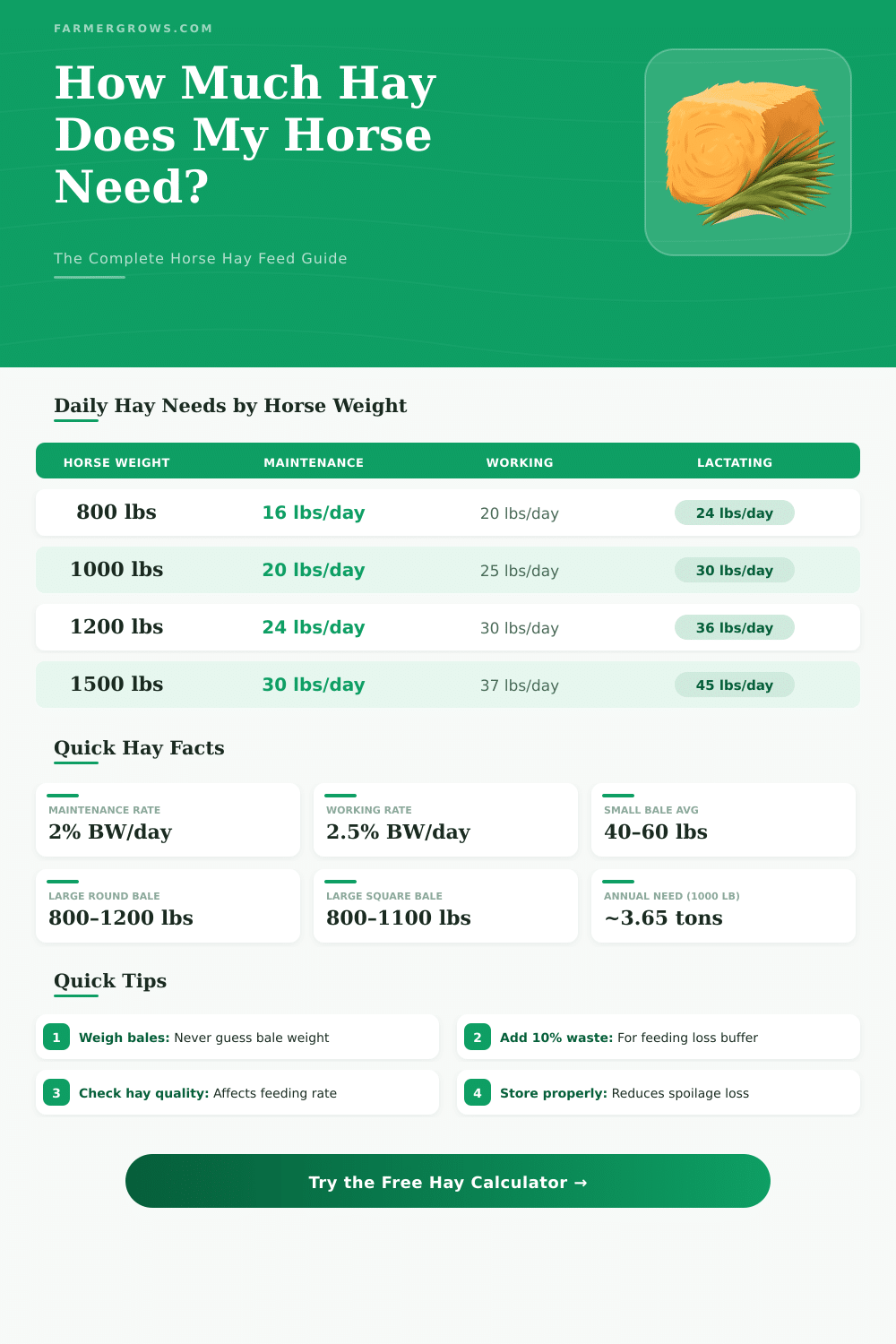
| Horse Weight (lbs) | Maintenance (lbs/day) | Light Work (lbs/day) | Heavy Work (lbs/day) | Lactating (lbs/day) | Weight (kg) |
|---|---|---|---|---|---|
| 600 lbs | 12 | 15 | 18 | 18 | 272 kg |
| 800 lbs | 16 | 20 | 24 | 24 | 363 kg |
| 900 lbs | 18 | 22.5 | 27 | 27 | 408 kg |
| 1000 lbs | 20 | 25 | 30 | 30 | 454 kg |
| 1100 lbs | 22 | 27.5 | 33 | 33 | 499 kg |
| 1200 lbs | 24 | 30 | 36 | 36 | 544 kg |
| 1400 lbs | 28 | 35 | 42 | 42 | 635 kg |
| 1500 lbs | 30 | 37.5 | 45 | 45 | 680 kg |
| 1800 lbs | 36 | 45 | 54 | 54 | 816 kg |
| Bale Type | Typical Weight (lbs) | Weight (kg) | Days for 1 Horse (1000 lb, maint.) | Days for 5 Horses |
|---|---|---|---|---|
| Small Square Bale | 40–60 lbs | 18–27 kg | 2–3 days | 0.4–0.6 days |
| Medium Square Bale | 100–130 lbs | 45–59 kg | 5–6.5 days | 1–1.3 days |
| Large Square Bale | 800–1,100 lbs | 363–499 kg | 40–55 days | 8–11 days |
| Small Round Bale | 400–600 lbs | 181–272 kg | 20–30 days | 4–6 days |
| Large Round Bale | 800–1,200 lbs | 363–544 kg | 40–60 days | 8–12 days |
| Mini Round Bale | 100–200 lbs | 45–91 kg | 5–10 days | 1–2 days |
| Herd Size | Avg Horse Wt (lbs) | Maintenance (tons/yr) | Working (tons/yr) | Metric Tonnes/yr |
|---|---|---|---|---|
| 1 horse | 1,000 | 3.65 | 4.56 | 3.31–4.13 |
| 2 horses | 1,000 | 7.3 | 9.1 | 6.6–8.3 |
| 5 horses | 1,000 | 18.3 | 22.8 | 16.6–20.7 |
| 10 horses | 1,100 | 40.2 | 50.2 | 36.5–45.5 |
| 20 horses | 1,100 | 80.3 | 100.4 | 72.9–91.0 |
| 50 horses | 1,200 | 219.0 | 273.8 | 198.6–248.3 |
Horses usually consume hay during the whole year, except when their owners have access to good feed. Although feed helps, hay stays necessary when the meadows no longer grow or are covered by snow. Most horse owners give their creatures that type of hay that they learnt to use, together with anything available in the region.
Hay is made up of dried grass, clover, alfalfa or other feeds, or mixes from those. It works best for creatures that eat grasses, for instance horses. Only excellent grassy hay can fully satisfy the nutritious needs of adult horse, that does not work.
Feeding Hay to Horses
Daily horse must receive around two percentages of its body weight in feed. For average adult that means around four until eight pieces of hay a day. If one gives too little, horses risk belly diseases, as stomach ulcers or problems in the back intestine.
Alfalfa is the most commonly used plant for nutrition of horses, even though other plants as red clover, crimson clover, lespedeza, birdsfoot trefoil and peanut hay also offer prime nourishment. They usually have more botom quality and are used less commonly. Many owners mix grassy and plant hay to balance the energies, proteins and fibers, that their horses require.
Feeds give lot of fibers, that bacteria ferment mostly in the back intestine. That fermentation makes heat inside the body. Feeds rich in fibers make heat, that lasts long and helps to keep the core temperature stable.
The back intestine works like a boiler four the horse.
Horses necessarily require nibbling during the whole day. At creatures with insulin problems the grassy meal must be limited, and hay be available around the clock. Continuous access to fiber foods stops acids from reaching the sensitive belly lining, when the stomach empties.
It ensures also, that the germs in the back intestine stay fed and can work well.
Hays from grain crops, as oat hay, barley hay or mix from three species, should not pass half of the everyday amount of feed. The grains in them carry unknown levels of simple carbohydrates. Straw from wheat or oat has fewer calories and carbohydrates than hay, but they give horses time to chew and fill the belly like needed.
One can use straw to replace up to thirty percentages of the hay.
Hay that is slimy or covered in dust, can cause problems in breathing and digestion. Old hay, that lost its green colour, stays nutritious, if it smells good and is not dusty. Colour does not show the quality.
To test hay for its nutritious content is a wise idea, because it reveals, how many everyday needs it covers and whether one must add grains or more feed.
There are feeders done for little portions of hay, and others for whole packages. Slow feeders force horses to take only little hay at a time, while free choice ones let them eat freely. Feeders at groundlevel help normal wear of teeth, rather than raised.
Square packages share more easily for horses than round.