🌾 Hay Bale Weight Calculator
Estimate the total weight of your hay bales by type, size, quantity & moisture level
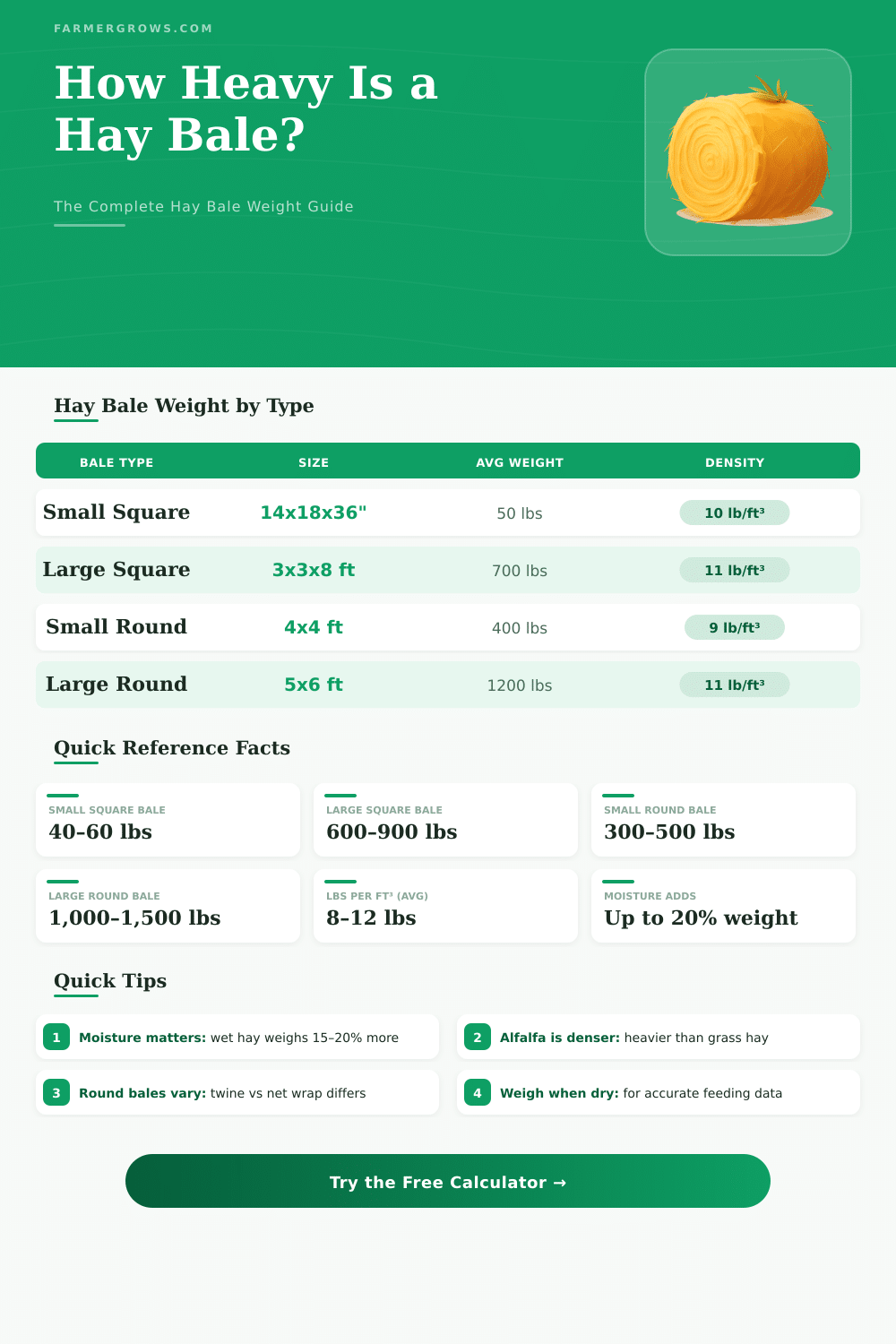
| Bale Type | Dimensions | Volume (ft³) | Avg Weight (lbs) |
|---|---|---|---|
| Small Square | 14"x18"x36" | 5.25 | 40–60 |
| Large Square 3x3x8 | 3x3x8 ft | 72 | 600–900 |
| Large Square 4x4x8 | 4x4x8 ft | 128 | 1,200–1,500 |
| Small Round 4x4 | 4 ft dia x 4 ft | 50.3 | 300–500 |
| Large Round 5x5 | 5 ft dia x 5 ft | 98.2 | 700–1,000 |
| Large Round 5x6 | 5 ft dia x 6 ft | 117.8 | 1,000–1,500 |
| Large Round 6x6 | 6 ft dia x 6 ft | 169.6 | 1,400–2,000 |
| Moisture Level | % Moisture | Weight Factor | Example (50 lb dry) |
|---|---|---|---|
| Bone Dry | 0% | 0.90x | 45 lbs |
| Dry Storage | 12–15% | 1.00x (base) | 50 lbs |
| Field Dry | 15–20% | 1.07x | 53.5 lbs |
| Slightly Wet | 20–25% | 1.14x | 57 lbs |
| Wet / Fresh | 25–30% | 1.22x | 61 lbs |
| Vehicle | Max Payload | Small Square Bales | Large Round Bales |
|---|---|---|---|
| Half-ton Pickup | 1,500 lbs | ~25–30 | 1 |
| 3/4-ton Pickup | 2,000 lbs | ~35–40 | 1–2 |
| 1-ton Pickup | 3,000 lbs | ~55–65 | 2–3 |
| Flatbed Trailer (20 ft) | 10,000 lbs | ~180–220 | 8–10 |
| Semi Flatbed | 48,000 lbs | ~800–1,000 | 40–48 |
| Animal | Daily Intake | Small Sq Bales/Day | Large Rnd Bales/Month |
|---|---|---|---|
| Horse (1,100 lb) | 22 lbs | ~0.4 | ~0.7 |
| Beef Cow (1,400 lb) | 28 lbs | ~0.5 | ~0.9 |
| Dairy Cow (1,500 lb) | 40 lbs | ~0.7–0.8 | ~1.3 |
| Sheep (150 lb) | 4 lbs | ~0.07 | ~0.13 |
| Goat (130 lb) | 3.5 lbs | ~0.06 | ~0.11 |
The Hay bale weight changes a lot based on the kind of hay itself and the method used to fill it. Here the little square bales clearly win because of their lightweight nature; they weigh between 40 and 75 pounds so you can easily lift one of them yourself, without needing help. And about big square or round bales?
Here start the truly heavy ones. One finds at least 500 pounds for the most lightweight, even so big round bales commonly reach 1,500 pounds or even more. Some of the most massive pass 2,000 pounds.
How Much Do Hay Bales Weigh and Why
The kind of hay that one gathers truly affects the weight. Alfalfa is denser and heavier than grasses like timothy or bermuda grass. Indeed, bales of timothy tend to be around 15% more lightweight than those of alfalfa, if they have the same size.
Grasses with two strings usually weigh from 45 to 55 pounds. Most ranchers that use average square bales, aim for 40 to 50 pounds each bale, and that stays pretty stable across various farms.
Moisture content is another big factor. Water adds to the Hay bale weight, so bales with more moisture will feel heavier. Even so, too much moisture causes trouble…
Mold and decay start quickly. The time hay dries under the sky, the moment of harvest and the place of storage all affect the final wait. The conditions during drying can change things a bit more than one would hope.
Round bales have various sizes. Bales of 4×5… So 4 feet wide and 5 feet diameter, usually weigh between 600 and 770 pounds.
If one goes to 4×6, the weight gets close to 1,250 pounds. Bales of 5×6 reach around 1,500 pounds. The usual sizes that appear commonly are 4×5, 4×6 and 5×6, with weights of around 880, 1,267 and 1,584 pounds.
Little bales go up to 4 feet wide by 5 feet diameter, while bigger machines reach up to 8 feet wide and 6 feet diameter.
The tension used when filling hay during baling changes the weight clearly. Bales filled loosely weigh around 9 pounds each cubic foot and give almost 880 pounds for dry material. If one stuffs denser, for instance 12 pounds each cubic foot, one gets almost 1,200 pounds of dry material.
More pressure in the baling process adds more, and new gear tends to press more tightly than old models.
Big square bales appeared soon after round bales became usual. They are similar in size and weight, but they handle more well the transfer of hay over long distances. The size, density and Hay bale weight of your bale affect the food value, themarket price, the costs for feeding and the ease to move or sell.
Even one foot difference in width or diameter changes the weight clearly. To get precise numbers, the best way is to weigh them on scales.