🌾 Hay Bale Storage Calculator
Calculate how many bales fit in your barn, shed, or storage area
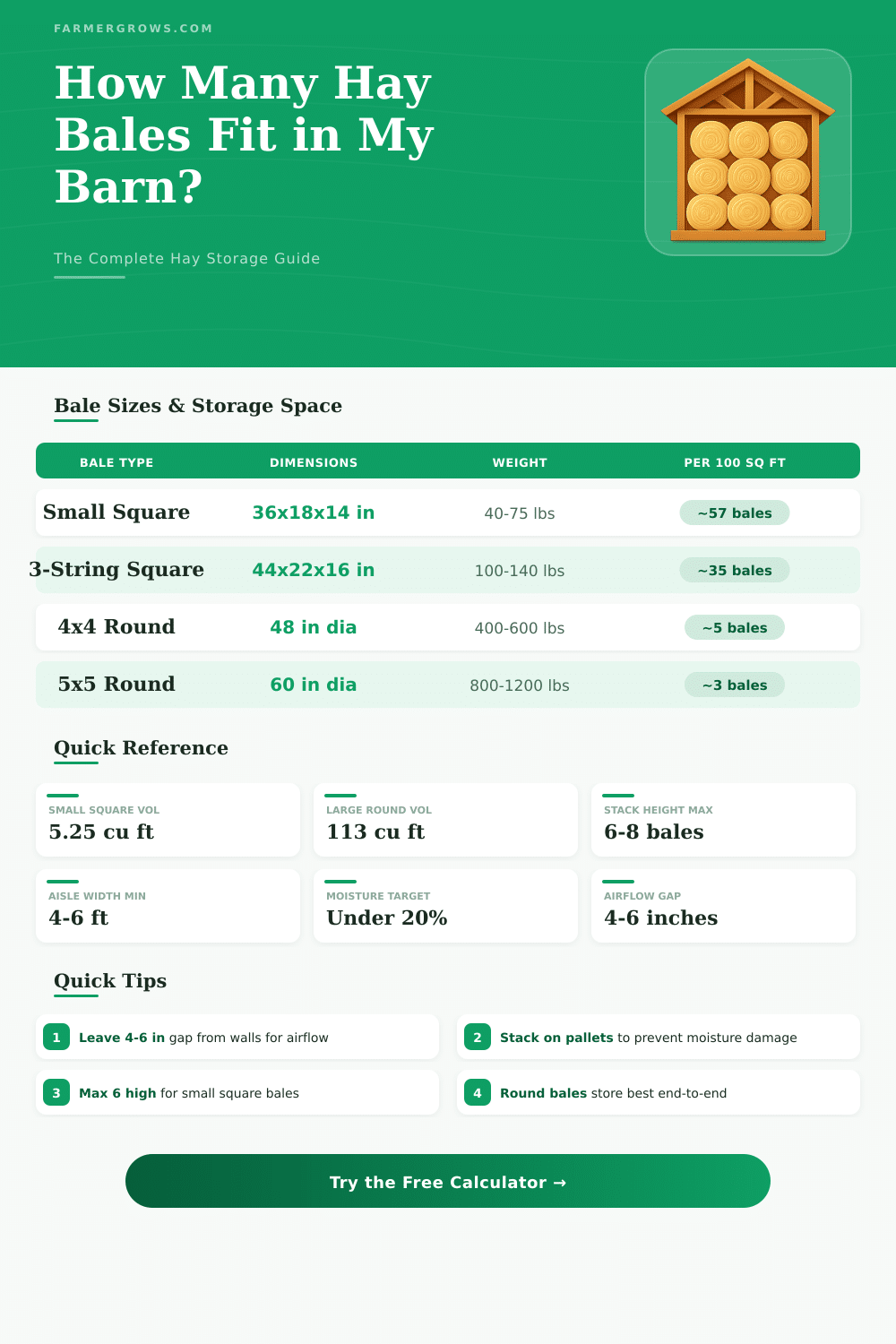
| Bale Type | Dimensions (in / ft) | Volume (cu ft) | Volume (m³) |
|---|---|---|---|
| Small Square | 36 × 18 × 14 in | 5.25 | 0.15 |
| 3-String Square | 44 × 22 × 16 in | 8.96 | 0.25 |
| Large Square 3×3×8 | 3 × 3 × 8 ft | 72.0 | 2.04 |
| Large Square 4×4×8 | 4 × 4 × 8 ft | 128.0 | 3.62 |
| Round 4×4 | 48 in dia × 48 in | 50.27 | 1.42 |
| Round 4×5 | 48 in dia × 60 in | 62.83 | 1.78 |
| Round 5×5 | 60 in dia × 60 in | 98.17 | 2.78 |
| Round 5×6 | 60 in dia × 72 in | 117.81 | 3.34 |
| Bale Type | Footprint (sq ft) | Per 100 sq ft (1 high) | Per 100 sq ft (m²) |
|---|---|---|---|
| Small Square | 1.75 (18×14 in) | 57 | 9.29 m² |
| 3-String Square | 2.44 (22×16 in) | 41 | 9.29 m² |
| Large Square 3×3×8 | 24.0 (3×8 ft) | 4 | 9.29 m² |
| Large Square 4×4×8 | 32.0 (4×8 ft) | 3 | 9.29 m² |
| Round 4×4 | 12.57 | 7 | 9.29 m² |
| Round 4×5 | 12.57 | 7 | 9.29 m² |
| Round 5×5 | 19.63 | 5 | 9.29 m² |
| Round 5×6 | 19.63 | 5 | 9.29 m² |
| Structure | Floor Area | Small Sq Bales (8 ft ceiling) | Round 5×5 Bales (1 high) |
|---|---|---|---|
| Small Shed 12×20 | 240 sq ft | ~775 | ~12 |
| Hay Shed 20×30 | 600 sq ft | ~1,940 | ~30 |
| Medium Barn 30×60 | 1,800 sq ft | ~5,810 | ~91 |
| Large Barn 40×80 | 3,200 sq ft | ~10,330 | ~163 |
| Horse Barn 36×72 | 2,592 sq ft | ~8,360 | ~132 |
| Hay Barn 60×120 | 7,200 sq ft | ~23,230 | ~366 |
| Bale Type | Max Safe Stack | Stack Height (ft) | Stack Height (m) |
|---|---|---|---|
| Small Square | 6–8 bales | 7–9.3 ft | 2.1–2.8 m |
| 3-String Square | 5–6 bales | 6.7–8 ft | 2.0–2.4 m |
| Large Square 3×3×8 | 3–4 bales | 9–12 ft | 2.7–3.7 m |
| Large Square 4×4×8 | 2–3 bales | 8–12 ft | 2.4–3.7 m |
| Round 4×4 | 1 (end-to-end rows) | 4 ft | 1.2 m |
| Round 5×5 | 1 (end-to-end rows) | 5 ft | 1.5 m |
| Round 5×6 | 1 (end-to-end rows) | 5 ft | 1.5 m |
The typical two-string square hay bale is small, that has only 36 by 18 by 14 inches and covers around 5.25 cubic feet. When one stacks loads of those tiny bales in a big barn, soon one reaches more than 5800 of them packed in that space. After checking several different designs for barns I found that 10-percent aisle reserve is the best solution.
It gives good freedom for moving, without removing too much of useful square footage.
Hay Bales: Types, Sizes, and Uses
Now round bales form a whole other issue. A heavy 5-foot unit can reach from 800 to 1200 pounds and require around 20 square feet on the floor. One can not really stack them, so the height of the ceiling does not matter too much.
The 4-foot round bales weigh a bit less, usually around 500 pounds and cover about 12.5 square feet. However the moisture content plays a decisive role. If it passes 20 percent, one risks real fire, literally.
I did not understand fully the weight of that, until I saw the data about fires in barns.
Hay ranks between those topics, that is much more complicated than most folks imagine. During travel through the countryside, big rectangular or round bales, scattered in the meadows, show commonly. Even so to hay belongs much more than meets the eye.
Between others, grassy hay like timothy belongs to the most spread kinds for animal feed. It usually sits at the bottom level for protein and energy, so one commonly advises it for horses, that does not require a lot of nutritious force or easily gets fat. Alfalfa forms another common choice, and mixes from alfalfa with grasses sell widely.
Two main kinds exist for rectangular bales: little squares and bigger three-string ones. Typical little squares measure around 14 inches high, 18 wide and 35 long, with weight between 40 and 75 pounds. They work well for tiny farms and solo horse owners, that can easily handle them.
Three-string bales are a bit bigger, with 21 inches wide, 16 high and 3 to 4 feet long, weighing around 100 pounds. Then appear the actual giants, big square bales, that range from 800 to 1500 pounds.
Round bales start at around 4 feet wide and 5 in diameter, while the biggest reach 8 feet wide and 6 high. The weight range is also wide, from 500 pounds up to 2500 for the most massive. Lightly filled 5-foot round bale stores around 880 pounds of dry material, while tightly pressed version takes almost 1200 pounds.
Farm business favors big bale types, because they prove more efficient for space and cost. One round bale matches roughly to 25 to 30 little squares, but costs only as 10 to 15 of those little. On the other hand, one requires heavy machinery to handle the loads.
Farmers aim to time the hay bale harvest exactly, when the seed heads are not too ripe, but the leaf growth reaches its peak. They allow the cut grass to dry on the field, to remove the biggest part of the water, even so preserve enough green matter, so that the machines can press everything in bales without problems. When hay dries too much, it becomes crumbly and breaks in sharp bits, real trouble for horses, because those sharp pieces can lodge in their mouths.
Besides only feeding animals, hay bale uses served many other practical goals. Hay bale gardening works, in that one sets the center of the bale with nitrogen-rich compost and later grows vegetables directly in it. Some gardeners even manage to recycle the same bale during two seasons.
Straw bales work for such uses also, for instance for growing potatoes. And square hay bales can serve doubly as insulation, by setting them around a well to protect water pumps against cold in winter.