🌿 Greenhouse Fan Size Calculator
Calculate the exact CFM rating and fan size your greenhouse needs for proper ventilation
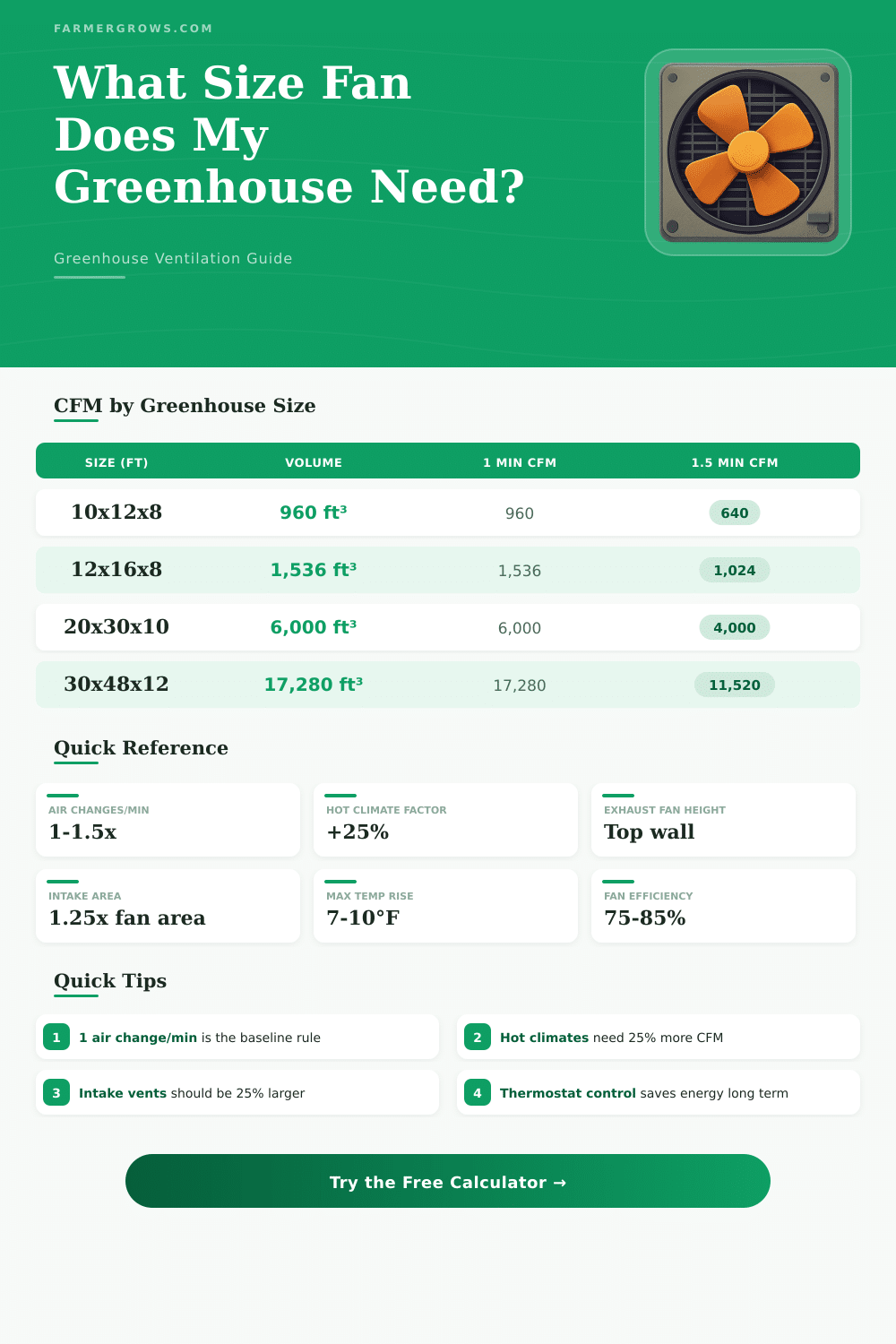
| Greenhouse (ft) | Volume (ft³) | 1.0x CFM | 1.5x CFM (Hot) |
|---|---|---|---|
| 8×10×7 | 560 | 560 | 840 |
| 10×12×8 | 960 | 960 | 1,440 |
| 12×16×8 | 1,536 | 1,536 | 2,304 |
| 14×20×9 | 2,520 | 2,520 | 3,780 |
| 20×30×10 | 6,000 | 6,000 | 9,000 |
| 24×40×10 | 9,600 | 9,600 | 14,400 |
| 30×48×12 | 17,280 | 17,280 | 25,920 |
| 30×96×14 | 40,320 | 40,320 | 60,480 |
| Climate Zone | Multiplier | Typical Region | Max Summer Temp |
|---|---|---|---|
| Cool / Northern | 0.75x – 1.0x | PNW, UK, Northern EU | 75–85°F (24–29°C) |
| Moderate / Temperate | 1.0x – 1.25x | Mid-Atlantic, Central EU | 85–95°F (29–35°C) |
| Hot / Southern | 1.25x – 1.5x | Southeast US, Mediterranean | 95–105°F (35–40°C) |
| Extreme / Desert | 1.5x – 2.0x | Southwest US, Middle East | 105°F+ (40°C+) |
| Fan Diameter | Typical CFM | Coverage (ft³) | Watts |
|---|---|---|---|
| 8 in (20 cm) | 500–800 | Up to 800 | 40–65 |
| 12 in (30 cm) | 800–1,400 | 800–1,400 | 60–120 |
| 16 in (41 cm) | 1,400–2,500 | 1,400–2,500 | 100–200 |
| 20 in (51 cm) | 2,500–4,500 | 2,500–4,500 | 180–350 |
| 24 in (61 cm) | 4,500–7,500 | 4,500–7,500 | 300–550 |
| 30 in (76 cm) | 7,500–12,000 | 7,500–12,000 | 500–750 |
| 36 in (91 cm) | 10,000–18,000 | 10,000–18,000 | 700–1,100 |
| 48 in (122 cm) | 18,000–30,000 | 18,000–30,000 | 1,000–1,800 |
| Fan Type | Best Use | Typical CFM Range | Efficiency |
|---|---|---|---|
| Exhaust (Wall-Mount) | Primary ventilation | 800–30,000 | 75–85% |
| Circulation (HAF) | Air mixing inside | 400–5,000 | 80–90% |
| Evaporative Cooling | Temp + humidity control | 2,000–25,000 | 70–80% |
| Motorized Inlet | Fresh air intake | 500–8,000 | 70–80% |
| Roof Vent | Hot air escape at ridge | 1,000–10,000 | 65–75% |
| Shutter Exhaust | Wall exhaust with louvers | 1,000–15,000 | 70–80% |
| Inline Duct | Ducted ventilation runs | 200–3,000 | 65–80% |
| Portable Box | Temporary / backup | 200–2,500 | 50–65% |
The standard greenhouse ventilation guideline is to exchange the entire air volume once per minute (1.0x air change rate). In hot climates or full-sun locations, increase this to 1.25x–1.5x. For cool or shaded greenhouses, 0.75x can be sufficient. Always size fans slightly larger than the calculated minimum.
Intake vent or louver area should be at least 1.25 times the exhaust fan opening area. For a 24-inch exhaust fan (about 3.14 ft² opening), provide at least 3.93 ft² of intake area. Undersized intakes reduce fan efficiency by 10–25% and create negative pressure problems.
Greenhouse ventilation runs on one core number: CFM, which stands for cubic feet per minute. Ive found that the 1x volume per minute rule holds up well for most setups around 75 to 85 degrees Fahrenheit.
The information below does not come from some computer program or tool used on that page. It bases on actual knowledge from looking back, discussions in forums and experiences of the community, that one finds everywhere on the net.
How to Move Air in a Greenhouse
Keeping the right heat and humidity in greenhouse are truly dangerous. One can use ceiling, standalone or wall fan units to create fresh wind, that helps to keep those conditions. Without good air move, the plants hardly manage, and problems like mold can appear very quickly.
Even a simple cheap USB fan in the greenhouse setup already suffices to almost fully remove the mold, that grows on home greenhouse mixes.
fan units for circulation rank between the most important tools for greenhouse. They commonly call horizontal air-moving fan units or HAF fan units. Those devices ensure equal heat through the whole space and make stable flow of air.
Their blades twist without resistance against static pressure and were designed to push the air through the vents. Because of the moving air around, they remove warm and cold spots, reduce moisture and bring freshness to the plants. The air motion also well spreads the heat, what helps to even growth of the crops.
For greenhouses there are fan units with heat control. Such a tool helps to keep the room fresh and well aired for the plants. A thermostat ruled blower, combined with solar panels and a small inverter, can give reliable service, similar too an attic fan.
Blowers one installs in greenhouses to push the warm air out. That forms vacuum, that draws fresh air inward through vents or intakes. There exists a model of fan with three speeds, that reaches 2950, 2050 and 1200 CFM.
In the highest speed it suffices to exchange the air in greenhouse twice in a minute. One lays that fan in the upper part of the end wall. A six-inch or eight-inch blower with flexible pipeline is another option.
The eight-inch model gives around 720 CFM and has adjustable control for speed. In full speed in an eight-foot greenhouse, it clearly sucks air from the sides of thebuilding.
There is no perfect rule for ventilation, but too much air move is almost impossible. When one plans to grow in summer, the heat becomes the biggest obstacle. To reach maximum air flow matters to use active blowers together with shade, that is the best way.
Solar powered fan units are very liked. A 15-watt solar panel grabs the energy of the sun and delivers electricity directly from light, what helps to save on bills during the whole year and promises use more than ten years. There are solar powered intake fan units, hybrid solar intake fan units, electrical intake fan units and solar powered exhaust fan units.
Combine a solar powered fan with a matching thermostat and intake beside the floor can more quickly cool the greenhouse in the evening, although temperatures outside above 97 degrees stay hard to control.
When exhaust fan units operate, one should turn the circulators, so that they do not mix the air flow. Laying insect netting on the outside of the intake is good to stop insects from entering. In bigger setups, build an arch outside of the intake, covered with insect netting, to expand the whole surface.
The usage of fan units overnight depends on the local climate. In some places you do not need to turn them overnight. In other parts, leaving them work overnight helps against sweating and dripping.
It is more well to turn and switch the fan than leave it permanently, because otherwise more rust happens and the device quickly fails. Contact with rain can rust the main parts, so maybe you need a cover or gateway.
A wet wall system is another way to cool. It works like flooded fresh air on steroids. One wall has cushions, that pour, and fan units draw the wet air through the greenhouse.
Even so in wet regions it does not work well. More small openings in the wall give less wind. In a 30-by-96-foot greenhouse with two 36-inch half horsepower fan units one can move around 20,616 CFM of air.
Good air flow is important for health and growth of plants, and much more than simply opening an intake or laying a fan in the room.