🪨 Gravel Under Concrete Slab Calculator
Calculate exactly how much gravel base material you need for your concrete slab project
lbs / cu yd
lbs / cu yd
lbs / cu yd
lbs / cu yd
lbs / cu yd
lbs / cu yd
lbs / cu yd
lbs / cu yd
| Depth | Sq Ft Covered | Sq Meters Covered | Cu Yds per 100 sq ft |
|---|---|---|---|
| 1 inch (2.5 cm) | 324 sq ft | 30.1 m² | 0.31 |
| 2 inches (5 cm) | 162 sq ft | 15.1 m² | 0.62 |
| 3 inches (7.6 cm) | 108 sq ft | 10.0 m² | 0.93 |
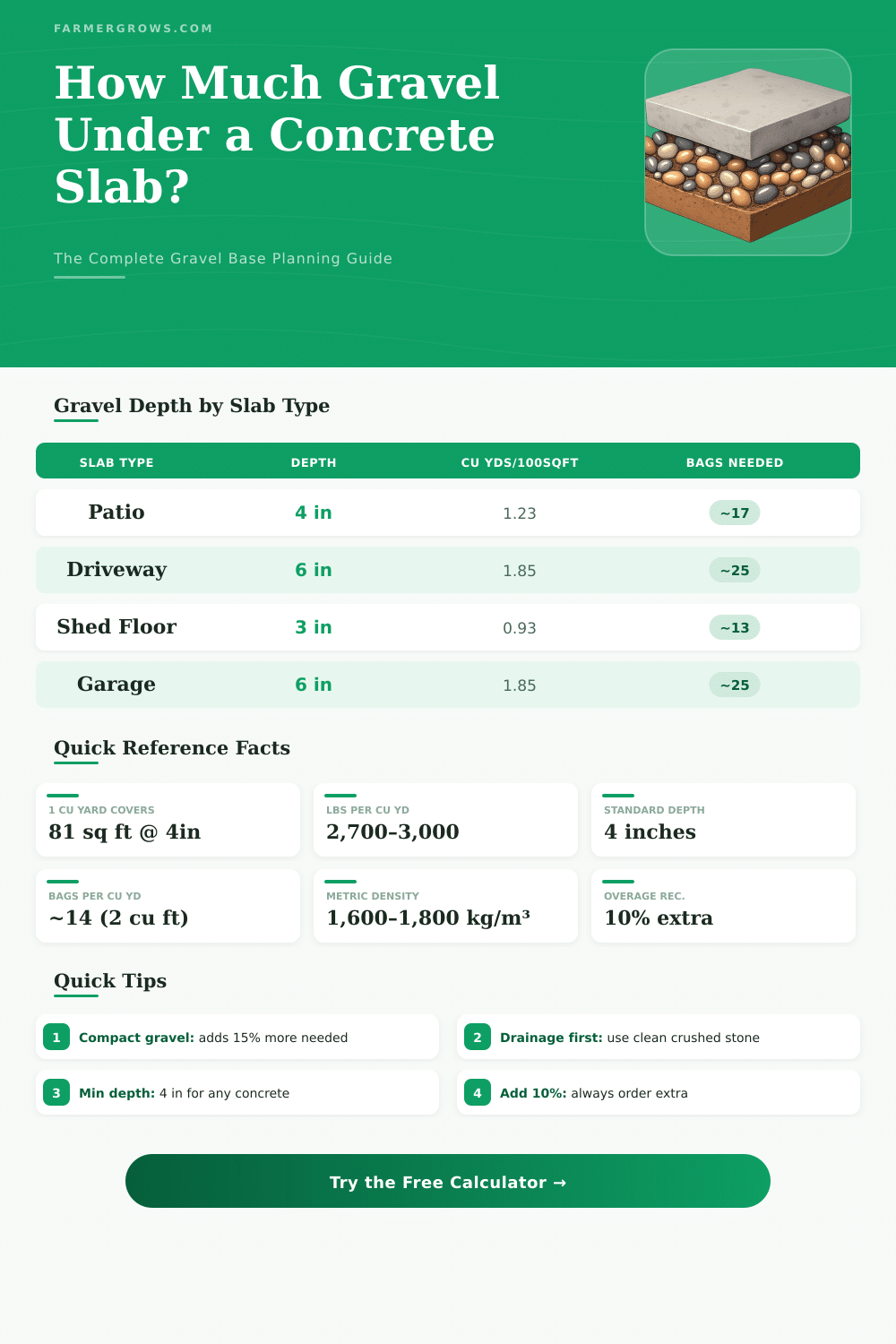
| 4 inches (10 cm) | 81 sq ft | 7.5 m² | 1.23 |
| 6 inches (15.2 cm) | 54 sq ft | 5.0 m² | 1.85 |
| 8 inches (20.3 cm) | 40.5 sq ft | 3.8 m² | 2.47 |
| 12 inches (30.5 cm) | 27 sq ft | 2.5 m² | 3.70 |
| Bag Size | Volume per Bag | Bags per Cu Yd | Coverage @ 4 in depth |
|---|---|---|---|
| 0.5 cu ft bag | 0.5 cu ft | 54 bags | 1.5 sq ft |
| 1 cu ft bag | 1 cu ft | 27 bags | 3 sq ft |
| 2 cu ft bag | 2 cu ft | 13.5 bags | 6 sq ft |
| 3 cu ft bag | 3 cu ft | 9 bags | 9 sq ft |
| 1 ton (bulk) | ~0.67 cu yd | — | ~54 sq ft @ 4 in |
| 1 cu yd (bulk) | 27 cu ft | — | 81 sq ft @ 4 in |
| Project | Typical Area | Cu Yds @ 4 in | Bags @ 4 in (2 cu ft) |
|---|---|---|---|
| Small Patio | 120 sq ft | 1.48 | ~20 |
| Single-Car Driveway | 240 sq ft | 2.96 | ~40 |
| Shed Floor (8x10) | 80 sq ft | 0.99 | ~14 |
| Garage (20x20) | 400 sq ft | 4.94 | ~67 |
| 2-Car Garage (20x24) | 480 sq ft | 5.93 | ~80 |
| Sidewalk (4x50) | 200 sq ft | 2.47 | ~34 |
| Pool Deck (15x30) | 450 sq ft | 5.56 | ~75 |
| Large Workshop | 576 sq ft | 7.11 | ~96 |
The gravel is genuinely a central part of the concrete work, and it matters a lot to understand, as it operates in building drafts. One commonly hears it called also aggregate; it is the same cause. Here the spot however: the mixes of concrete fit to various situations hence the size of gravel and its makeup depends on that, what one builds.
The most many pre-mixed concrete mixes are made up of Portland cement, sand and various kinds of gravel or stones. Standard choice gives around 4 000 PSI pressing strength and works for general concrete builds and repair works, without too much effort. Mix of sand and gravel, sometimes called tricky mix, combines pure sand with graded gravel in pre-mixed bags.
Gravel in Concrete: Types and Uses
One finds it in several types, with sizes of gravel as 3/8 inches or 1 inch. For structural work, 20 mm gravel is the usual default, but 10 mm gravel is used sometimes, when one needs stronger coevring of rebar than normally.
Here where it becomes interesting: cement powder itself mixed only with water? That simply is cement. The powder is made up of silica,ite ash and calcium oxide, mixed together.
Now add a bit of sand and gravel to that cement mix and it starts to act (you have concrete). That difference folks commonly no quite a lot notice, but it genuinely matters.
The layer of gravel under a concrete slab can be the most important element for a foundation, that genuinely will last. The soil moves everywhere almost all the time, so gravel stabilises everything before shedding something. It cares also about drainage, so that water does not stay under the fresh concrete.
Clean and draining base stops moisture, that would cause failure or motion, that would crack your concrete slab. Crushed stone number 57, around three-quarter inch, is that, what the most many use, because concrete slabs stand flat on those angled bits, that fill the bottom. While preparing the place, one must dig quite deep to have four to six inches of packed gravel plus the thickness of the concrete slab.
Gravel works also as cheap filler, that almost packs itself and creates a firm base for concrete. One needs solid raw ground and enough stones to fill and level everything well. From my experience, five-inch concrete slab with six-inch mesh stands very well.
Sealing of concrete after pouring certainly extends its life.
Besides concrete, gravel is used in many other places. Banking gravel mixes big rocks, little rocks, sand and clay. It drains the water very well, which stops erosion and helps the plants grow.
All-use gravel works for landscaping, gardens, terraces, walkways, fish floors and aquariums. Crushed stone is made in factories, while natural gravel has smooth, rounded edges and usually comes from rivers ore streambeds. Aggregate is the general term, that covers sand, gravel and crushed stone in construction.
Having your own source of gravel spares a lot of money. Dry Portland cement in bags costs around five dollars each unit, and five bags give one cubic yard. That is about twenty-eight dollars per yard, compared toprice of pre-mixed concrete.