🌱 Grass Dirt Calculator
Find exactly how much soil you need to grow a healthy lawn
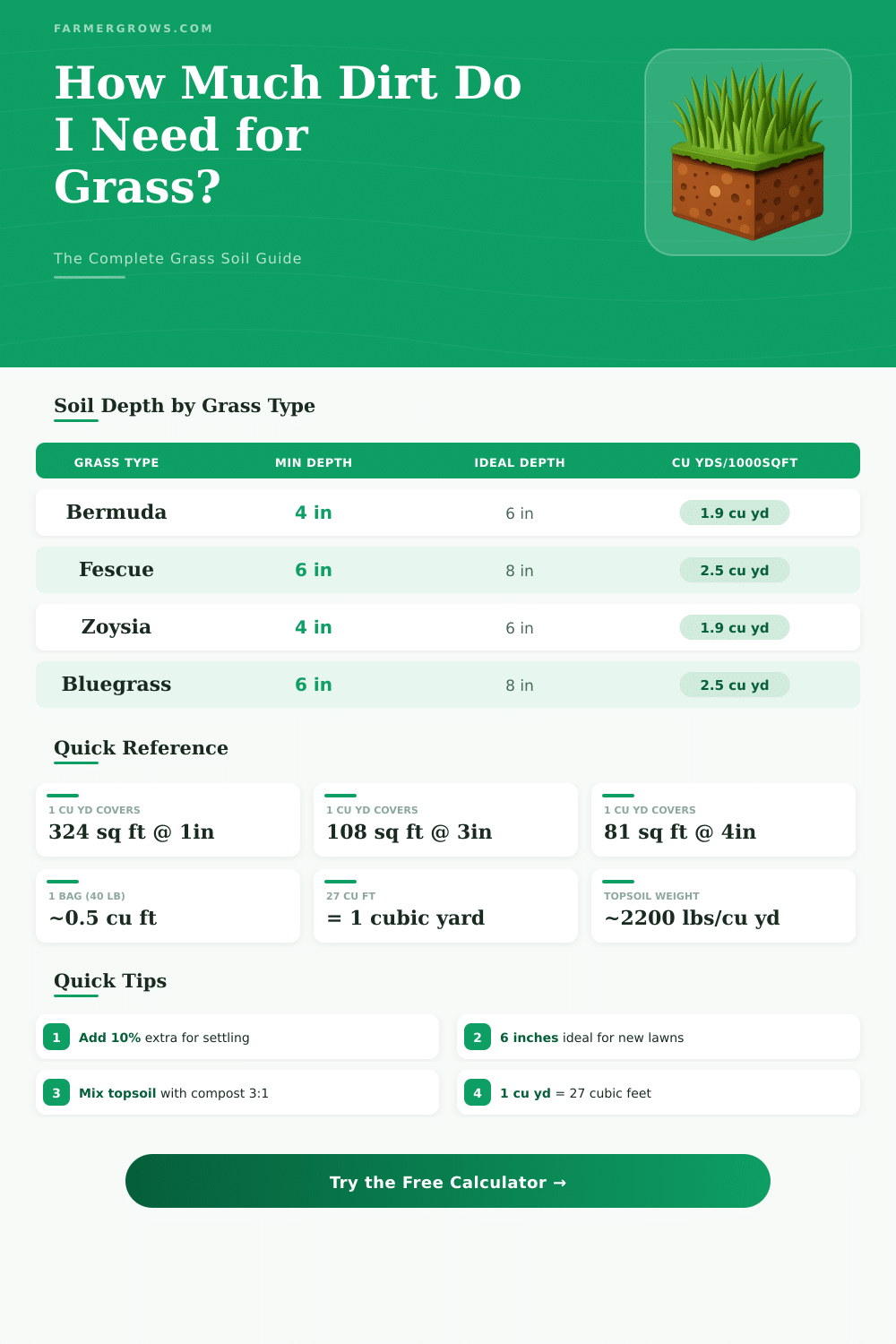
| Depth | Sq Ft Covered | Sq Meters Covered | Cu Ft per Cu Yd |
|---|---|---|---|
| 1 inch (2.5 cm) | 324 sq ft | 30.1 m² | 27 cu ft |
| 2 inches (5 cm) | 162 sq ft | 15.1 m² | 27 cu ft |
| 3 inches (7.6 cm) | 108 sq ft | 10.0 m² | 27 cu ft |
| 4 inches (10 cm) | 81 sq ft | 7.5 m² | 27 cu ft |
| 6 inches (15 cm) | 54 sq ft | 5.0 m² | 27 cu ft |
| 8 inches (20 cm) | 40.5 sq ft | 3.8 m² | 27 cu ft |
| 12 inches (30 cm) | 27 sq ft | 2.5 m² | 27 cu ft |
| Bag Size | Volume per Bag | Bags per Cu Yd | Coverage @ 3 in |
|---|---|---|---|
| 0.75 cu ft bag | 0.75 cu ft | 36 bags | 3 sq ft |
| 1 cu ft bag | 1 cu ft | 27 bags | 4 sq ft |
| 1.5 cu ft bag | 1.5 cu ft | 18 bags | 6 sq ft |
| 2 cu ft bag | 2 cu ft | 13.5 bags | 8 sq ft |
| 3 cu ft bag | 3 cu ft | 9 bags | 12 sq ft |
| Bulk 1 cu yd | 27 cu ft | 1 yard | 108 sq ft |
| Project | Area | Cu Yds @ 4 in | 2 cu ft Bags |
|---|---|---|---|
| Small Patch | 200 sq ft | 2.5 cu yd | 34 bags |
| Front Lawn | 1,000 sq ft | 12.3 cu yd | 166 bags |
| Average Yard | 2,500 sq ft | 30.9 cu yd | 417 bags |
| Large Yard | 5,000 sq ft | 61.7 cu yd | 833 bags |
| Half Acre | 21,780 sq ft | 269 cu yd | 3,631 bags |
| Full Acre | 43,560 sq ft | 538 cu yd | 7,260 bags |
For a brand new grass installation, aim for at least 6 inches of quality topsoil or loam. Grass roots need room to anchor and access water — shallow soil leads to patchy, drought-stressed lawns.
If you need more than 2 cubic yards, ordering bulk delivery is far more efficient than bags. One cubic yard equals 13.5 bags of 2 cu ft soil — buying bulk for large lawns saves time and effort significantly.
Grassy dirt forms a main theme for each that wants to grow a green lawn. The best dirt for grasses is loam type. That loam dirt drains water well and stays lightweight, while it keeps enough nutrients for feeding of the grass.
Ideal pH level for such dirt sits between 6.5 and 7.0. Most grasses and garden plants like a bit sour ground. Scale of ground pH goes from 0 to 14 where 7 marks neutral.
Best Soil for a Green Lawn
Everything under 7 makes it sour, and above 7 is alkaline.
Loam dirt with around 40% sand, 40% silt and 20% clay by weight works best for growth of grasses. Eveness of loam often creates troubles. If one gets it and spreads equally, the grass will look even through the whole yard, rather than in patchy areas, where it can suffer.
grass can grow on almost every kind of dirt. It even succeeds in almost pure sand, if one adds dressing. Also in strongly packed ground, that lasts heavy truck without traces of wheels, grass finds way.
Species, that adapt to bare, dense, poor or dry surroundings, usually have deep or efficient roots, low feeding needs, resistance against pH extremes and slow growth, what reduces knead of dressing.
Topsoil can provide all basic needs for fresh grass. General rule suggests to use it for the upper 3 to 6 inches of the lawn. Even so too much topsoil creates soft spots and uneven areas, that help funguses, mold and unwanted grasses.
Lawn dirt often helps to fill big holes or level ground at buildings. If one lays it more than 2 inches deep, it packs easily. Smaller amounts work more well.
Three or four inches fully will kill already growing grass, but under one inch it probably will last.
Top dressing means to add a thin layer of dirt above existing grass. Main key is apply only quarter to half of an inch. Thicker layers can choke the grass.
For lawns one avoids garden dirt. It carries too much organic matter and holds water, what often causes rot, that kills grass, especially young grass. Big difference exists between dirt and real soil.
Mix of 50% dirt and 50% compost works well for filling empty spots.
When you prepare ground for sowing of grass, plants or stones, dig it to 3 inch depth. Rake to remove stones and smooth the surface. Mix in compost, topsoil and starter dressing, then work them in the dirt.
For overseeding of lawn, mix from 75% topsoil and 25% peat forms good balance. At warm season grasses, ground temperatures must stay above 65 degrees always before sowing. Heavy clay dirt responds well to organic additions.
Covering it with at least one inch ofmulch for around 3 months, you do one of the most useful steps for improving it.