🌾 Grain Bin Calculator
Calculate grain bin storage capacity in bushels, cubic feet & metric tonnes
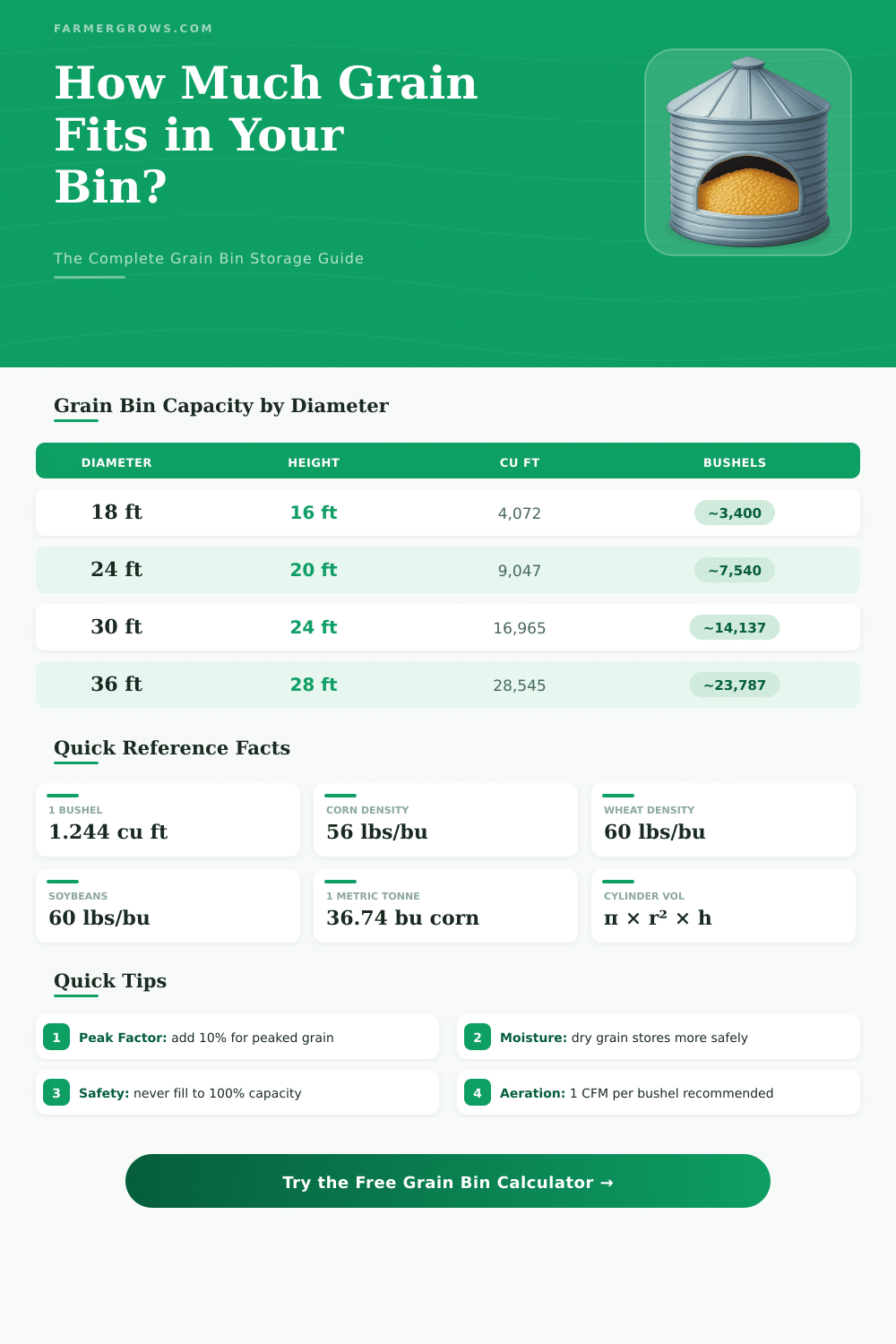
| Diameter | Eave Ht | Cu Ft | Bushels (Corn) | Bushels (Wheat) | Metric Tonnes (Corn) |
|---|---|---|---|---|---|
| 15 ft | 12 ft | 2,120 | 1,764 | 1,882 | 44.8 |
| 18 ft | 16 ft | 4,072 | 3,388 | 3,613 | 86.0 |
| 21 ft | 18 ft | 6,237 | 5,190 | 5,535 | 131.7 |
| 24 ft | 20 ft | 9,047 | 7,527 | 8,029 | 191.0 |
| 27 ft | 22 ft | 12,629 | 10,506 | 11,208 | 266.7 |
| 30 ft | 24 ft | 16,965 | 14,114 | 15,055 | 358.3 |
| 36 ft | 28 ft | 28,545 | 23,757 | 25,340 | 603.0 |
| 48 ft | 36 ft | 65,144 | 54,202 | 57,839 | 1,376 |
| Grain Type | Lbs / Bushel | Cu Ft / Bushel | Bu / Cu Ft | Kg / Bushel | Bu / Tonne |
|---|---|---|---|---|---|
| Corn (Maize) | 56 | 1.2445 | 0.8036 | 25.4 | 39.37 |
| Wheat | 60 | 1.2445 | 0.8036 | 27.2 | 36.74 |
| Soybeans | 60 | 1.2445 | 0.8036 | 27.2 | 36.74 |
| Barley | 48 | 1.2445 | 0.8036 | 21.8 | 45.93 |
| Milo / Sorghum | 56 | 1.2445 | 0.8036 | 25.4 | 39.37 |
| Oats | 32 | 1.2445 | 0.8036 | 14.5 | 68.89 |
| Canola | 50 | 1.2445 | 0.8036 | 22.7 | 44.09 |
| Sunflower | 25 | 1.2445 | 0.8036 | 11.3 | 88.18 |
| Bin Size | Shape | Cu Ft | Corn (bu) | Wheat (bu) | Metric (m³) |
|---|---|---|---|---|---|
| 18 ft x 16 ft | Round | 4,072 | 3,271 | 3,270 | 115 |
| 24 ft x 20 ft | Round | 9,047 | 7,271 | 7,271 | 256 |
| 30 ft x 24 ft | Round | 16,965 | 13,632 | 13,632 | 480 |
| 36 ft x 28 ft | Round | 28,545 | 22,946 | 22,946 | 808 |
| 20 x 30 x 15 ft | Rect | 9,000 | 7,232 | 7,232 | 255 |
| 40 x 50 x 20 ft | Rect | 40,000 | 32,143 | 32,143 | 1,132 |
Grain bin is made up of big round buildings, that serve for storage of dry crops like wheat, beans, corn, oats barley and rice. This kind of bins forms from curved metal sheets, covered by a cone-shaped roof from metal, that can be opened. They were designed for guarding the contents against humidity, pests and decay.
The grain can be preserved here for some weeks or even years, until the time to sell it in the market.
Grain Bins: Types, Uses and Safety
Compared to silos, Grain bin usually are lower, broader and more well aired. Silos are used for sealed storage of silage, that is fed to the animals. One must consider those differences, when one chooses a method for keeping.
Bins with flat base work for long storage of grain, and they operate for small farms as well as for big commercial businesses, that handle volumes of one kind of crop. They cost little and are reliable. They come in various sizes, for instance 25,000, 50,000 or 100,000 bushel capacities, and sometimes include help for the assembly.
One spot about those bins with flat base is, that around 10 to 15 percent of teh content can stay inside for more time and need to be removed.
Bins with cone-shaped bottom is another model. They were designed for simple loading and good cleaning. That style best suits for medium-term keeping, commonly moving grain or careful storage of feed.
For farms, that deal with picked seeds, those bins with cone-shaped bottom commonly is the best option.
Some Grain bin carry dryers inside the bin to lower the humidity in the grain. Airing matters, because the grain commonly enters warm. Pests can become a problem, what sometimes requires fumigation.
For grain, that is preserved during months or even years, airing and control of temperature is entirely necessary.
Stored grain can bee very flammable and release explosive gases. Many fires and accidents with Grain bin happened during the years, what caused rules about safety. Important risk is the bridging of grain, when the upper layer becomes smooth and solid.
Walking on it can break the loose layer, what causes falling through it and choking. Entering a full Grain bin without safe tools is truly dangerous.
A well built bin can serve up to 30 years, if one cares for it correctly. Moisture over 14 percent causes buildup on the walls. Bins with stiffened structure use very thin panels with stiffeners, that take the tension, while average farm bins use sheets, that become thicker below.
Storage on the farm helps for more income. Sale during the harvest commonly must accept discount, because customers pay less based on weight, humidity or other things. Owning bins means to keep the grain more long and sell it for higher prices.
Some farmers even repaid the bins from one single harvest, when the market was good. The setup cost is around four dollars per bushel. Grain bin are also recycled nicely forhouses or little buildings.