🌱 Garden Yield Calculator
Estimate harvest from any garden plot — enter your dimensions, crop type & spacing for accurate yield predictions
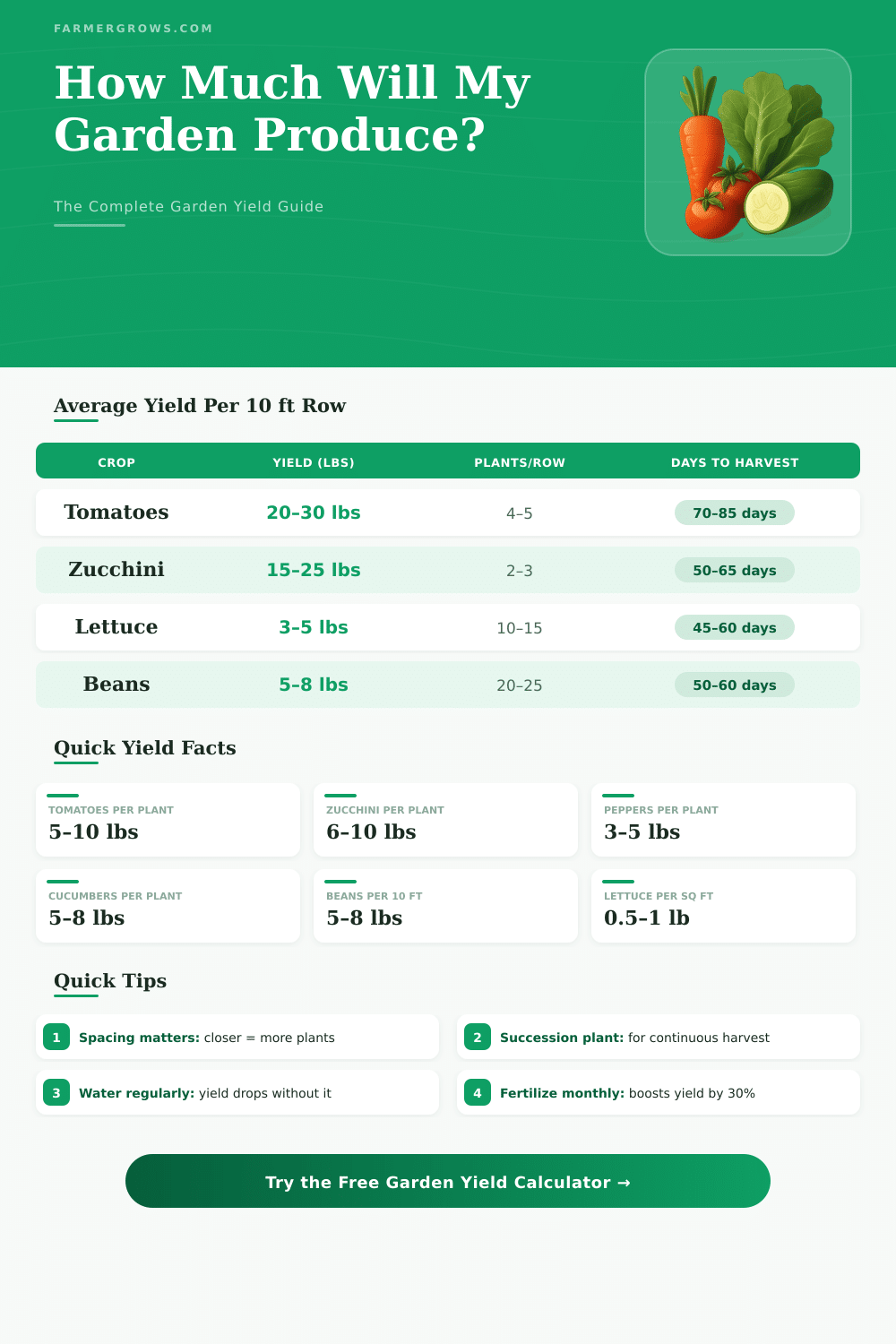
| Crop | Spacing (in) | Plants / 10 sq ft | Yield / 10 sq ft (lbs) | Days to Harvest |
|---|---|---|---|---|
| Tomatoes | 24 | 2 | 10–20 | 70–85 |
| Zucchini | 36 | 1 | 6–10 | 50–65 |
| Peppers | 18 | 4 | 12–20 | 60–90 |
| Cucumbers | 12 | 8 | 40–64 | 55–65 |
| Green Beans | 6 | 26 | 13–21 | 50–60 |
| Lettuce | 6 | 26 | 13–26 | 45–60 |
| Spinach | 4 | 56 | 14–28 | 40–50 |
| Kale | 12 | 10 | 10–20 | 55–75 |
| Carrots | 3 | 160 | 40–60 | 70–80 |
| Potatoes | 12 | 10 | 20–40 | 70–120 |
| Crop | Plants / Sq Ft | Yield / Sq Ft (lbs) | Yield / 4x8 Bed (lbs) |
|---|---|---|---|
| Lettuce | 4 | 0.5–1.0 | 16–32 |
| Spinach | 9 | 0.5–0.75 | 16–24 |
| Carrots | 16 | 0.5–0.75 | 16–24 |
| Onions | 16 | 0.3–0.5 | 10–16 |
| Kale | 1 | 1.0–2.0 | 32–64 |
| Beans (bush) | 9 | 0.5–0.75 | 16–24 |
| Peppers | 1 | 0.75–1.25 | 24–40 |
| Tomatoes | 1 | 1.25–2.5 | 40–80 |
| Garden Size | Area (sq ft) | Mixed Yield (lbs) | Metric Area (m²) |
|---|---|---|---|
| Window Box | 6 | 3–6 | 0.56 |
| 4x8 Raised Bed | 32 | 20–50 | 3.0 |
| 10x10 Plot | 100 | 60–120 | 9.3 |
| 10x20 Plot | 200 | 120–250 | 18.6 |
| 20x30 Plot | 600 | 350–700 | 55.7 |
| 50x50 Plot | 2500 | 1500–3000 | 232 |
How many food one receives from garden depend on several factors. The size of the area itself the efficiency of your farming, the quality of the ground, the weather, that it throws against you, and the skill of every plant produce actually, everything this matters. Focusing on the basics and choosing wisely from the start, one does all the difference for the final harvest.
Tomatoes are one from the simplest ways to reach big amounts of product. One small plant cost around three dollars, and after three months you have plenty of ripe tomatoes from that single plant. No bad cost for such prize.
How to Get More Vegetables from Your Garden
Types of cherry tomatoes and grape tomatoes especially like to produce wildly. They grow compact and well adapt, whether planted in soil or in fixed jar on balcony or terrace. They only require privacy.
Here something notable: one healthy tomato plant in limited space almost always surpass two slim plants, that struggles because of same resources, and the fruits come more quality.
Beans and squash forms the main successes for Garden yield. Pole beans surpass bush beans according to total amount, although they require something to climb. They continuously give harvests during months, starting in around 60 days after crop and lasting until cold halt everything.
Good pole bean plant gives around 20 harvests at once, maybe more. Bush beans allow four plnats in square foot, while pole beans enter six until eight in same area. Squash?
Here everything becomes wild. Plant of five seeds during two seasons gives at least 18 squash, weighing almost 100 pounds of product.
Bell peppers are truly hard workers in the field of amounts. In warmer regions as Alabama, they produce fruits from June until October, with some plants reaching 30 or more peppers each. Everything that well works for cut, stuff either freeze for longer use.
Peas offer another good idea, they are seasonal vegetables and very productive, if one harvests regularly. Sugar snap-peas especially give wonderful results regarding the little space, that they involve.
Ground ends most important more then almost everything else in that equation. Plants benefit in healthy soil, problems with pests disappear, and production follows naturally. Prepare compost and mix it in your beds give to vegetables the food, that they require to grow big and give more.
Add organic aids in addition strengthen the gift. Raised beds filled with rich ground is good strategy. Build the ground right and place plants in triangles instead of lines can give better results.
Thinning small plants and trimming them help a lot. Remove extra small plants and cut back plants open space for better flow of air and light. Beans and peas give fruits as soon as they ready and prepare for new round soon.
Grow up instead of along the ground spare useful area during production stay high. Rotation of crops is not optional. Plant in same place year after year weaken your amounts over time.
Mix plants around and avoidcoming back to same spot during three years help to stop whole problems.