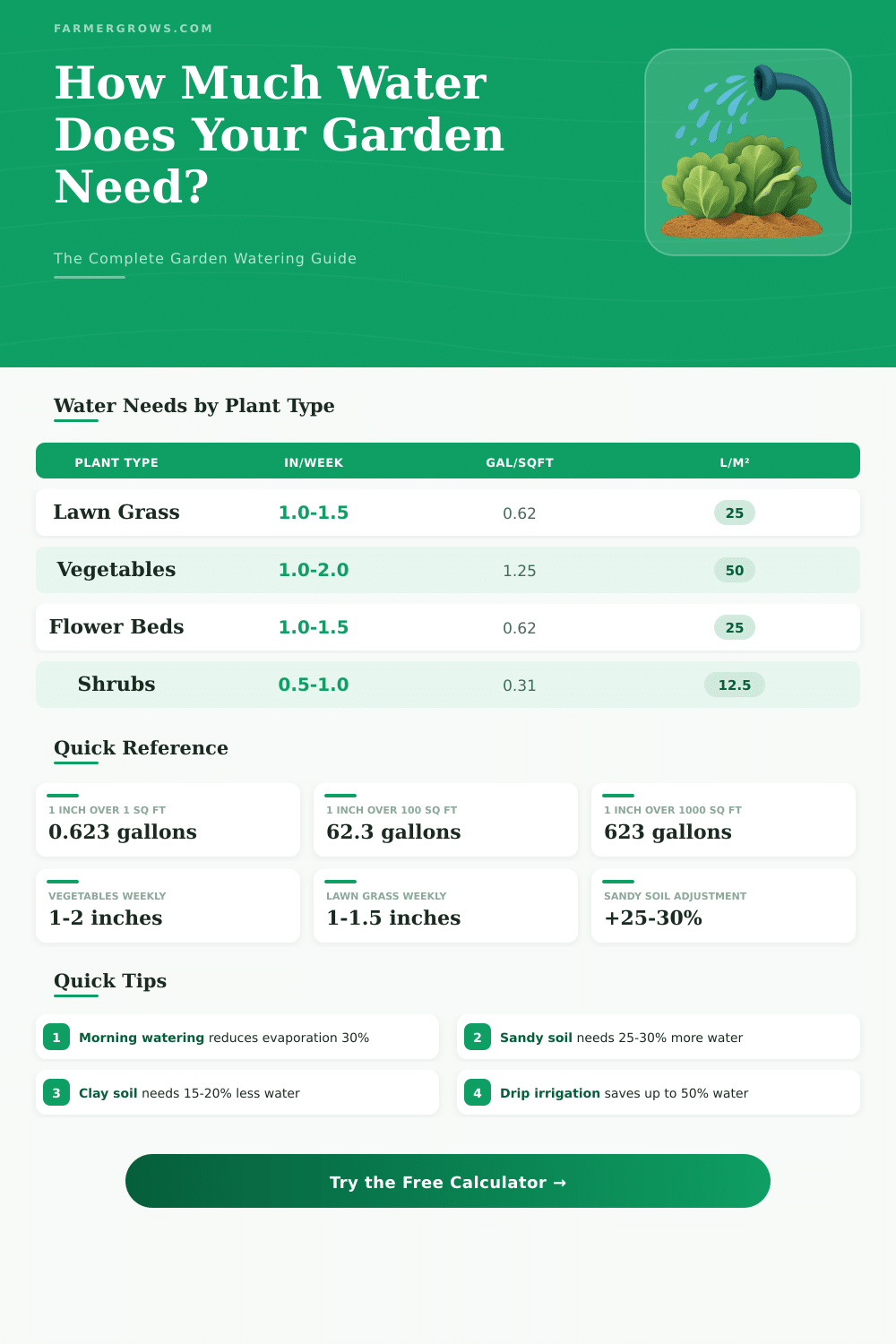
💧 Garden Water Usage Calculator
Calculate exactly how much water your garden needs per week, month, and season
| Depth (in) | Gal / sq ft | Liters / m² | Gal / 100 sq ft |
|---|---|---|---|
| 0.25 | 0.156 | 6.35 | 15.6 |
| 0.50 | 0.312 | 12.71 | 31.2 |
| 0.75 | 0.468 | 19.06 | 46.8 |
| 1.00 | 0.623 | 25.37 | 62.3 |
| 1.25 | 0.779 | 31.73 | 77.9 |
| 1.50 | 0.935 | 38.08 | 93.5 |
| 2.00 | 1.247 | 50.79 | 124.7 |
| Method | Efficiency | Water Multiplier | Best For |
|---|---|---|---|
| Drip Irrigation | 90–95% | 1.05× | Beds, rows, containers |
| Soaker Hose | 80–90% | 1.15× | Borders, hedges, beds |
| Hand Watering | 70–85% | 1.25× | Small areas, pots |
| Sprinkler | 50–70% | 1.55× | Lawns, large open areas |
| Project | Area (sq ft) | Gallons / Week | Liters / Week |
|---|---|---|---|
| Small herb bed | 32 | 20 | 76 |
| Flower border | 48 | 30 | 113 |
| Vegetable garden | 200 | 125 | 473 |
| Perennial bed | 225 | 140 | 530 |
| Medium lawn | 1,000 | 623 | 2,358 |
| Quarter-acre lawn | 2,500 | 1,558 | 5,897 |
| Large property | 5,000 | 3,115 | 11,793 |
| Soil Type | Adjustment | Infiltration Rate | Watering Strategy |
|---|---|---|---|
| Sandy | +25 to 30% | 1–8 in/hr | Frequent, shorter sessions |
| Loam | Baseline (0%) | 0.5–1 in/hr | Standard schedule |
| Silt Loam | -5 to 10% | 0.4–0.8 in/hr | Moderate, even sessions |
| Clay | -15 to 20% | 0.1–0.4 in/hr | Slow, infrequent, deep soak |
In aquatic garden forms kind of green space where water itself most commonly in form of pool, plays the main role. Such areas go from tiny pools in back garden to big setups with falls and little rivers. Basic idea stays easy: water stands in centre, while plants spread around or even inside of it.
In aquatic garden pools need aquatic plants. Around 75 percent of the aquatic area should be covered by them. Advantage is in that, that plants for pool can stay in separate jars with standard garden ground.
How to Make and Care for a Water Garden
If pool is well installed, water then never needs changing.
In average gardens getting water to plants becomes a whole other cause. Tubes for watering well serve for setup, because too much water hitting leaves can create problems like mold. Have system, that little computer leads and that connects to tap by means of tubes, allow to give exactly the needed amount of water to every plant through thin plastic tubes with dropper.
That mode of work truly alters the game for any garden.
Morning and evening rank among the best moments for garden setup. Setup during those hours works against too much drying, because water does not sit on soil in the most heat of day. Automated watering devices together with timers allow gardeners to set watering time, that adapts to there everyday life, while ensuring, that plants receive right amount of water in the right moment.
Systems for gathering rain water present other smart mode. Combine water of rain from roof or drain and use gravity for move it works well. Big garden maybe needs around 350 gallons for week in dryness, so only rain water itself will not be enough for big areas.
Water from shower bucket forms other option, fill bucket until the water is warm and use it for watering crops works for little zones, for instance for row of corn.
When dealing with decorative aquatic elements, size does not matter a lot. Tiny bubble fountain or fountain on terrace can give just as big calm as pool in vast farm. Flowing water together with gentle sprays makes back garden seem more alive.
Fountain, that flows or falls, loses less water by means of drying than one, that plays it in the air. When fountain creates spray, adjust it so, that water does not raise more than four inches in the air, helps to save water. Fountains running by means of solar power now sell in many garden stores, what makes setup easy, because one does not need other electrical source forthe pump.
Saving water around home helps to protect nature and stop pollution of water in lakes and rivers. It also cuts emissions of gases from fossil fuels and can help saving of natural habitats.