🪜 Garden Step Calculator
Calculate how many steps, risers, and tread depth you need for your garden path or slope
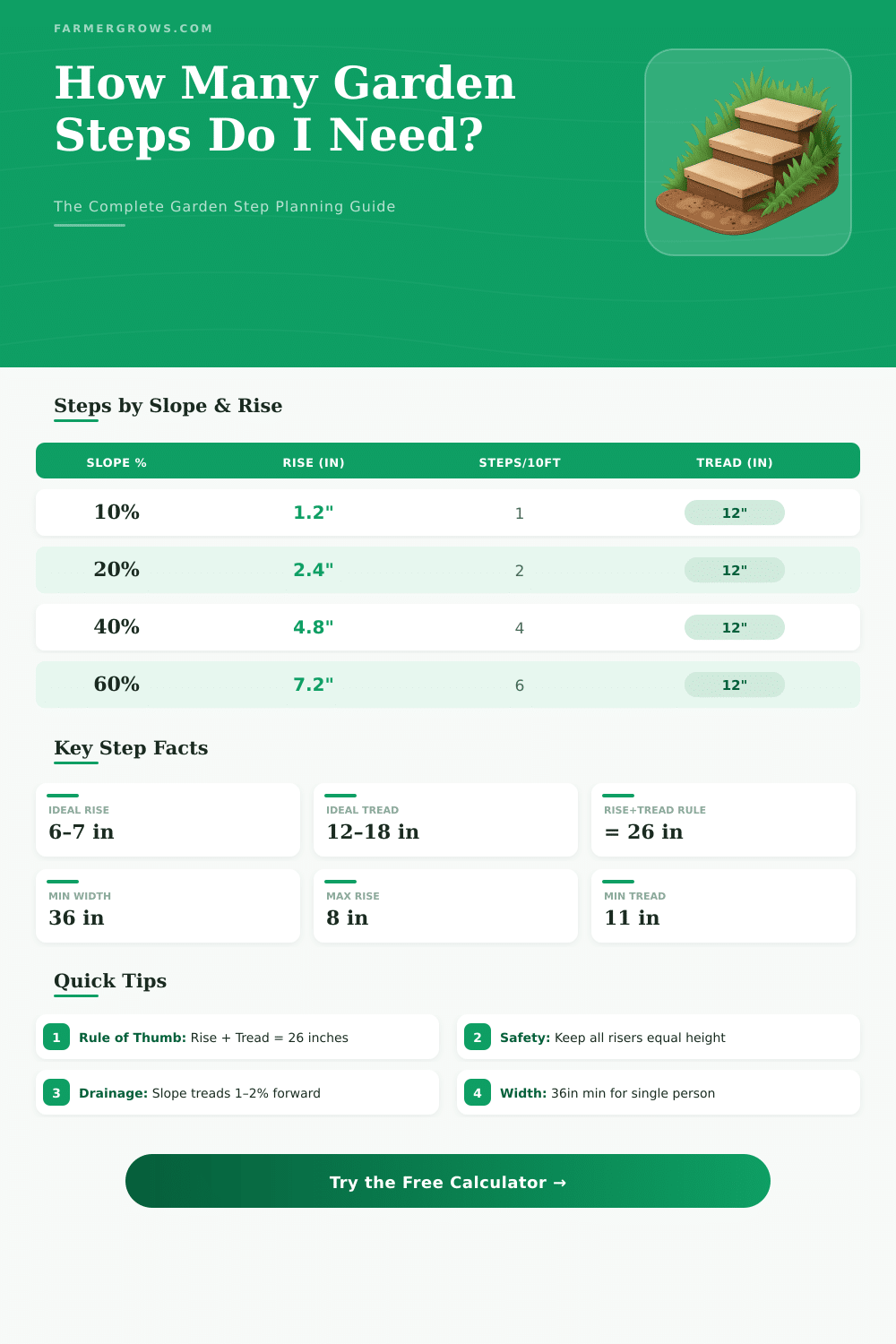
| Riser Height | Tread Depth (26” rule) | Comfort Level | Best For | Metric Rise |
|---|---|---|---|---|
| 4 in | 22 in | Very Easy | Gentle garden paths | 10.2 cm |
| 5 in | 21 in | Easy | Elderly/accessible paths | 12.7 cm |
| 5.5 in | 20.5 in | Easy | Landscape steps | 14 cm |
| 6 in | 20 in | Comfortable | Most garden steps | 15.2 cm |
| 6.5 in | 19.5 in | Comfortable | Standard garden use | 16.5 cm |
| 7 in | 19 in | Standard | Steeper slopes | 17.8 cm |
| 7.5 in | 18.5 in | Moderate | Hillside terracing | 19 cm |
| 8 in | 18 in | Steep | Maximum allowed | 20.3 cm |
| Total Rise (in) | Total Rise (cm) | Steps @ 6” | Steps @ 7” | Steps @ 8” |
|---|---|---|---|---|
| 12 in | 30.5 cm | 2 | 2 | 2 |
| 24 in | 61 cm | 4 | 4 | 3 |
| 36 in | 91.4 cm | 6 | 6 | 5 |
| 48 in | 121.9 cm | 8 | 7 | 6 |
| 60 in | 152.4 cm | 10 | 9 | 8 |
| 72 in | 182.9 cm | 12 | 11 | 9 |
| 84 in | 213.4 cm | 14 | 12 | 11 |
| 96 in | 243.8 cm | 16 | 14 | 12 |
| 120 in | 304.8 cm | 20 | 18 | 15 |
| Material | Min Thickness | Recommended | Weight (lbs/ft³) |
|---|---|---|---|
| Concrete (poured) | 3.5 in / 8.9 cm | 4–6 in / 10–15 cm | 150 |
| Natural Flagstone | 1.5 in / 3.8 cm | 2–3 in / 5–7.6 cm | 165 |
| Brick / Pavers | 2.25 in / 5.7 cm | 2.25–3 in / 5.7–7.6 cm | 130 |
| Timber / Ties | 4 in / 10.2 cm | 6–8 in / 15–20 cm | 35 |
| Compacted Gravel | 4 in / 10.2 cm | 6 in / 15.2 cm | 100 |
| Granite / Bluestone | 1.5 in / 3.8 cm | 2–3 in / 5–7.6 cm | 168 |
| Sandstone / Limestone | 1.75 in / 4.4 cm | 2–2.5 in / 5–6.4 cm | 145 |
| Composite Decking | 1 in / 2.54 cm | 1.25–1.5 in / 3.2–3.8 cm | 50 |
| Project | Typical Rise | Steps @ 6” | Total Run @ 12” | Tread Area (ft²) |
|---|---|---|---|---|
| Deck to Garden (2 ft) | 24 in / 61 cm | 4 | 48 in / 122 cm | 16 ft² |
| Side Yard Entry (3 ft) | 36 in / 91 cm | 6 | 72 in / 183 cm | 24 ft² |
| Gentle Terrace (4 ft) | 48 in / 122 cm | 8 | 96 in / 244 cm | 32 ft² |
| Steep Hillside (5 ft) | 60 in / 152 cm | 10 | 120 in / 305 cm | 40 ft² |
| Full Slope (7 ft) | 84 in / 213 cm | 14 | 168 in / 427 cm | 56 ft² |
| Long Garden Path (10 ft) | 120 in / 305 cm | 20 | 240 in / 610 cm | 80 ft² |
Garden steps belong to those elements that change the outdoor area. They do not limit to utility… They help to easily move between different heights.
And they deliver to your garden real visual charm. If you have a slope or height change this actually gives you a chance to do something nice instead of only a headache during working around it.
Garden Steps Ideas and Materials
Garden steps offer a really playful option compared to a simple paved path. They bind two different outdoor parts in a stepped garden or cover the distance between deck and lawn. Whether you choose real wood or fake wood-like material, that adds to modern gardens a pure and sorted look.
They also contrast well with wild and overgrown plants, what gives to the whole area much more life.
What about materials? There is a lot of variety. Rustic stone plates seem, as if they sat here for decades.
Modern concrete on the other hand provides those sharp and clean lines, that one sees everywhere today. Here the key. Old concrete slabs one can break and rearrange in a stepping-stone style, that looks rustic and leaves your wallet glad, because you recycle used bits from renewals or buy them in local recycling centers.
Thick slices from tree trunks work well as natural garden steps, especially if you want a forest-like look. The best part? You can create nice and practical steps for less than two hundred dollars, if you are ready to use scraps and do not care to get your hands dirty with a bit of simple handy work.
Wooden steps from Red Sweep or Bangkirai give a more fancy look and really require almost no attention. Everything, what you must, is keep them clean, so that they do not slip. Steel supports come in two-, three-, four- or five-step setups, according to your kneed.
Products for garden steps commonly have several styles and color options. A classic option could include a curved edge with visual upper and bottom parts, while a modern profile version simplifies that to a curved form with a cleaner and fancy shape. You can choose between twelve colors and four different finishes.
Grass works surprisingly for soft touches in a simple garden area. Broad paths covered with grass, tied with stone faces, feel like a little amphitheater, while one walks down from an open terrace zone. It looks especially good beside modern houses.
A curved wall from stacked stones with steps cutting threw it can be really nice, especially when it enters a slope and raises your plants upward, so that everything is in perfect height for touch.
Raised plant beds, that run flat and match with the line of steps, create a gentle stepped look. Floating steps bring a bold style and quietly divide different areas, without breaking the natural flow of thewhole garden. Old wood pieces get new life as sloping steps, with concrete poured in every grade or gravel as a more lightweight option.