🌱 Garden Soil Mix Ratio Calculator
Calculate cubic yards, bags needed, and total weight for any garden bed or planting area
⚡Quick Presets
📏Bed Dimensions
✅ Your Soil Calculation Results
⚖Soil Mix Weight Reference
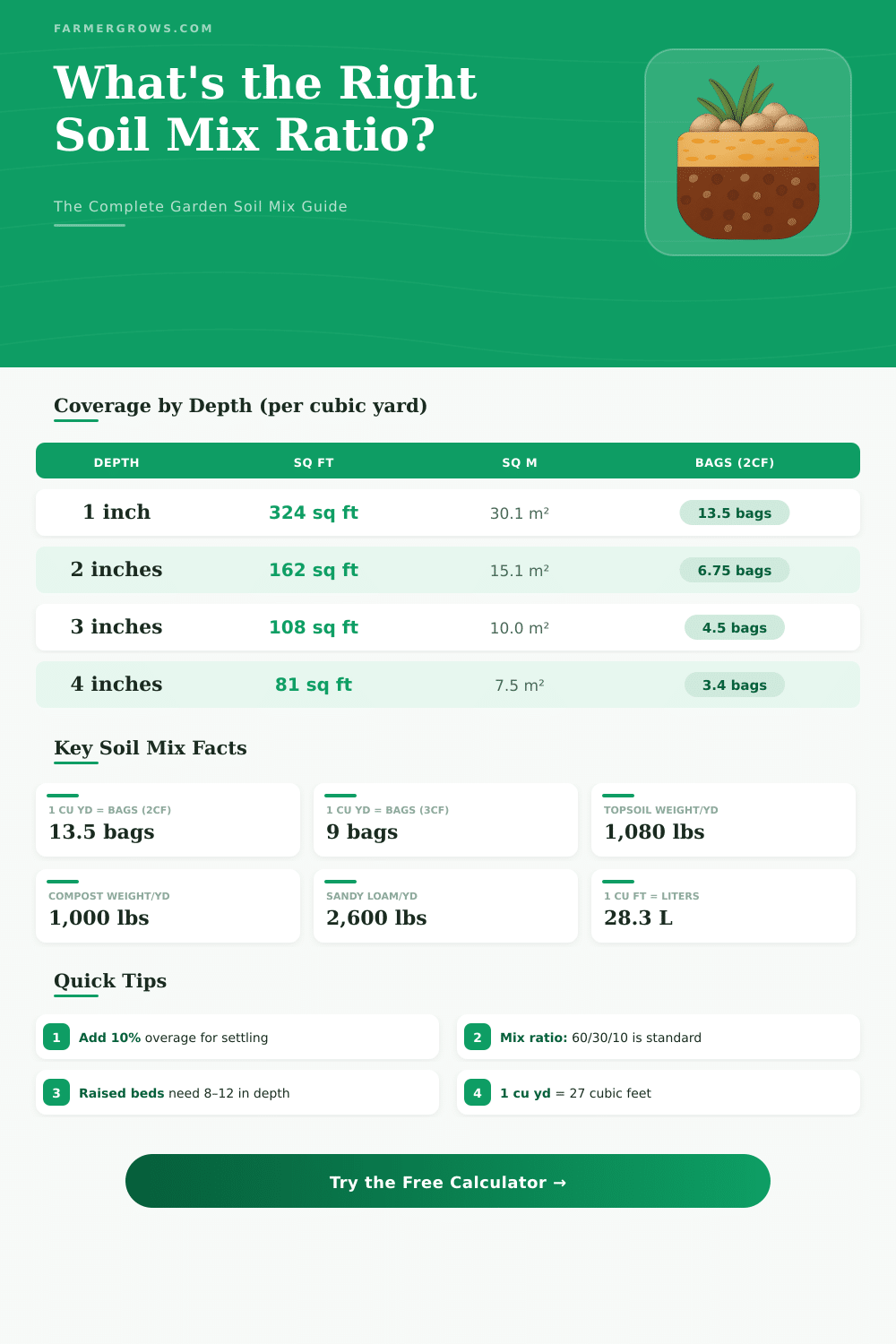
📊Coverage by Depth (per cubic yard)
| Depth | Sq Ft / Cu Yd | Sq M / Cu Yd | 2 cu ft Bags / Yd | 3 cu ft Bags / Yd |
|---|---|---|---|---|
| 1 inch (2.5 cm) | 324 sq ft | 30.1 m² | 13.5 bags | 9 bags |
| 2 inches (5 cm) | 162 sq ft | 15.1 m² | 13.5 bags | 9 bags |
| 3 inches (7.6 cm) | 108 sq ft | 10.0 m² | 13.5 bags | 9 bags |
| 4 inches (10 cm) | 81 sq ft | 7.5 m² | 13.5 bags | 9 bags |
| 6 inches (15 cm) | 54 sq ft | 5.0 m² | 13.5 bags | 9 bags |
| 8 inches (20 cm) | 40.5 sq ft | 3.76 m² | 13.5 bags | 9 bags |
🛍Bags vs. Bulk Conversion
| Bag Size | Cu Ft / Bag | Bags per Cu Yd | Coverage @ 3 in | Weight (est.) |
|---|---|---|---|---|
| Small bag | 1 cu ft | 27 bags | 4 sq ft | ~40 lbs |
| Standard bag | 2 cu ft | 13.5 bags | 8 sq ft | ~40–80 lbs |
| Large bag | 3 cu ft | 9 bags | 12 sq ft | ~60–120 lbs |
| Jumbo bag | 1.5 cu ft | 18 bags | 6 sq ft | ~50 lbs |
| Bulk yard | 27 cu ft | 1 yard | 108 sq ft | 400–2,800 lbs |
🌱Common Garden Project Sizes
| Project | Area (sq ft) | Cu Yds @ 3 in | Bags (2 cu ft) | Bags (3 cu ft) |
|---|---|---|---|---|
| Window box (2x6) | 12 sq ft | 0.11 yd³ | 2 bags | 1 bag |
| Small raised bed (4x8) | 32 sq ft | 0.30 yd³ | 5 bags | 3 bags |
| Standard bed (10x10) | 100 sq ft | 0.93 yd³ | 13 bags | 9 bags |
| Large bed (10x20) | 200 sq ft | 1.85 yd³ | 25 bags | 17 bags |
| Veggie garden (20x20) | 400 sq ft | 3.70 yd³ | 50 bags | 34 bags |
| Yard renovation (50x50) | 2,500 sq ft | 23.1 yd³ | 313 bags | 209 bags |
💡Pro Tips
The right Garden soil mix ratio can truly change the growth of plants. There is no single ideal, because each garden has its details. Even so, some common proportions prove themselves good for many cases.
One commonly uses the method of three parts. It is made up of a third of topsoil, a third of manure and a third of peat moss. That simple and easy mix works for most raised beds as well as for veggie crops.
Simple Garden Soil Mixes for Beds and Pots
Moreover, another well known recipe is the 103-mix, that holds 33% topsoil, 33% compost, 33% plain sand and 4% nutrients like worm castings or aged manure.
For most raised beds, the mix 60/30/10 of topsoil, compost and potting mix deserves attention. Tested recipe for such beds include 5 parts compost, 5 parts topsoil, 1 part perlite and half part soilless potting mix. Topsoil stays the cheapest option, when one buys bags of soil.
Fast-drying beds work well with compost and soilless growing mix in portion 1:1.
The Mel-mix forms a classic recipe for raised beds. It requires 1:1:1 proportion of peat moss, vermiculite and compost. One can mix it directly in the raised bed.
For potting ground, one starts with 40% garden soil, 40% coco peat and 20% compost. Above 20% compost risks hurting plants in pots. A Garden soil mix ratio that worked over years has 40% compost, 30% coir, 20% vermiculite and 10% extras.
Vegetables in containers widely benefit from soilless mixes with around 70% peat moss ore coir, 20% vermiculite and 10% perlite.
Use peat no more than in proportion 3:1 as a useful rule. A closer way is to limit it to 25% of the whole mix. When one adds peat moss to a bed, it should not pass 20% of the whole.
Also the amount of rain plays a role. In regions with less than 30 inches of rain yearly, more compost at 60% with 40% topsoil helps a lot. The proportion 50% coconut coir or peat, 25% vermiculite and 25% compost or topsoil works well, and one can add perlite.
Such mix adapts based on the weather zone.
Potting mix is clean and soilless, so it does not carry diseases like fungus. Garden soil mix ratio blends soil with soilless parts to improve beds in gardens. Normal garden soil sometimes causes troubles, so people created potting mix.
Too much compost can make the mix too soft and wet. The ideal stays light, airy blend thatdrains quickly and lets roots freely move.