💡 Garden Lighting Cable Calculator
Calculate cable length, voltage drop & wire gauge for low voltage outdoor lighting
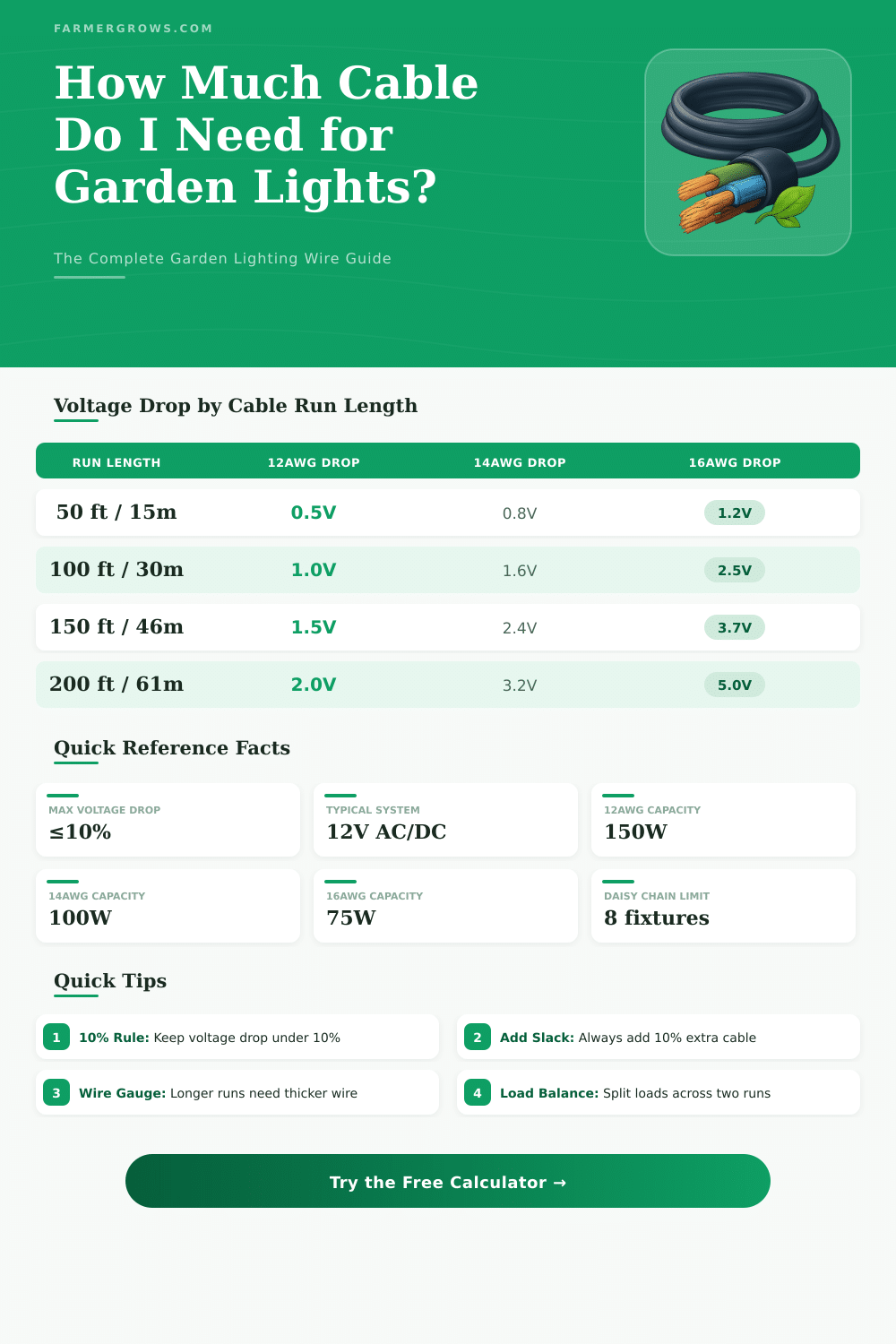
| Run Length | Total Load | 12 AWG Drop | 14 AWG Drop | 16 AWG Drop | Recommended |
|---|---|---|---|---|---|
| 25 ft (7.6m) | 24W | 0.2V (2%) | 0.4V (3%) | 0.6V (5%) | 16 AWG OK |
| 50 ft (15m) | 48W | 0.5V (4%) | 0.8V (7%) | 1.2V (10%) | 14 AWG Min |
| 75 ft (23m) | 72W | 0.7V (6%) | 1.2V (10%) | 1.8V (15%) | 12 AWG Min |
| 100 ft (30m) | 96W | 1.0V (8%) | 1.6V (13%) | 2.5V (21%) | 12 AWG |
| 150 ft (46m) | 120W | 1.5V (13%) | 2.4V (20%) | 3.7V (31%) | 10 AWG |
| 200 ft (61m) | 150W | 2.0V (17%) | 3.2V (27%) | 5.0V (42%) | 10 AWG + |
ℹ️ Values calculated for 12V system with 8 x 3W LED fixtures at noted run lengths. Actual drop varies by total wattage.
| Fixture Type | Wattage | Max on 12 AWG | Max on 14 AWG | Max on 16 AWG |
|---|---|---|---|---|
| LED Path Light | 3W | 50 fixtures | 33 fixtures | 25 fixtures |
| LED Spotlight | 5W | 30 fixtures | 20 fixtures | 15 fixtures |
| LED Flood | 10W | 15 fixtures | 10 fixtures | 7 fixtures |
| LED Step Light | 2W | 75 fixtures | 50 fixtures | 37 fixtures |
| LED Well Light | 6W | 25 fixtures | 16 fixtures | 12 fixtures |
| Halogen Path | 20W | 7 fixtures | 5 fixtures | 3 fixtures |
| Halogen Spot | 35W | 4 fixtures | 2 fixtures | 2 fixtures |
| Fixture Spacing | Fixtures per 50ft Run | Fixtures per 100ft Run | Cable Needed (m equiv) |
|---|---|---|---|
| 4 ft (1.2m) | 12 | 25 | 15.2m / 30.5m |
| 6 ft (1.8m) | 8 | 16 | 15.2m / 30.5m |
| 8 ft (2.4m) | 6 | 12 | 15.2m / 30.5m |
| 10 ft (3.0m) | 5 | 10 | 15.2m / 30.5m |
| 12 ft (3.7m) | 4 | 8 | 15.2m / 30.5m |
| 15 ft (4.6m) | 3 | 6 | 15.2m / 30.5m |
When dealing with installation of outdoor light, the Garden lighting cable ranks between the most often ignored, even so useful stuff. It connects your lights to the source of energy and must last all weather conditions, rain, frost, sunlight, everything. Choose the right cable to make a genuinely big change for the safety and the efficiency of your whole installation.
The Garden lighting cable for low voltage lights is built specially for those systems of 12 to 24 volts that feeds the most many home locations. Here the key spot: thicker cables have less resistance, so fewer voltage lost along the way. That loss of voltage affects the length of your cable lines, the number of lights bound to it and the energy that they consume.
How to Choose the Right Cable for Garden Lights
With LED lights for garden, genuinely, it rarely becomes a problem, because they work much better than old halogen alternatives. Although, it stays wise to keep the cable distances as short as possible without troubles.
Diversity of tasks requires different ratings for cables and it is useful to know the variants. Normal cable of 1.3 mm² works surprisingly well for LED and halogen garden lights in most cases. At bigger loads in watts, one walks to 2.1 mm² heavy service cable without hesitation.
Types of SPT cables also offer differences, the big SPT-3 lasts until 150 watts of load, while the small SPT-1 limits at around 120 watts. For many garden light systems with energy saving LEDs, that small SPT-1 suffices well.
Some outdoor cables have grade SPT-2, what surpasses the usual level for such lightings. One receives high quality copper covered by flexible PVC mantle. Rubber variants like H07RN-F serve another way for outdoor work and come in various thicknesses with different numbers of cores.
Rubber cable of 0.75 mm² or 1.50 mm² fits well with 12 volt LED garden lights, and the round form simplifies the fitting.
If you bury cable threw the garden to reach lights in the centre, one must bundle it four to six inches under the surface. Shovel cuts a cone in the soil, what forms space for smooth introduction of the cable. For direct burial, you require three core cable with two leads and earth wire for safety.
At run of mains voltage line, SWA armoured cable will be the usual solution and burial happens without trouble.
Some plug-and-play cables for garden lights have IP68 rate, what makes them reliable for outdoor usage. They operate in 12 volt DC low voltage, so genuinely safe around children and pets. Home setup gets simpler and safer with those solutions.
Plan your cable routes before starting the gardening, to escape big headache later. Adding lights after finishing the landscape can require lifting pavings or cutting walls, costly and bothering. Use large low voltage Garden lighting cable already from thestart, to have flexibility for future changes, especially because LED lighting dramatically drops the needs of energy.