🪨 Garden Gravel Calculator
Calculate exactly how much gravel you need for any garden project
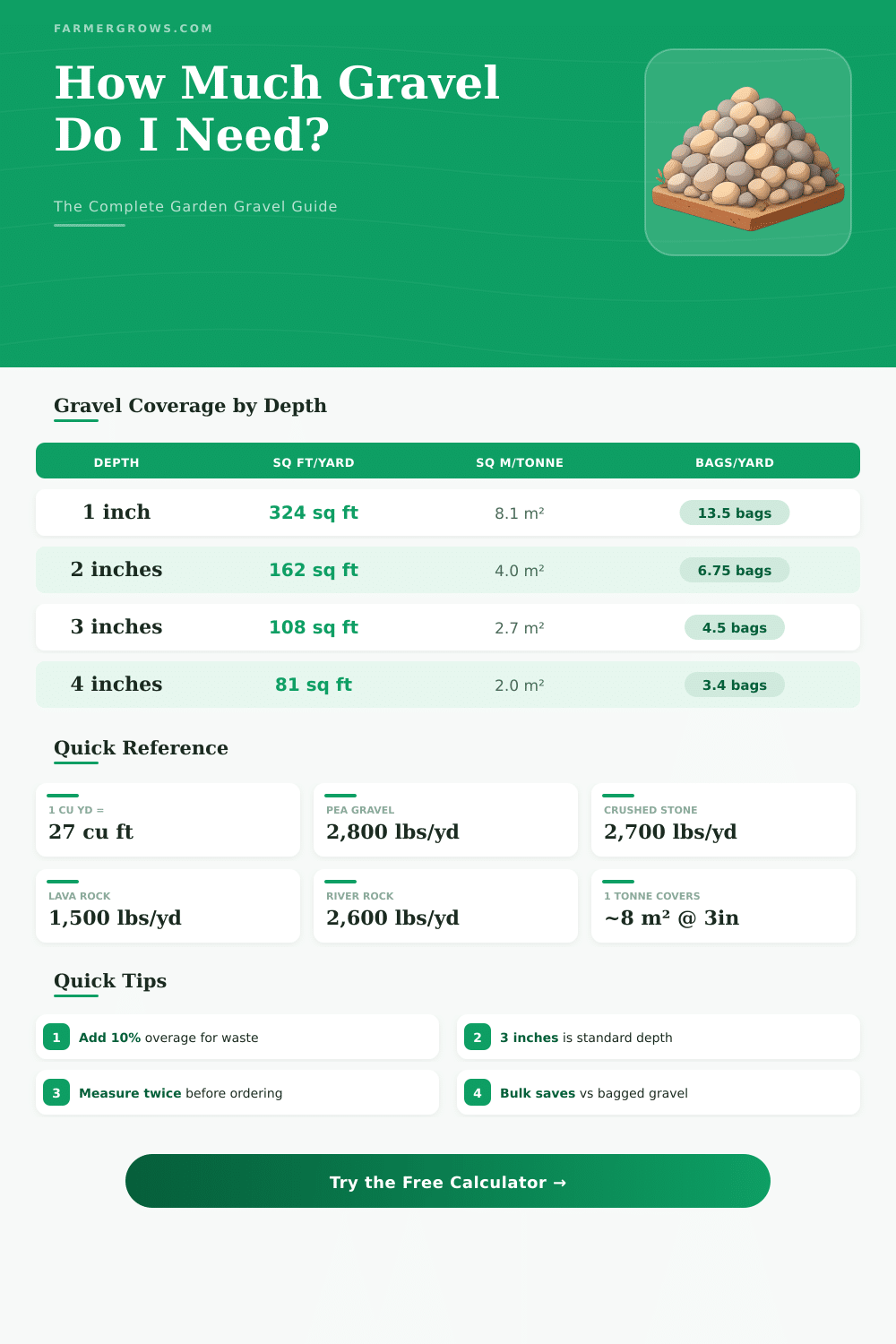
| Depth | Sq Ft per Cu Yd | Sq M per Cu M | Cu Yds per 100 Sq Ft | Cu M per 10 Sq M |
|---|---|---|---|---|
| 1 inch (2.5 cm) | 324 sq ft | 40 m² | 0.31 yd³ | 0.25 m³ |
| 2 inches (5 cm) | 162 sq ft | 20 m² | 0.62 yd³ | 0.50 m³ |
| 3 inches (7.5 cm) | 108 sq ft | 13.3 m² | 0.93 yd³ | 0.75 m³ |
| 4 inches (10 cm) | 81 sq ft | 10 m² | 1.23 yd³ | 1.00 m³ |
| 6 inches (15 cm) | 54 sq ft | 6.7 m² | 1.85 yd³ | 1.50 m³ |
| Bag Size | Volume per Bag | Bags per Cu Yd | Cu Ft per Bag | Coverage at 3 in |
|---|---|---|---|---|
| 0.5 cu ft bag | 0.5 cu ft | 54 bags | 0.5 cu ft | ~2 sq ft |
| 0.8 cu ft bag | 0.8 cu ft | 33.75 bags | 0.8 cu ft | ~3.2 sq ft |
| 1 cu ft bag | 1 cu ft | 27 bags | 1 cu ft | ~4 sq ft |
| 2 cu ft bag | 2 cu ft | 13.5 bags | 2 cu ft | ~8 sq ft |
| 3 cu ft bag | 3 cu ft | 9 bags | 3 cu ft | ~12 sq ft |
| Bulk (1 ton) | ~18–20 cu ft | — | — | ~64–72 sq ft |
| Project | Dimensions | Area (sq ft) | Cu Yds @ 3 in | Bags @ 3 in (2 cu ft) |
|---|---|---|---|---|
| Small Path | 10 x 3 ft | 30 sq ft | 0.28 yd³ | ~4 bags |
| Garden Bed | 12 x 8 ft | 96 sq ft | 0.89 yd³ | ~13 bags |
| Tree Ring (Ø6 ft) | Ø 6 ft circle | 28 sq ft | 0.26 yd³ | ~4 bags |
| Patio | 15 x 15 ft | 225 sq ft | 2.08 yd³ | ~28 bags |
| Driveway Strip | 50 x 10 ft | 500 sq ft | 4.63 yd³ | ~63 bags |
| Large Yard | 50 x 30 ft | 1,500 sq ft | 13.89 yd³ | ~188 bags |
Gravel Garden forms a kind of Garden, in that Gravel replaces the upper layer of the ground. Commonly one removes the upper four to eight inches of soil and replaces it with Gravel. That belongs to dry gardening that stresses the saving of water.
Little stones fill the role of ground covers and plant beds. Even newcomers manage to grow plants in such a system.
Gravel Garden: Low Water and Easy Care
Gravel ranks among the most flexible materials for landscape use. It works as a path cover, plant bed filler around paving stones or even a drain. It costs little for hard landscape in outdoor markets.
Crushed stone and pea Gravel are commonly chosen for driveways, terraces paths and flower beds. The angular form of crushed stone ensures a firm setting, which helps to keep everything in its place.
Many reasons point to choosing Gravel in a Garden. Under the feet it gives a pleasant rustling. It is cheaper than many other hard landscape materials.
Gravel slows bad drainage and erosion, which benefits the nature. It goes well with almost every landscape style. Moreover, it blesses the creatures.
That surface creates an ideal habitat for drought-tolerant plants, that attracts creatures, while other Garden parts maybe do not do that.
A Gravel Garden can live only from natural rain over time and does not require fertilizer or other chemicals. For such gardens, lasting and fancy species work. One favours strong plants with little water need.
The plan of the Garden can carry also trees, bushes, ground covers, flowers, big rocks and various hard landscape elements with different texture.
A modern Gravel Garden brings a fresh and clean impression to any outdoor area. Use different sizes and different colored Gravel pieces too create bold forms and simple lines. Combining Gravel with concrete, metal or wood helps to reach the wanted style.
Pea Gravel works well, because it fills little spaces, for instance around the roots of a bush with brick borders.
Even so Gravel does face some troubles. Soil will build up from rotting leaves and Garden waste, which helps the growth of unwanted grasses. Landscape fabric does not always help best.
Most unwanted grasses grow from unchanged soil, that builds up on top, not from below. That fabric does not block that and only forms a layer on the ground, that is hard to remove. If Gravel is no longer needed, it is better to remove it than cover it withmulch, because the two will ultimately harden together.