⛏️ Fill Dirt Calculator
Calculate how many cubic yards of fill dirt you need for any project
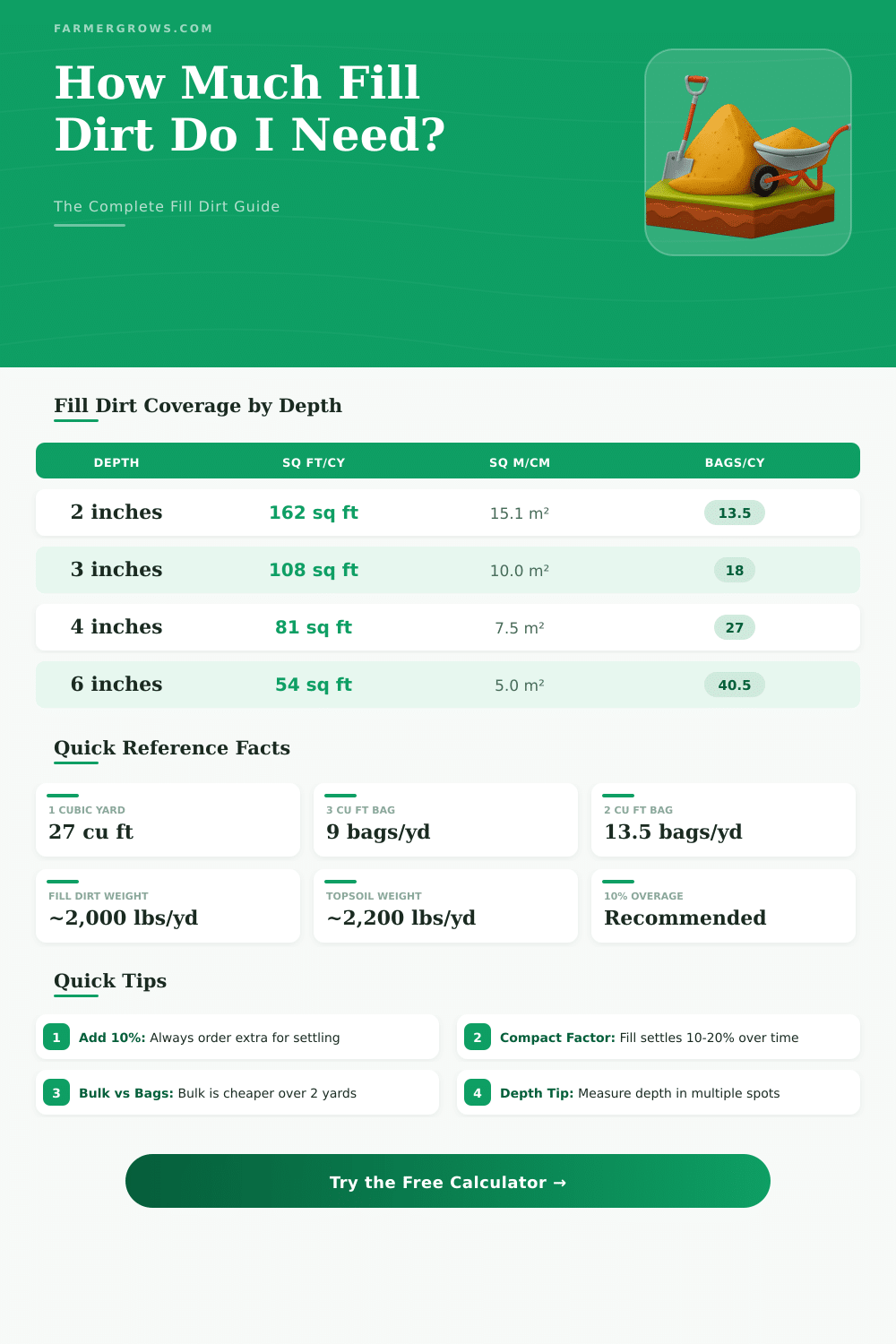
| Depth | Sq Ft per Cu Yd | Sq M per Cu M | Cu Yds per 1,000 Sq Ft |
|---|---|---|---|
| 1 inch (2.54 cm) | 324 sq ft | 30.1 m² | 3.1 cu yd |
| 2 inches (5.1 cm) | 162 sq ft | 15.1 m² | 6.2 cu yd |
| 3 inches (7.6 cm) | 108 sq ft | 10.0 m² | 9.3 cu yd |
| 4 inches (10.2 cm) | 81 sq ft | 7.5 m² | 12.4 cu yd |
| 6 inches (15.2 cm) | 54 sq ft | 5.0 m² | 18.5 cu yd |
| 12 inches (30.5 cm) | 27 sq ft | 2.5 m² | 37.0 cu yd |
| Bag Size | Volume per Bag | Bags per Cu Yd | Coverage at 3 in Depth |
|---|---|---|---|
| 0.5 cu ft bag | 0.5 cu ft | 54 bags | 2 sq ft |
| 1 cu ft bag | 1 cu ft | 27 bags | 4 sq ft |
| 2 cu ft bag | 2 cu ft | 13.5 bags | 8 sq ft |
| 3 cu ft bag | 3 cu ft | 9 bags | 12 sq ft |
| 1 cu yd bulk | 27 cu ft | 1 bulk load | 108 sq ft |
| Project | Approx Area | Cu Yds @ 3 in | Bags @ 3 in (2 cu ft) |
|---|---|---|---|
| Small Garden Bed | 200 sq ft | 1.9 cu yd | ~26 bags |
| Medium Backyard | 500 sq ft | 4.6 cu yd | ~62 bags |
| Large Lawn Area | 1,000 sq ft | 9.3 cu yd | ~125 bags |
| Half-Acre Lot | 21,780 sq ft | 202 cu yd | Bulk only |
| Raised Bed 4x8 | 32 sq ft | 0.3 cu yd | ~4 bags |
| Driveway Base 20x40 | 800 sq ft | 7.4 cu yd | ~100 bags |
Getting the right amount of fill dirt for your project can be harder than one thinks at first. It serves for many tasks, for instance, one uses it to fill holes, level the ground, smooth uneven gardens and prepare areas for landscaping or building. If you learn about the different kinds and understand how to estimate the volume, then you will escape many headaches, expenses and useless work.
Happily, the math is fairly easy. You take the length in feet, multiply by the width in feet, then by the depth in feet to get cubic feet. Then divide by 27, and you have cubic yards, because one cubic yard holds 27 cubic feet.
How to Figure Out How Much Fill Dirt You Need
Assume that you work with an area of 10 feet by 5 feet, that needs 2 feet depth, that gives 100 cubic feet, which matches around 3.7 cubic yards. The most many website calculators let you enter values in inches or feet, and they give results in cubic yards cubic feet or even tons, if you need that.
But here is the key, always plan your order 10 to 15 percent bigger, to make up for the shrinking and pressing after the install. The soil moves and compacts when one lays it in place. That shrinkage effect means that you probably will need a bit more material, to raech the wanted height or level of fill.
Any calculation that you do is only a good guess.
The water content plays a big role and changes how everything works. Wet soil weighs more and acts different than dry soil. If you have wet fill dirt, the numbers shift a bit.
One can not well compact soil that is fully soaked, the water must first drain away. The rate of compacting simply points to how the soil will sink and shrink when it is packed down.
fill dirt usually weighs around 2410 pounds each cubic yard, or roughly 1.21 tons each cubic yard. Twenty cubic yards match 540 cubic feet, which is almost won whole ton of material, probably needs two trips, if you order a 10-yard dump truck. Some suppliers limit the load to six cubic yards, and anything more than that usually requires you to pay extra delivery costs.
What price you will pay depends on your place and amount. Basic fill dirt costs less than garden soil. Plan a budget of around one dollar each yard for basic clay fill, up to nine or ten dollars each yard for better picked or structural fill.
Bagged soil from garden centers is much more expensive than bulk. Fill dirt is basic natural materials mixed with sand, rocks and stones. You can use it to raise garden beds, but one will want to lay garden soil on top, if you genuinely plant something.
Sometimes one can get soil for free. Landscaping contractors sometimes must move stock quickly and dump it cheap. Soil is one of those funny things, when you need it, it seems impossible to find, but when you try to getrid of it, that becomes a whole other problem.