🌿 Fig Tree Sun Calculator
Calculate daily sunlight hours & coverage area for your fig tree's ideal growth
⚡Quick Presets
⚙️Calculator Inputs
🌞 Your Fig Tree Sunlight Analysis
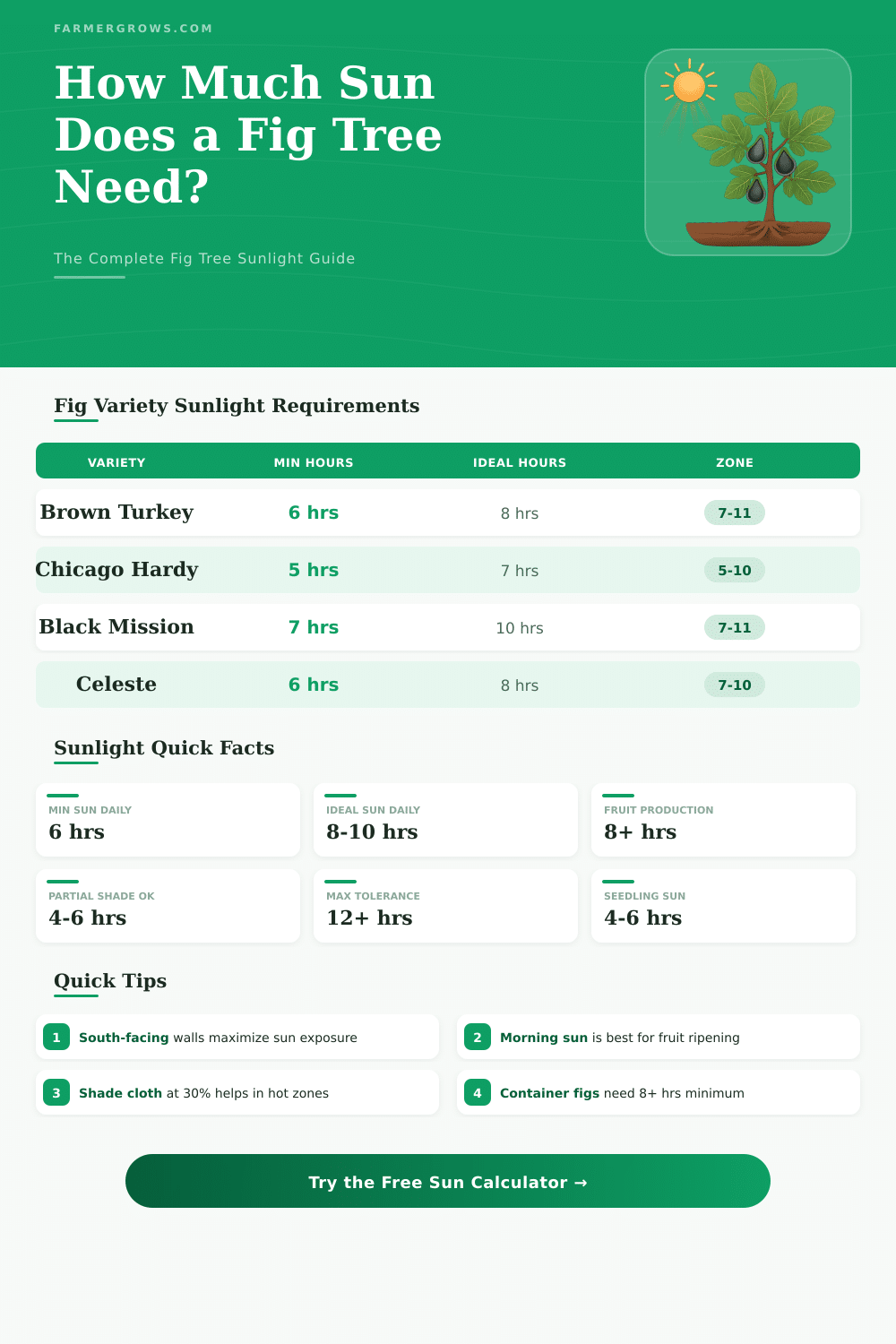
📊Sunlight Hours by Fig Variety
📋Sunlight Needs by Growth Stage
| Growth Stage | Min Sun (hrs) | Ideal Sun (hrs) | Notes |
|---|---|---|---|
| Seedling (0–1 yr) | 4 | 5–6 | Protect from intense afternoon sun |
| Young Tree (1–3 yrs) | 5 | 6–8 | Gradually increase exposure |
| Established (3–7 yrs) | 6 | 8–10 | Full sun preferred for fruiting |
| Mature (7+ yrs) | 6 | 8–12 | Maximum sun boosts fruit yield |
| Container / Potted | 6 | 8–10 | Rotate pot for even coverage |
| Espalier Wall | 6 | 8–10 | Wall reflection adds 5–15% |
🌍Sunlight by Climate Zone
| Climate Zone | USDA Zone | Daily Hrs Needed | Sun Intensity Adj. |
|---|---|---|---|
| Cold / Northern | 5–6 | 6–8 hrs | Maximize; every hour counts |
| Temperate | 7–8 | 7–9 hrs | Standard — no adjustment |
| Hot / Arid | 9–11 | 8–10 hrs | Afternoon shade cloth at 20–30% |
| Humid / Subtropical | 8–10 | 7–9 hrs | Morning sun most beneficial |
📐Sun Angle & Effective Coverage
| Sun Angle / Aspect | Effective Sun Gain | Best For | Area Bonus |
|---|---|---|---|
| South-Facing Wall | +15% | Espalier in cold zones | Reflects radiant heat |
| West-Facing Wall | +8% | Afternoon warmth zones | Good ripening boost |
| East-Facing Wall | +5% | Morning sun lovers | Gentle early sun |
| North-Facing Wall | −5% | Avoid for figs | Reduces yield |
| No Wall / Open | 0% | Standard in-ground | Baseline |
Fig Tree trees truly adore the Sun as if worshippers. They grow well with at least 6 to 8 hours of direct sunshine daily and honestly eight hours already work for reaching a good amount of fruits. The main lesson?
Give your Fig Tree as much light as it is possible.
How Much Sun Do Fig Trees Need
Figs give their best result in full sunshine, which means more than 6 hours of direct Sun rays that reach the tree daily. Partial Sun is possible, but it slows the growth and fruit making. If you skimp on the light, you will end with long, slim and bare branches.
In strong shade, a Fig Tree can even die or give only little, poor fruits. Even so, figs handle a bit of shade, but they truly thrive when the Sun rays hit them strongly.
For good fruit making you need strong sunshine. Morning or evening light that comes in at a low angle simply does not work. Without proper strength of light, you will only grow a leafy houseplant without any fruit.
Just as seriously, make sure that the shadier branches recieve their part of Sun, because here can form the most fruits.
Different types have different needs for light. Some truly require strong direct Sun rays to create fruit buds, while others are less strict. If your place does not receive full Sun daily, choose an early ripening type.
For instance, the Hardy Chicago grows well with less strong light. The Desert King is one of the best choices for shady areas; it produces a lot and faithfully, with green-yellow outside and nice red flesh inside. The Brown Turkey sometimes works for partial shade or only 3 to 6 hours of Sun, although most gardeners and books say that figs favour full Sun or at least partial.
But here comes the hard part… In regions with very high UV-levels, like South California, the Central Valley and Arizona, that can cause trouble. When the Sun becomes too harsh, it truly burns the leaves, which then curl inward for self-protection.
So yes, figs love the Sun, but too much strong light is also bad news.
Fiddle leaf figs follow other rules than fruit figs. They like bright indirect light with some direct Sun mixed. A southeast window or some good LED grow lights will do the job.
An east window brings gentle morning light, that works well. Lay a fiddle leaf fig beside an east, west or south window, and it will receive enough light all day. Give it 4 to 6 hours of direct Sun, and it will grow well.
The warning? Young leaves of a fiddle leaf fig burn quickly under strong direct Sun. When you move it outside, do the change slowly, starting with morning or evening light and watch how it reacts.
Artificial lights can add to direct light, but they do not fully replace it. LEDs lack the red waves that natural sunshine gives, so plants grow better if the room stays warm. In field setups, a V-shaped arrangement of branches helps so that all parts of theFig Tree receive equal Sun exposure.