💧 Fertilizer Injector Calculator
Calculate injection ratios, stock solution volumes, and nutrient delivery rates for any fertigation system
100% soluble
+19% Ca
KNO₃
Phosphate
10% Mg, 13% S
46% N
Concentrate
Mix
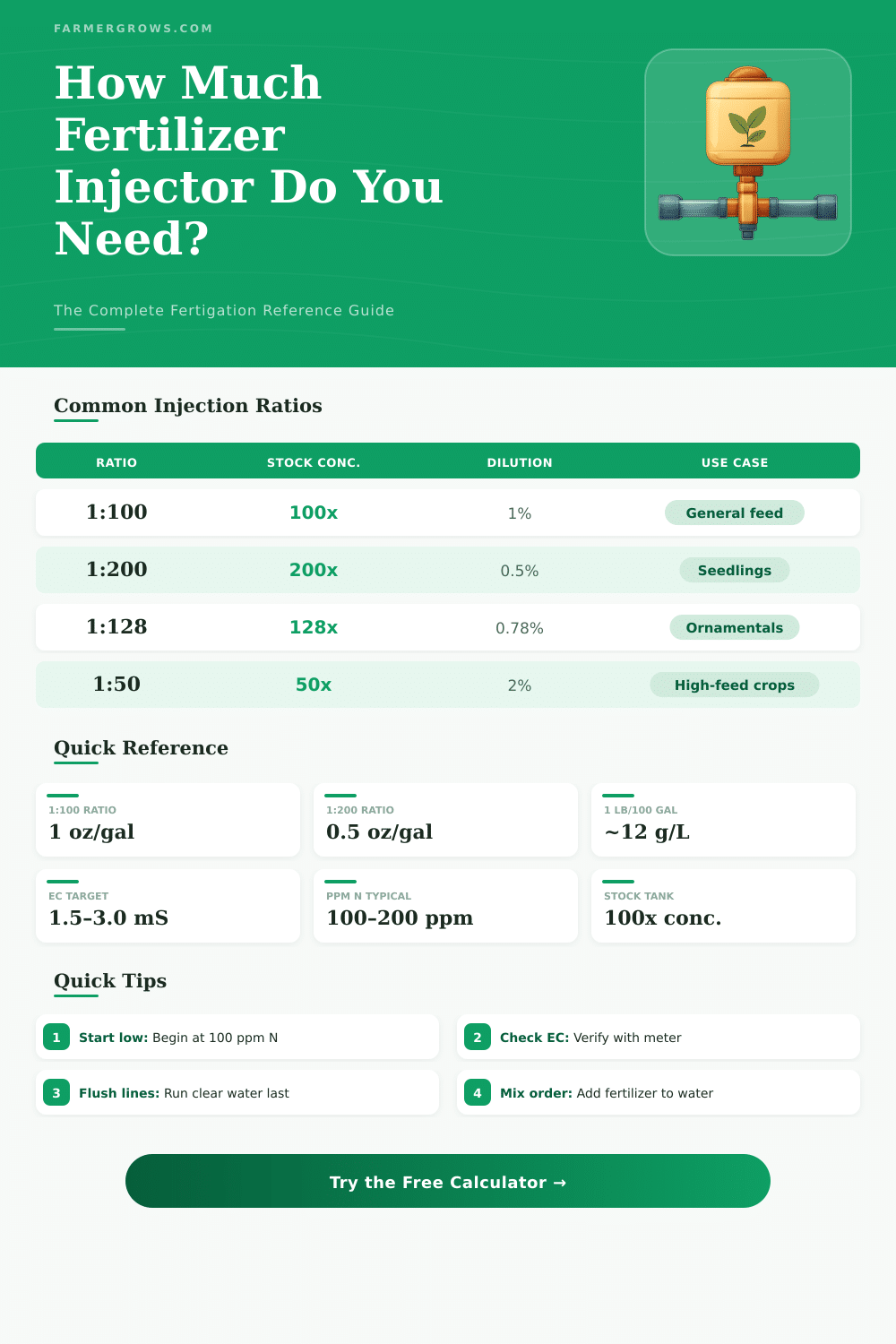
| Injection Ratio | Stock Concentration | mL per Liter | oz per Gallon | Typical Use |
|---|---|---|---|---|
| 1:50 | 50x concentrate | 20 mL/L | 2.56 oz/gal | High-demand crops |
| 1:100 | 100x concentrate | 10 mL/L | 1.28 oz/gal | General vegetables |
| 1:128 | 128x concentrate | 7.8 mL/L | 1.0 oz/gal | Ornamentals |
| 1:200 | 200x concentrate | 5 mL/L | 0.64 oz/gal | Seedlings, low feed |
| 1:256 | 256x concentrate | 3.9 mL/L | 0.5 oz/gal | Very sensitive plants |
| 1:512 | 512x concentrate | 1.95 mL/L | 0.25 oz/gal | Micronutrients |
| Target N (ppm) | oz/100 gal | g/100 L | Crop Stage | EC Approx (mS/cm) |
|---|---|---|---|---|
| 50 ppm N | 1.5 oz | 11.2 g | Seedling / Transplant | 0.8–1.2 |
| 100 ppm N | 3.0 oz | 22.5 g | Early vegetative | 1.2–1.8 |
| 150 ppm N | 4.5 oz | 33.7 g | Active growth | 1.8–2.4 |
| 200 ppm N | 6.0 oz | 45.0 g | High demand crops | 2.4–3.0 |
| 250 ppm N | 7.5 oz | 56.2 g | Fruiting / Peak feed | 2.8–3.5 |
| 300 ppm N | 9.0 oz | 67.5 g | Heavy feeders only | 3.2–4.0 |
| Stock Tank Size | Ratio 1:100 Covers | Ratio 1:200 Covers | Fertigation Area Est. |
|---|---|---|---|
| 5 gal (19 L) | 500 gal (1,893 L) | 1,000 gal (3,785 L) | ~500–1,000 sq ft |
| 15 gal (57 L) | 1,500 gal (5,678 L) | 3,000 gal (11,356 L) | ~1,500–3,000 sq ft |
| 30 gal (114 L) | 3,000 gal (11,356 L) | 6,000 gal (22,712 L) | ~3,000–6,000 sq ft |
| 55 gal (208 L) | 5,500 gal (20,820 L) | 11,000 gal (41,640 L) | ~5,500–11,000 sq ft |
| 100 gal (379 L) | 10,000 gal (37,854 L) | 20,000 gal (75,708 L) | ~1–2 acres |
| 250 gal (946 L) | 25,000 gal (94,635 L) | 50,000 gal (189,270 L) | ~2.5–5 acres |
A Fertilizer injector is a device that adds liquid food or chemicals to watering systems. It helps to save a lot of time because the feeding and the watering happen together. Those two tasks rank between the most important and long ongoing activities in plant fields, hence their joining simplifies the everyday work.
Thirty common kinds of Fertilizer injector exist. Tank injectors use a container to store the mix. Venturi injectors work by creating suction to pull the feed into the water line.
Fertilizer Injectors: Types and How to Choose
Pump-operated injectors use a pump to push the solution into the watering net. Every model fits best for different needs, according to the particular setup.
Some injectors are water-powered, so the water flow through them moves the internal parts. That simplifies their use and care. Roller pumps press a tube to transport the food into the watering water.
They offer high accuracy and require only minimal effort. Electrical injectors depend on electricity and allow setting the amount of applied feed.
Fertigation systems use already existing drip or sprinkler nets to dissolve water-soluble foods. Except feeds, they can distribute pestisides, insecticides and growth controls. The foods must be liquids and well mixed, so that everything works well in such setups.
The flow rate is the main standard during the choice of injector. Some models require water pressure to work and have a small valve, that controls the focus of the solution when it mingles with water. Precise parts ensure the right portion of the mix, according to changing watering flows, similar to pumps that adapt to the rhythm.
Venturi injectors come in sizes of half an inch up to two inches and commonly include a bypass and manifold assembly. Simple systems, as the EZ-FLO, divert water pressure into the tank, however the mixing can change constantly during water flows and solution spills. Dosatron is another known brand of professional injectors, designed for computer controlled and advanced uses.
The Chapin HydroFeed is an inline automatic blender for feeds, meant for lawns and gardens. The Hoss Fertilizer Injector is meant for gardeners to feed while they water by means of hoses or sprinklers. EZ-FLO systems are easily installed and use refillable tanks.
Some copies of famous brands offer lower prices, although they do not always use UV-resistant plastic and require protection againstsunlight.
For homemade systems it matters to find a pump that matches the flow rate and the food amount. The pump must fit and quickly adapt to different flows. A flow meter that signals to the monitor is also needed.
Building a whole homemade setup costs more work, but it gives big freedom to adapt to own needs.