🌿 11-52-0 Fertilizer Calculator
Calculate the exact amount of MAP (monoammonium phosphate) fertilizer for your lawn, garden, or field
lbs/1,000 ft²
lbs/1,000 ft²
lbs/1,000 ft²
lbs/1,000 ft²
lbs/1,000 ft²
lbs/1,000 ft²
lbs/1,000 ft²
lbs/1,000 ft²
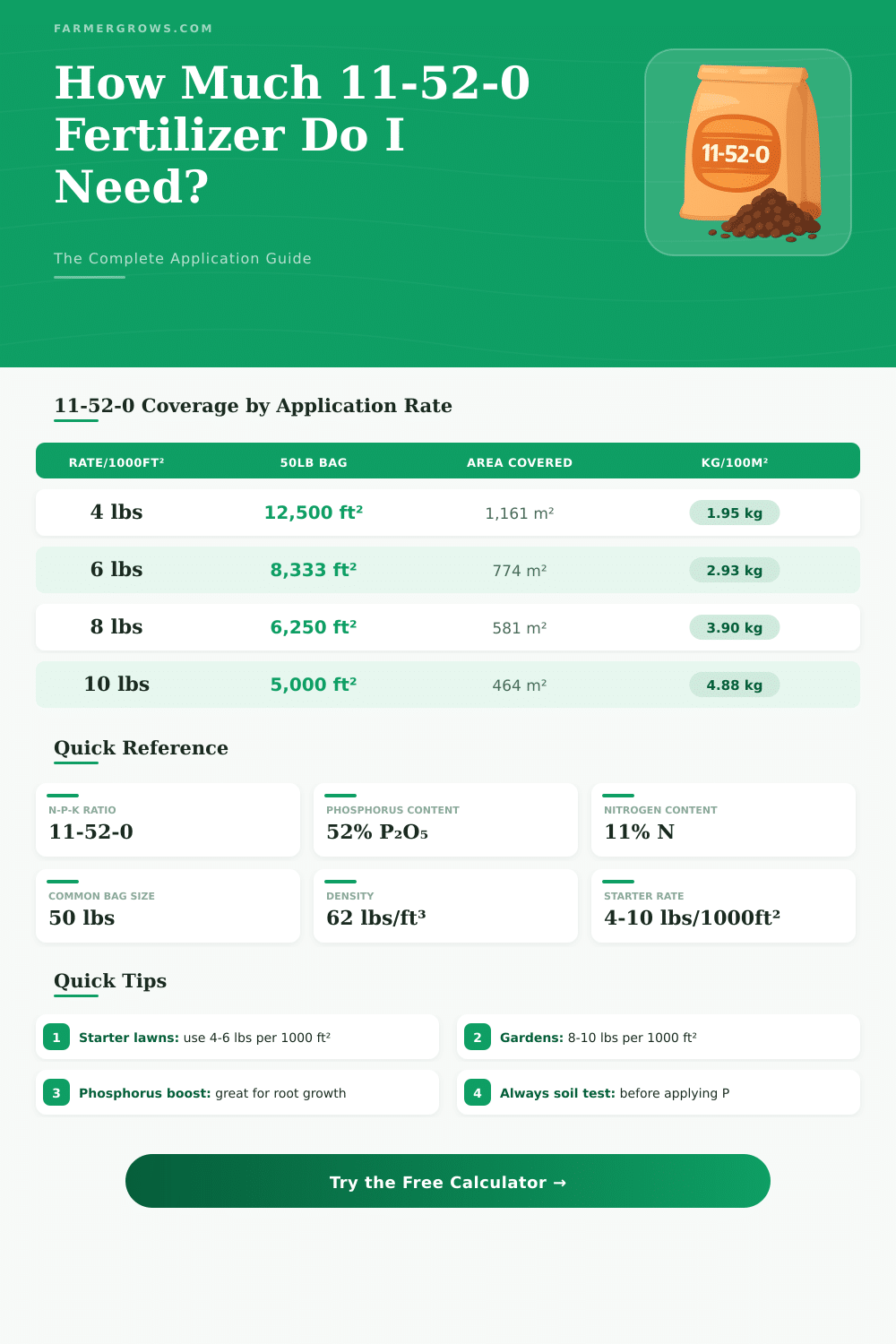
| Rate (lbs/1,000 ft²) | Area per 50 lb Bag (ft²) | Area per 50 lb Bag (m²) | Bags per Acre |
|---|---|---|---|
| 2 lbs | 25,000 | 2,323 | 1.7 |
| 4 lbs | 12,500 | 1,161 | 3.5 |
| 6 lbs | 8,333 | 774 | 5.2 |
| 8 lbs | 6,250 | 581 | 7.0 |
| 10 lbs | 5,000 | 464 | 8.7 |
| 12 lbs | 4,167 | 387 | 10.5 |
| Bag Size | Weight (kg) | Covers at 6 lbs/1000ft² | Bags per Acre (6 lbs rate) |
|---|---|---|---|
| 10 lbs | 4.5 kg | 1,667 ft² (155 m²) | 26.1 |
| 25 lbs | 11.3 kg | 4,167 ft² (387 m²) | 10.5 |
| 50 lbs | 22.7 kg | 8,333 ft² (774 m²) | 5.2 |
| 100 lbs (bulk) | 45.4 kg | 16,667 ft² (1,548 m²) | 2.6 |
| Rate (lbs/1000ft²) | Nitrogen (N) Delivered | Phosphorus (P₂O₅) Delivered | Potassium (K₂O) Delivered |
|---|---|---|---|
| 2 lbs | 0.22 lbs N | 1.04 lbs P₂O₅ | 0 lbs |
| 4 lbs | 0.44 lbs N | 2.08 lbs P₂O₅ | 0 lbs |
| 6 lbs | 0.66 lbs N | 3.12 lbs P₂O₅ | 0 lbs |
| 8 lbs | 0.88 lbs N | 4.16 lbs P₂O₅ | 0 lbs |
| 10 lbs | 1.10 lbs N | 5.20 lbs P₂O₅ | 0 lbs |
| Project | Area | Fertilizer at 6 lbs/1000ft² | 50 lb Bags Needed |
|---|---|---|---|
| Small Garden Bed | 100 ft² (9.3 m²) | 0.6 lbs (0.27 kg) | 1 |
| Flower Bed | 250 ft² (23 m²) | 1.5 lbs (0.68 kg) | 1 |
| Medium Lawn | 1,000 ft² (93 m²) | 6.0 lbs (2.7 kg) | 1 |
| Large Lawn | 2,500 ft² (232 m²) | 15 lbs (6.8 kg) | 1 |
| Quarter Acre | 5,000 ft² (464 m²) | 30 lbs (13.6 kg) | 1 |
| Half Acre Lawn | 10,000 ft² (929 m²) | 60 lbs (27.2 kg) | 2 |
| Full Acre | 43,560 ft² (4,047 m²) | 261 lbs (118 kg) | 6 |
Monamoni-phosphate, or MAP 11-52-0 as farmers commonly call it is made up of very dense mineral fertilizer that provides natural nourishment for every grain. It sells in 50-pound bags and has the advantage of round grains that stay uniform in size. That same size ensures that it spreads evenly over the ground without problems of uneven coverings or mixing mistakes.
What stands out about the storage of MAP is its behaviour regarding humidity, or more well, its lack of such behaviour. It does not absorb moisture, so you escape clumping or spoiling during storage, unlike many other products. The phosphorus part dissolves in water and has bitter character, what shows itself very helpful for treatment of chalky soil areas that require nutritious push.
MAP 11-52-0: What It Is and How to Use It
Farmers and professional growers rely on that substance as reliable nourishment for the needs of their crops.
The main advantage of MAP 11-52-0 shows when plants are hungry in nitrogen and phosphorus at the same time. It mingles well in special dry compositions and works with almost every methdo of usage that one applies. If you prepare seed beforehand, normal spreading or work it in by means of ploughing, it adapts easily.
One can also use it as side nutrition or mix it directly in the soil where it most requires.
When tests of ground show phosphorus levels under 150 pounds, many farmers consider that adding 50 or 100 pounds of MAP settles the cause. It serves also as good settled starter fertilizer. Ideal for seedlings who require initial push for root growth.
When any crop points need of more phosphorus, that product works effectively and cheerfully.
Here is the secret about reading those numbers of fertilizer on the bag. The three figures point to nitrogen, phosphorus and potassium in that precise order. Nitrogen helps too produce chlorophyll and push the growth of leaves.
Phosphorus backs the flowering, while potassium works as basic structural system for the plant. Formula 20-20-20 is twice more focused than 10-10-10, because the amounts double while the proportion stays same.
fertilizer 10-10-10 reaches right balance, it covers everything, with equal parts of the three nourishments enclosed. One can apply it to almost any plant without issues. Even so, if one nourishment truly limits the growth, adding more of other will not change much.
Testing of soil is truly important here. When the phosphorus level already reaches high spot, one would want fertilizer with little or no phosphorus entirely. The trouble?
Finding the right special mix for small areas can seem almost impossible. Big farm businesses mix big batches to reach precise proportions, but home owners and small growersmust usually settle for the nearest available in bags.