🌿 Granular Fertilizer Calculator
Calculate exactly how much granular fertilizer you need for any area shape and application depth
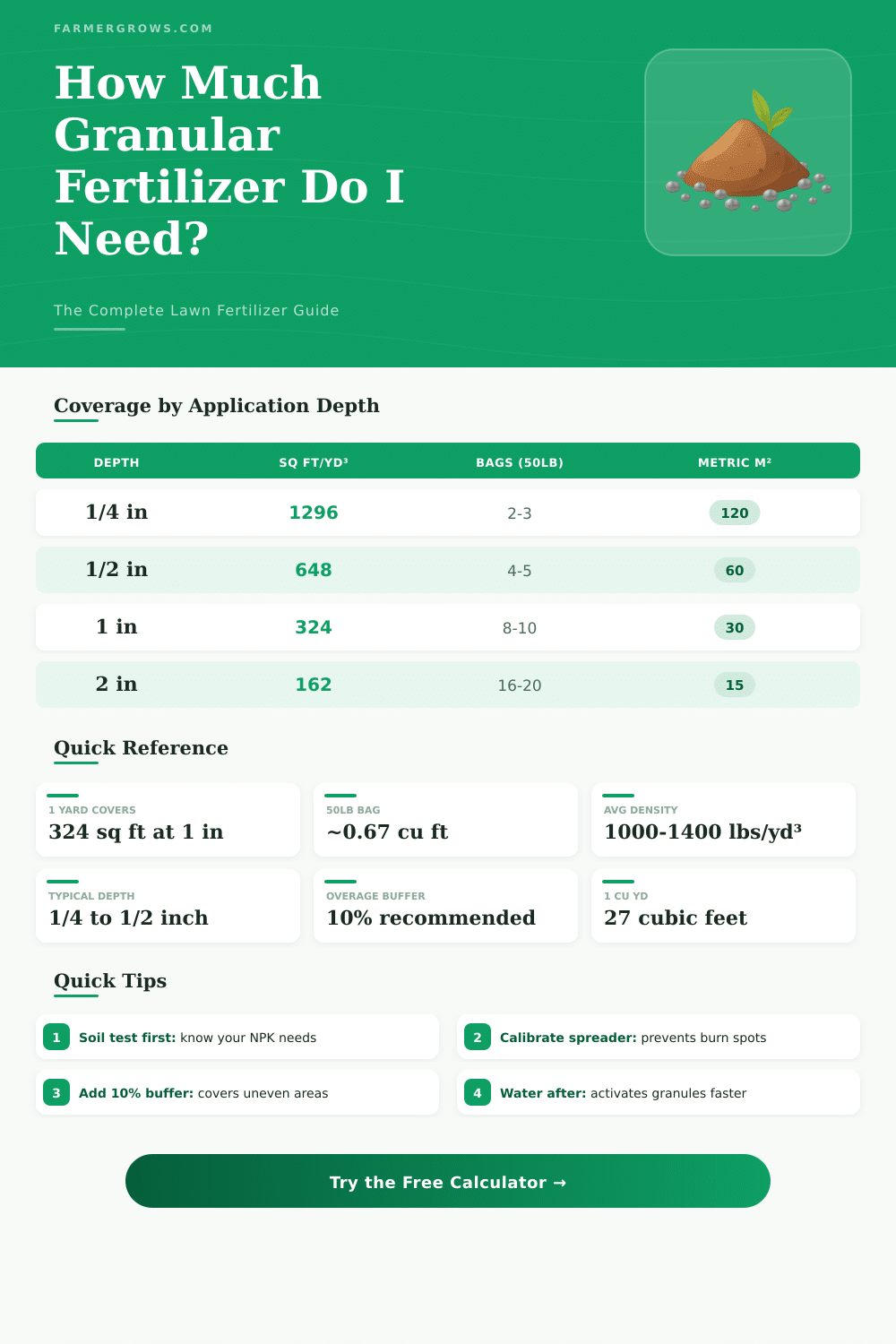
| Depth | Sq Ft per Cu Yd | m² per m³ | Typical Use |
|---|---|---|---|
| ¼ in (0.64 cm) | 1,296 | 157.5 | Light top-dress |
| ½ in (1.27 cm) | 648 | 78.7 | Standard broadcast |
| 1 in (2.54 cm) | 324 | 39.4 | Heavy application |
| 2 in (5.08 cm) | 162 | 19.7 | Soil amendment |
| 3 in (7.62 cm) | 108 | 13.1 | Bed preparation |
| 4 in (10.16 cm) | 81 | 9.8 | Renovation/rehab |
| Bag Size | Volume per Bag | Bags per Cu Yd | Coverage at ½ in |
|---|---|---|---|
| 25 lb bag | ~0.33 cu ft | ~81 | ~8 sq ft |
| 40 lb bag | ~0.53 cu ft | ~51 | ~13 sq ft |
| 50 lb bag | ~0.67 cu ft | ~40 | ~16 sq ft |
| 2 cu ft bag | 2.0 cu ft | 13.5 | ~48 sq ft |
| 3 cu ft bag | 3.0 cu ft | 9 | ~72 sq ft |
| Project | Area | Cu Yds at ½ in | 50 lb Bags Needed |
|---|---|---|---|
| Small flower bed | 100 sq ft | 0.15 | 6 |
| Garden plot | 250 sq ft | 0.39 | 16 |
| Front yard patch | 500 sq ft | 0.77 | 31 |
| Medium lawn | 1,000 sq ft | 1.54 | 62 |
| Standard lawn | 2,500 sq ft | 3.86 | 155 |
| Large lawn | 5,000 sq ft | 7.72 | 309 |
One cubic yard of fertilizer 10-10-10 covers about 648 square feet in half-inch depth, what really does not seem a lot until one understands that that is the usual recommended amount that professional lawn care workers use. If one goes thinner, quarter inch, then the same yard stretches to around 1.296 square feet. That makes a big difference.
Urea weighs less, around 850 pounds each yard compared to ammonium sulphate at 1.200 pounds, so it eases moving when one handles 2.500 square feet or more.
How Much Granular Fertilizer to Use and How to Apply It
I counted with 10-15% extra cost for slopes and rough surfaces, what matches with typical business calculations for material. For 5.000 square feet of lawn in half-inch depth requires around 7,7 cubic yards; so about 309 bags of 50 pounds. Here is a serious amount.
In smaller 250-square-foot beds I used usually 16 bags, whether we give or take a bit. For metric users: one cubic metre of fertilizer is enough for 78,7 square metres in 1,27 cm depth.
The following details do not come from some calculator or converter here on the page. They are based on practical exeprience, forum talks and community knowledge from various websites.
fertilizer dressing forms from small, even granules, that one easily handles, stores and spreads. It mixes built-in plant nutrients like nitrogen, phosphorus and potassium. That is the main nutrients, that crops and lawns need for healthy growth.
Some granular products also come with calcium, magnesium and sulphur, although they commonly lack several micro-nutrients.
Big advantage of fertilizer dressing is its slow action. It must break down in the ground before releasing nutrients. Usually a weak or some days passes before visible effects appear.
Well mix it in the soil before sowing commonly helps. Commonly used property options are formulas like 8-8-8 or 10-10-10.
Various kinds of granular dressings exist. Between them are summer stretch types, starter nutrients, ground food for lawns in basic or bitter territories, macro- and micro-mixes, ground amendments and carbon-based products. Organic granular dressings release slowly and help to improve the soil over time.
Monthly application of good organic fertilizer forms a reliable everyday routine.
For lawns one prefers fertilizer compared to liquid. Liquid nutrition works more for leaves and foliar feeding, while fertilizer focuses on roots. Liquids need applying commonly.
Fertilizer gives longer relief, rather than liquid, that acts right away. Combining both without checking the nutrient level of the fertilizer can overload the plant.
Particle size plays a big role in fertilizer dressing. The relation between surface and volume decides the pace of nutrient release. If particles range a lot, one must reduce the spreading beam to escape uneven distribution.
Set the flow of the spreader, spin speed of the rotor and back corner according to the material kind a lot helps. Evenness of particles matters also during blending of different fertilizer types for same spreading.
Granular dressings sometimes are “warm”, because they carry much salt. Roots can escape problems with too much nitrogen or potassium. Less mobile elements like phosphorus stay at the grains, rather than liquid form, where they spread freely in the ground water.
Choosing fertilizer gives more options about size, form and weight during application. Even in months without strong growth, it feeds roots and prepares them for bad weather. Weak root nets have troubles with absorbing, and fertilizer depends strongly onhealthy roots to work well.