🌿 Grass Fertilizer Calculator
Calculate exactly how much fertilizer your lawn needs based on area, fertilizer type, and application rate
Balanced 10-10-10
High Nitrogen 32-0-4
Slow-Release 22-0-4
Starter 18-24-6
Winterizer 22-0-14
Organic 5-3-4
Weed & Feed 28-0-3
Iron Supplement
| Depth | Sq Ft per Cu Yd | Sq M per Cu M | Use Case |
|---|---|---|---|
| 1 in (2.5 cm) | 324 | 40 | Light top-dress |
| 2 in (5 cm) | 162 | 20 | Renovation dressing |
| 3 in (7.6 cm) | 108 | 13.3 | Standard application |
| 4 in (10 cm) | 81 | 10 | Heavy application |
| 6 in (15 cm) | 54 | 6.7 | Soil amendment fill |
| Bag Size | Volume | Bags per Cu Yd | Coverage at 3 in |
|---|---|---|---|
| Small (2 cu ft) | 0.074 cu yd | 13.5 | 8 sq ft |
| Medium (3 cu ft) | 0.111 cu yd | 9 | 12 sq ft |
| 25 lb bag | Varies | — | 2,500–5,000 sq ft* |
| 40 lb bag | Varies | — | 5,000–10,000 sq ft* |
| 50 lb bag | Varies | — | 10,000–15,000 sq ft* |
*Coverage for granular fertilizer varies by product and application rate. Cubic volume bags are for bulk amendments and topdress.
| Project | Area | Fertilizer (40 lb bags)* | Annual N (lbs) |
|---|---|---|---|
| Small front lawn | 1,000 sq ft (93 m²) | 1 bag / app | 3–4 |
| Average front yard | 2,500 sq ft (232 m²) | 1–2 bags / app | 7.5–10 |
| Medium full yard | 5,000 sq ft (465 m²) | 2–3 bags / app | 15–20 |
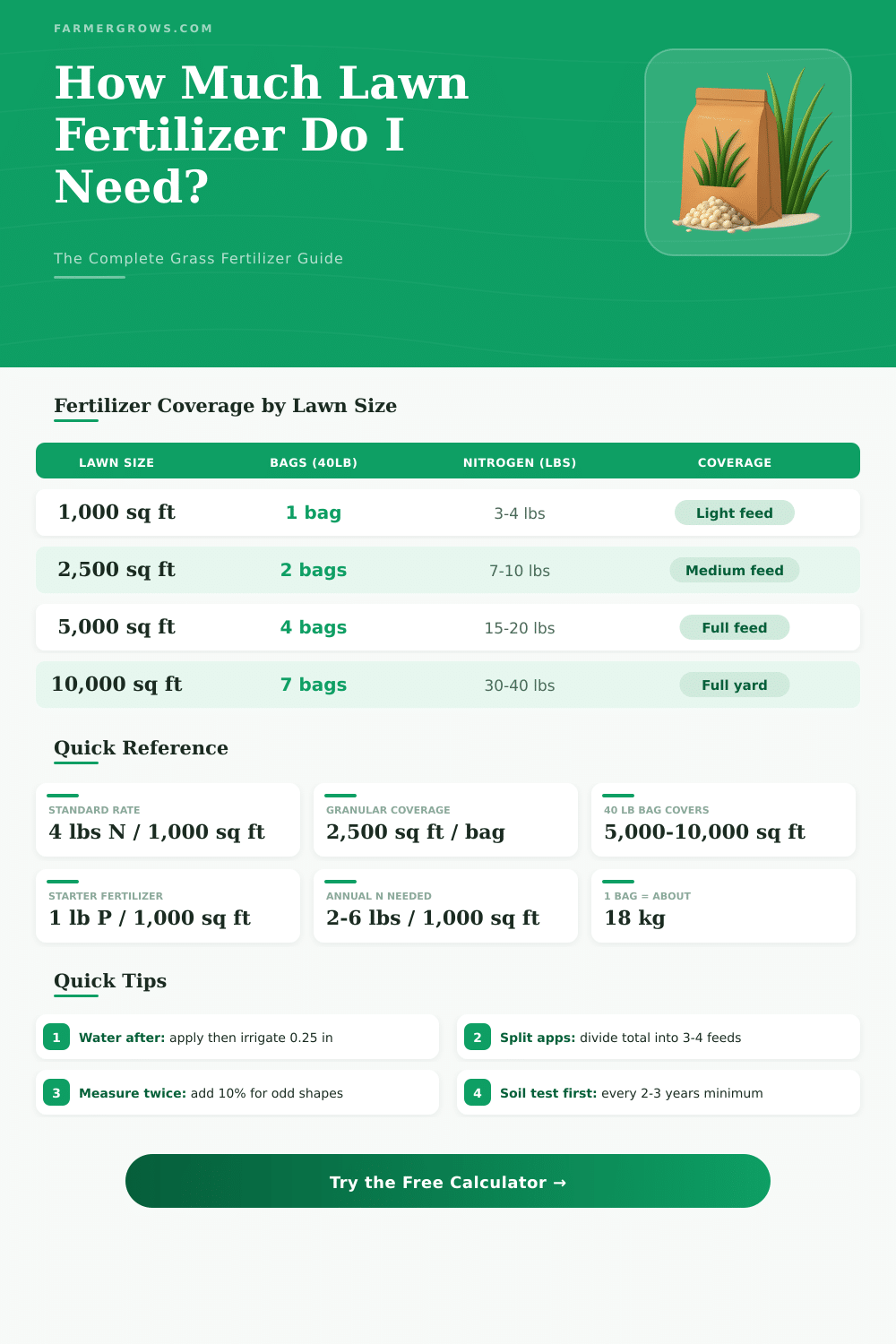
| Large yard | 10,000 sq ft (929 m²) | 4–6 bags / app | 30–40 |
| Half acre lot | 21,780 sq ft (2,023 m²) | 8–12 bags / app | 65–87 |
| Full acre | 43,560 sq ft (4,047 m²) | 16–24 bags / app | 130–174 |
*Based on standard 40 lb bag covering 5,000–10,000 sq ft depending on product type. Annual N assumes 3–4 lbs per 1,000 sq ft for cool-season grasses.
A bag of 40 pounds with 10-10-10 carries only 4 pounds of real nitrogen, that surprised me when I first counted it as guard warned. For 5 000 square feet of lawn, that requires 3 pounds of N each thousand square feet, one requires around 15 pounds of nitrogen in whole, so almost 4 bags. If one extends to 10 000 square feet, at least 8 bags will be needed.
Organic blends, for instance 5-3-4, require much more material. Around 8 pounds each thousand square feet to reach the usual levels. Cool season grasses require 2 to 6 pounds of N yearly each thousand square feet (that is 20 to 60 grams each square metre).
How to Fertilize Your Lawn
Warm season species want a bit less, closely 2 to 4 pounds. Slopes and sandy areas can easily use up 15-20% of the amuont.
The info below does not come from any calculator or converter tool on that page. They are based on actual research, discussions in forums and experiences of communities shared through the net.
fertilizer for grass provides to lawns the nutrients that they require to grow thick, green and healthy. In fertilizer for lawn the three main elements are nitrogen, phosphorus and potassium. Nitrogen helps the grass have green, dense and strong look.
Phosphorus matters for the growth of roots. Potassium backs the resistance of the lawn against dryness and diseases. Those three nutrients show on every bag of fertilizer as N-P-K label, three numbers separated by dashes, for instance 10-10-10.
grass uses nitrogen more than any other nutrient. The plant cells of the grass absorb it from the soil daily in big amounts, so one must regularly add it during the growing season. So nitrogen commonly is the highest number in the N-P-K label.
If one adds nitrogen, the grass will grow more quickly, more dense and more live green.
fertilizer 10-10-10 delivers to the lawn each a bit of everything, without overloading one alone nutrient. It escapes the kneed of guessing, when one did not test the soil. For nice lawns one should use maintaining fertilizer with 3-1-2 ratio, as 15-5-10.
Already set up lawns usually do not require extra phosphorus. Starter mixes are other cause… Something as 24-25-4 stimulates fast root growth and cover for fresh grass.
Doing a test of the soil is a wise step. It shows exactly what minerals lack in the ground and what fertilizer to use. Usually the soil requires a mix of nitrogen, phosphate and potassium.
Lime is other mineral that helps to give the grass its dense green look.
fertilizer with slow release is safer than those with fast. Quick release kind, as pure urea, can raise the risk of problems in the lawn during summer and fungus. Milorganite is a famous slow option that does not burn the grass and does not require immediate water.
Compost also works well as natural fertilizer that builds healthy soil.
Time of applying is very important. Spring and autumn are ideal moments to fertilize, when the grass actively grows. A good plan is to fertilize every 4 to 6 weeks until middle of summer.
The standard advice is use half to one pound of real nitrogen each thousand square feet per time. Too much of that can burn the lawn.
Liquid fertilizer one can spread by means of sprayers or a tank. Granular kinds one easily scatters by hand or using spreaders. Returning the cut grass to the lawn is also useful, because they break down and spare fertilizer over time.
The best fertilizer depends on the place of the lawn, the species of grass that grows there, andwhat problems it has.