🌿 Dry Fertilizer Calculator
Calculate exactly how much granular fertilizer you need for any area
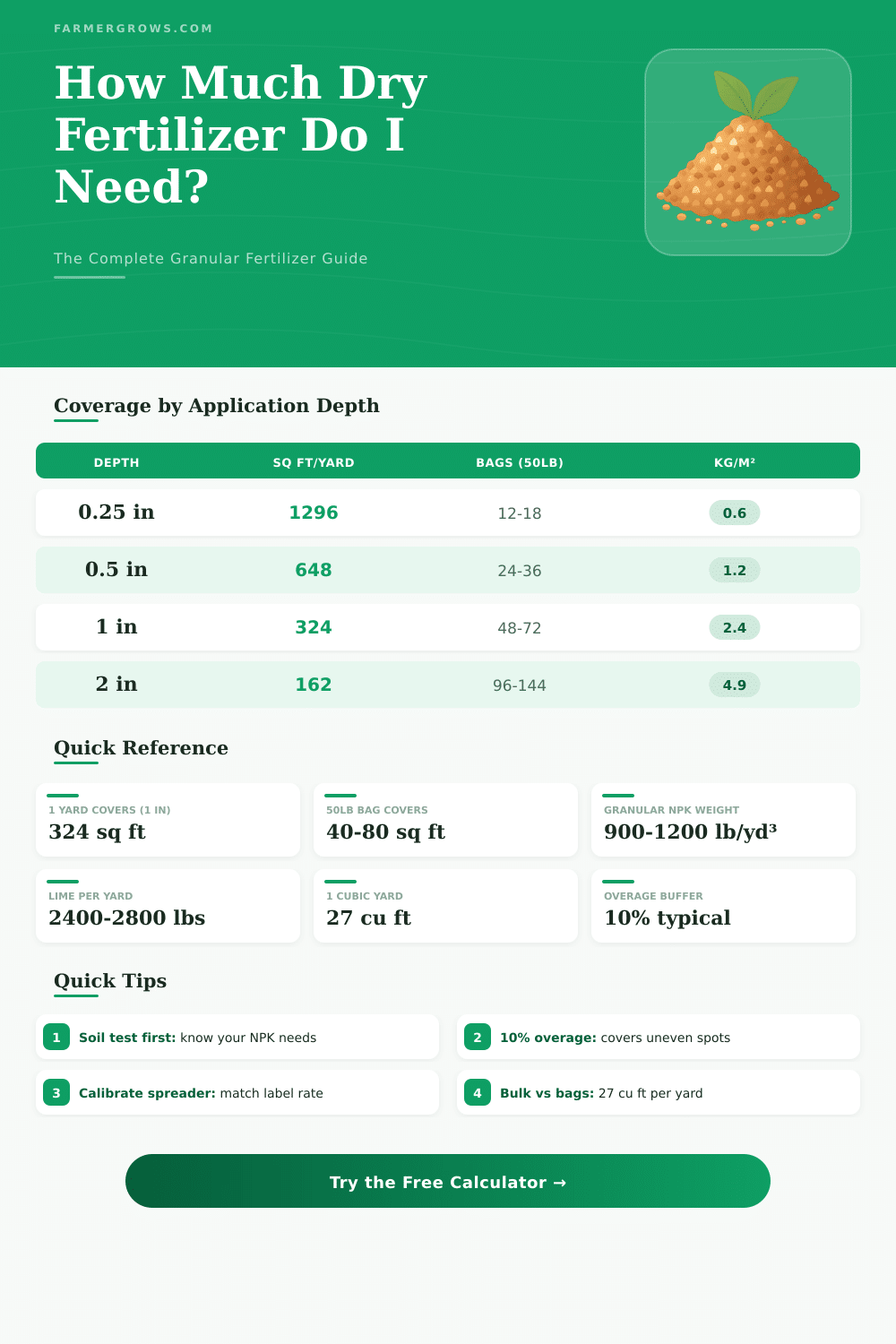
| Depth (in) | Depth (cm) | Sq Ft / Yard | m² / Yard |
|---|---|---|---|
| 0.25 | 0.64 | 1,296 | 120.4 |
| 0.5 | 1.27 | 648 | 60.2 |
| 1 | 2.54 | 324 | 30.1 |
| 2 | 5.08 | 162 | 15.1 |
| 3 | 7.62 | 108 | 10.0 |
| 4 | 10.16 | 81 | 7.5 |
| 6 | 15.24 | 54 | 5.0 |
| Bag Size | Volume (cu ft) | Bags per Yard | Coverage at 3 in |
|---|---|---|---|
| Small bag | 1 cu ft | 27 | 4 sq ft |
| Standard bag | 2 cu ft | 13.5 | 8 sq ft |
| Large bag | 3 cu ft | 9 | 12 sq ft |
| 25 lb bag | ~0.5–0.7 cu ft | ~40–54 | ~2–3 sq ft |
| 40 lb bag | ~0.8–1.1 cu ft | ~25–34 | ~3–4 sq ft |
| 50 lb bag | ~1.0–1.5 cu ft | ~18–27 | ~4–6 sq ft |
| Project | Area (sq ft) | Cubic Yards | 2 cu ft Bags |
|---|---|---|---|
| Small flower bed | 100 | 0.93 | 13 |
| Medium garden | 250 | 2.31 | 32 |
| Large garden bed | 500 | 4.63 | 63 |
| Quarter-acre section | 1,000 | 9.26 | 125 |
| Half-acre lawn | 2,500 | 23.15 | 313 |
| Full-acre application | 5,000 | 46.30 | 625 |
One cubic yard of NPK fertilizer covers more little surface than one would think, we talk about around 108 square feet in 3 inches of depth. If one cuts that depth by half for normal top dress, then the same amount extends to 648 square feet. That is big change, right?
Urea weighs less than I would guess, between 800 and 950 pounds a yard, while chalk lumps reach up to 2,800 pounds. So almost two tons.
How Much Fertilizer You Need and How to Use It
For 1,000 square feet of lawn in 3 inches depth, I consider a bit more than 9 yards as the ideal amount. If one scales up to 5,000 square feet, then you need around 46 cubic yards, really. I noticed that 10 percent extra is enough to cover the overlap of the spreader on flat soil, but on slopes that grows to 15 or even 20 percent.
About other materials, bone meal weighs around 800 to 1,100 puonds a yard, and plaster is a bit heavier, usually 2,000 to 2,400 pounds.
Dry fertilizer comes in various forms (powders), pellets, lumps. Their main benefit is that you can apply them directly on the ground and mix to meet the feeding needs of anything you grow. Some of them even consist of entirely natural ingredients, like compost and manure, dried in solid form.
The main difference between dry and liquid fertilizer is quite simple. Dry is made up of mineral powders and pellets, while liquids are focused minerals or organic material settled in water. None of them is naturally better, they simply work a bit differently.
Liquid fertilizer soaks into the plants almost right away, while dry needs too dissolve over days, weeks or even months, before the plants can start taking it in. Pellet fertilizer stays in the soil more long, while liquids give very fast absorption. However the chemical makeup is commonly quite alike, so the final results are alike.
Dry fertilizer can store smaller amounts of nutrients like magnesium, calcium, sulphur, iron, boron, zinc and copper. When one mixes dry mixes, the size of the pellets matters, even size helps to avoid separation during storage and use.
Using dry fertilizer through a planter was a common method, it cost little to place the material directly in the ground. Some folks still do that today, especially when one applies product with high slow release and middle nitrogen in dry conditions, because toomuch nitrogen can cause diseases.
Storing dry fertilizer is very easy. Keeping them in bins with closing seals works well, and adding big amounts of dryer helps to absorb extra moisture in wet places. Some dry products stay fresh more than a year, which always pleases.
Organic fertilizer comes in dry and liquid forms, meant to feed the plants during the growing season and boost the whole output. There are types for different growing phases (some for leafy growth), others for early flowering and budding, and high-phosphorus ones for the final fruiting.
Another option is to make your own dry fertilizer to fit your need. That only takes some minutes, and the savings compared to ready liquids can be huge. A goodscale helps to exactly weigh the various parts.