🌿 Fertilizer Calculator
Calculate exactly how much fertilizer, compost, or soil amendment you need for any project
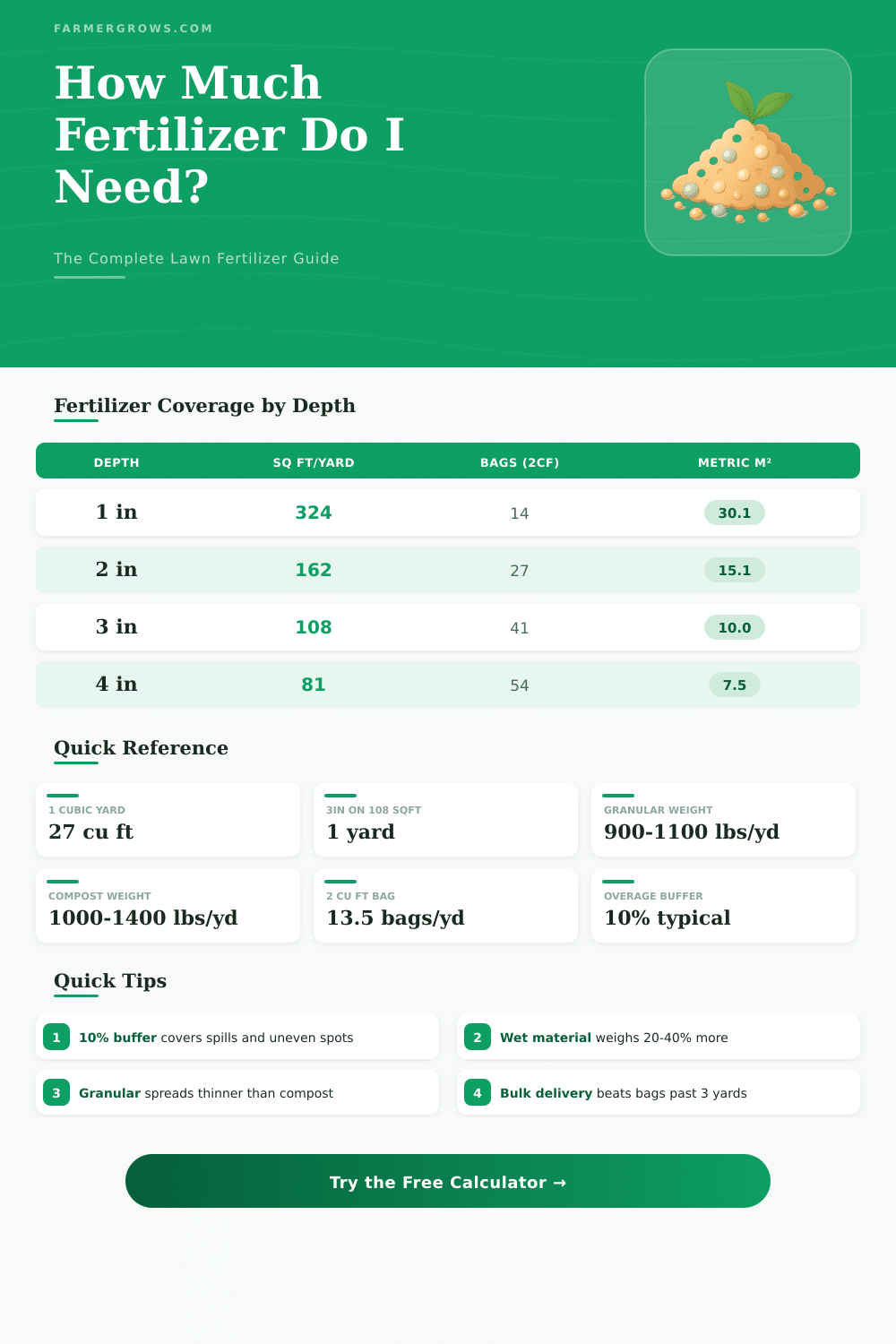
| Depth | Sq Ft per Yd³ | Sq M per M³ | Metric Depth |
|---|---|---|---|
| 1 in | 324 | 39.6 | 2.54 cm |
| 2 in | 162 | 19.8 | 5.08 cm |
| 3 in | 108 | 13.2 | 7.62 cm |
| 4 in | 81 | 9.9 | 10.16 cm |
| 6 in | 54 | 6.6 | 15.24 cm |
| Bag Size | Volume per Bag | Bags per Yd³ | Coverage at 3 in |
|---|---|---|---|
| Small Bag | 2 cu ft (0.074 yd³) | 13.5 | 8 sq ft |
| Large Bag | 3 cu ft (0.111 yd³) | 9 | 12 sq ft |
| 40 lb Bag | ~0.75 cu ft | 36 | 3 sq ft |
| 50 lb Bag | ~1 cu ft | 27 | 4 sq ft |
| Project | Area (sq ft) | Yd³ at 3 in | 2 cu ft Bags |
|---|---|---|---|
| Small Garden Bed | 100 | 0.93 | 13 |
| Medium Flower Bed | 250 | 2.31 | 32 |
| Large Bed / Border | 500 | 4.63 | 63 |
| Quarter Acre Lawn | 1,000 | 9.26 | 125 |
| Half Acre Lawn | 2,500 | 23.15 | 313 |
| Full Acre Treatment | 5,000 | 46.30 | 625 |
One cubic yard of that 10-10-10 material usually covers about 324 square feet when one spreads it one inch thick. Even so, if one uses the more usual depth of 3 inches, then the covering limits to only 108 square feet. Whether that is not big difference?
For 1 000 square feet of lawn I used around 3,1 cubic yards for one-inch top layer, say, almost 84 cubic feet. Also the weight is surprisingly heavy, between 900 and 1 100 pounds each cubic yard for those top dressings.
Fertilizer for Lawns: How Much to Use and Why
Compost commonly has weight between 800 and 1 000 pounds each cubic yard, when it is dry. Even so add a bit of moisture easily raises the weight by 25-30%. Bone meal is dense itself, commonly above 1 000 pounds each yard.
Old manure weighs less, usually from 600 to 900 pounds, what makes it easier to transprot and spread. On sloping areas I noticed, that one must add 15-20% more, to make up for drainage and settle problems.
The info below does not come from some calculator, it is based on real user experiences, forum talks and chatter in the gardening community.
fertilizer, natural or artificial, is food for plants. They deliver the nutrients, that plants need to probably benefit and reach there maximum skill. Without that extra push even the richest soil can run out because of the crops and growth over time.
The three main nutrients in fertilizer are N-P-K. N stands for nitrogen, that pushes general plant growth and helps the leaves stay green and strong. P means phosphorus, that helps the plant move all nutrients over there, where they need.
K is potassium, key for whole plant health and protection against diseases and stress.
Numbers N-P-K on the bag always follow same order. For instance, 100-pound bag of 10-20-10 holds 10 pounds of nitrogen, 20 of phosphorus and 10 of potassium; totally 40 pounds of nutrients. A formula with a lot of nitrogen could be 10-5-5, while 5-10-5 stresses flowering.
fertilizer comes in many forms. Grains, powder, crystals, liquids and others. One can spread them over a field or apply directly on plants.
Organic types feed the plants, while they also improve the soil structure, airflow and control of moisture. Artificial fertilizer works a bit differently.
“Balanced” fertilizer has equal N-P-K numbers, like 5-5-5 or 10-10-10. It works well for many flower and veggie gardens. For good care of lawn one prefers a ratio of 3-1-2, for instance 15-5-10.
Strong lawns usually do not need extra phosphorus. A test of soil stays the most reliable way to hear, what nutrients lack.
Good use of fertilizer is key for keeping grass in good shape and help it recover after heavy usage. It is not a useless cause, rather, it serves to refill the nutrients, that run out and go when the plant makes fruits, leaves and so on.
Feeding plants is a task, that one easily forgets or does late. Even so, if one understands, how fertilizer works, how to apply them and when they most work, that can changea lot. Even urine can serve as organic fertilizer, because it quickly breaks down and well fills the nutrient gap.