🪣 Quikrete Fence Post Calculator
Calculate exactly how many bags of concrete you need for any fence post project
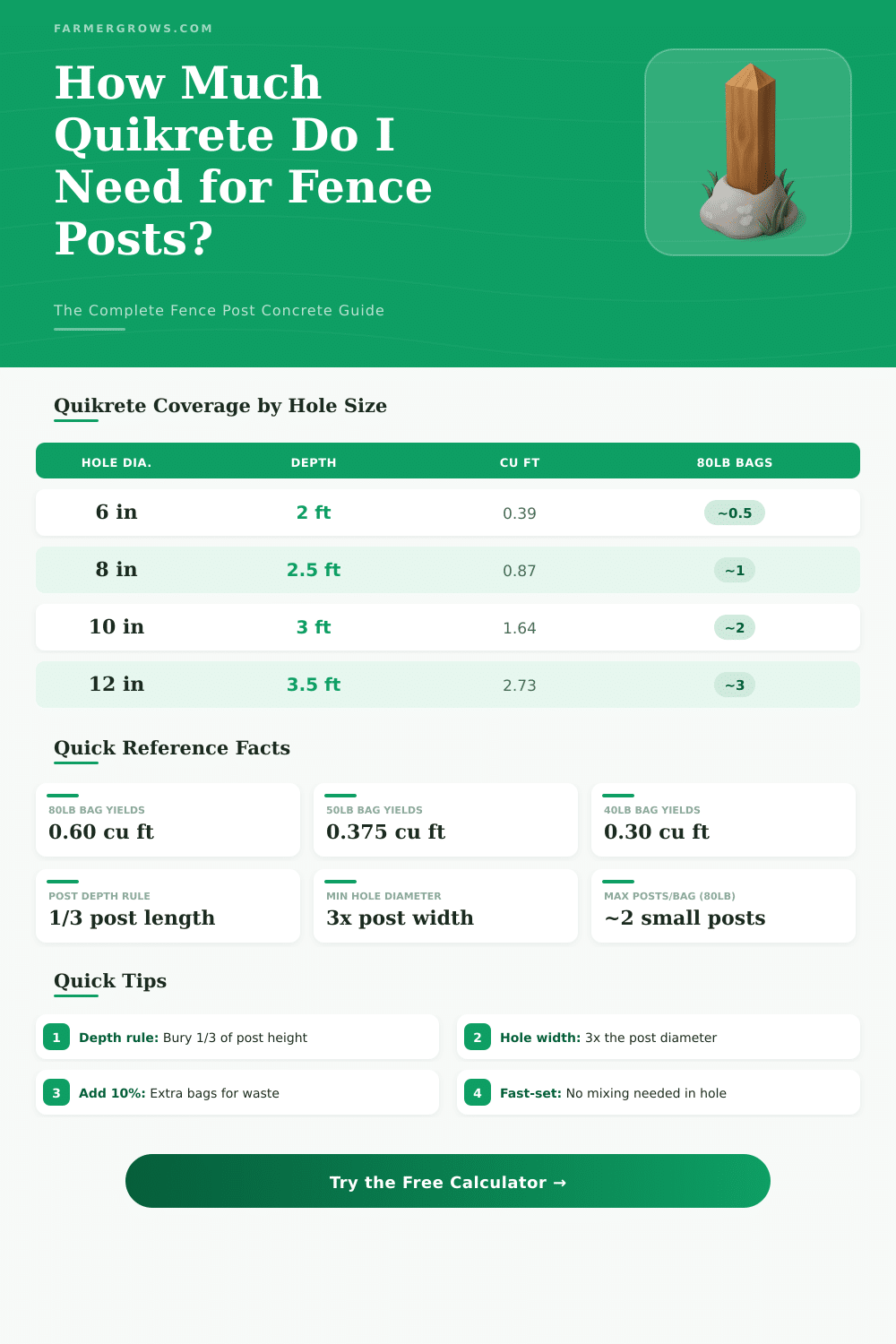
| Hole Dia. (in) | Depth 24 in | Depth 30 in | Depth 36 in | Depth 42 in |
|---|---|---|---|---|
| 6 in (15 cm) | 0.98 cu ft | 1.23 cu ft | 1.47 cu ft | 1.72 cu ft |
| 8 in (20 cm) | 1.40 cu ft | 1.74 cu ft | 2.09 cu ft | 2.44 cu ft |
| 10 in (25 cm) | 2.18 cu ft | 2.73 cu ft | 3.27 cu ft | 3.82 cu ft |
| 12 in (30 cm) | 3.14 cu ft | 3.93 cu ft | 4.71 cu ft | 5.50 cu ft |
| 14 in (36 cm) | 4.28 cu ft | 5.35 cu ft | 6.42 cu ft | 7.49 cu ft |
| Post Size | Hole Dia. | Depth 2 ft | Depth 2.5 ft | Depth 3 ft |
|---|---|---|---|---|
| 2x2 or 2x3 post | 6 in | 1–2 bags | 2–3 bags | 2–3 bags |
| 4x4 post | 8 in | 2–3 bags | 3 bags | 3–4 bags |
| 4x4 post (large) | 10 in | 3–4 bags | 4–5 bags | 5–6 bags |
| 6x6 post | 12 in | 5–6 bags | 6–7 bags | 7–8 bags |
| Round post 3 in | 10 in | 3–4 bags | 4–5 bags | 5–6 bags |
| Post Height Above Ground | Recommended Depth | Total Post Length | Hole Dia. (min) |
|---|---|---|---|
| 4 ft (1.2 m) | 24 in (2 ft) | 6 ft total | 3x post width |
| 5 ft (1.5 m) | 24–30 in | 7.5–8 ft | 3x post width |
| 6 ft (1.8 m) | 30–36 in | 8.5–9 ft | 3x post width |
| 8 ft (2.4 m) | 36–42 in | 11 ft total | 3x post width |
| 10 ft (3 m) | 42–48 in | 14 ft total | 3x post width |
Fence posts form the base for any fencing system. They give the needed structure and support that helps fences stand straight and stay stable. Without reliable posts the whole fence simply will not last a long time.
One can choose from various kinds of fence posts. Wooden fence posts include treated cedar and similar types, with treatments like CCA and ACQ. They are popular for farms, homes and business fences.
Fence Posts: Types, How to Set and Care for Them
Steel posts are another strong option. Some steel posts arrive with parts included and are made of G60 galvanised steel with a smooth surface. There are also concrete fence posts, that work as a tough replacement for usual wooden posts.
One interesting steel type has a unique shaped Y-form design, that provides strenght and reliability. It has also an arrow-shaped point at the bottom, what makes setting easier with concrete. The steel is covered with materials that resist rust, for long-lasting usage.
When dealing with the setting of posts, the depth plays a big role. The usual rule says, that one third of the post goes in the soil, while two thirds stay up. For a wooden fence six feet high on metal posts, setting them three feet in the ground can be enough without concrete, if only the corner and gate posts are sunk in concrete.
Eighteen inches is the weakest minimum depth, while twenty-four inches are the advised minimum. Posts installed in or above the frost line risk early failure.
Gravel can help with drainage. Putting six inches of gravel in the bottom of the hole helps keep the post from sitting in water. Wooden posts that touch gravel below drain more effectively than when you cover the wood entirely with concrete.
When using concrete, slightly mound it up allows water to flow down the side.
At the top of the post, cutting it at an angle is useful for shedding water. Regular use of paint or sealer, or adding a metal cap, helps to keep the moisture away. Also protecting the bottom part of the post against ground touch, where it exits from the ground, matters, because hear posts commonly rot.
Different types of wood last very different times. Black locust and osage orange last twenty to twenty-five years. Red cedar lasts fifteen to twenty years.
White oak lasts around ten years. Southern pine, honey locust and yellow poplar last only three to seven years. Hickory reaches five to seven years.
Good posts cost around fifteen dollars and need double the amount of preservative. Getting a post quite a bit longer for a two-foot hole makes sense. Cheap posts with only one dose of preservative quickly rot.
Sometimes it is better to replace a bad post than strengthen it, becauseposts do not cost that much.