🏗️ Fence Post Concrete Calculator
Calculate exactly how many bags of concrete you need for your fence posts
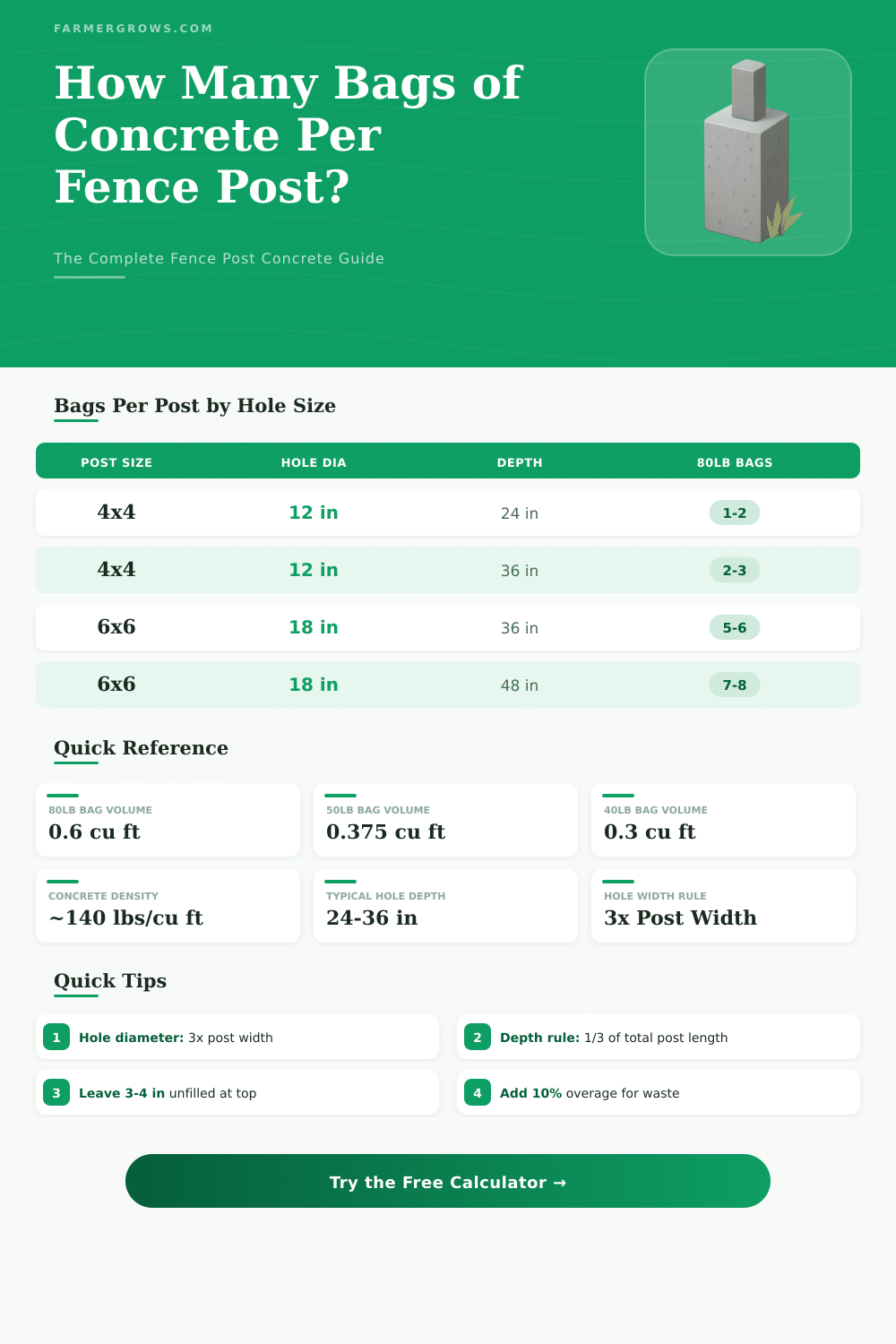
| Post Size | Hole Diameter | Hole Depth | Volume (cu ft) | 80 lb Bags | 50 lb Bags |
|---|---|---|---|---|---|
| 4x4 | 10 in | 24 in | 0.87 | 1–2 | 2–3 |
| 4x4 | 12 in | 24 in | 1.18 | 2 | 3–4 |
| 4x4 | 12 in | 30 in | 1.57 | 2–3 | 4–5 |
| 4x4 | 12 in | 36 in | 1.96 | 3–4 | 5–6 |
| 4x4 | 12 in | 42 in | 2.35 | 4 | 6–7 |
| 6x6 | 18 in | 24 in | 3.16 | 5–6 | 8–9 |
| 6x6 | 18 in | 36 in | 5.09 | 8–9 | 13–14 |
| 6x6 | 18 in | 48 in | 7.03 | 11–12 | 18–19 |
| Hole Diameter | 18 in Deep | 24 in Deep | 36 in Deep | 48 in Deep |
|---|---|---|---|---|
| 8 in (20 cm) | 0.52 cu ft | 0.70 cu ft | 1.05 cu ft | 1.40 cu ft |
| 10 in (25 cm) | 0.82 cu ft | 1.09 cu ft | 1.64 cu ft | 2.18 cu ft |
| 12 in (30 cm) | 1.18 cu ft | 1.57 cu ft | 2.36 cu ft | 3.14 cu ft |
| 14 in (36 cm) | 1.60 cu ft | 2.14 cu ft | 3.21 cu ft | 4.28 cu ft |
| 18 in (46 cm) | 2.65 cu ft | 3.53 cu ft | 5.30 cu ft | 7.07 cu ft |
| Bag Weight | Volume per Bag | Bags per Cubic Yard | Bags per Cubic Foot |
|---|---|---|---|
| 40 lb (18 kg) | 0.30 cu ft (8.5 L) | 90 | 3.33 |
| 50 lb (23 kg) | 0.375 cu ft (10.6 L) | 72 | 2.67 |
| 60 lb (27 kg) | 0.45 cu ft (12.7 L) | 60 | 2.22 |
| 80 lb (36 kg) | 0.60 cu ft (17.0 L) | 45 | 1.67 |
| Project Type | Posts | Post Size | Total 80lb Bags (24in depth) | Total 80lb Bags (36in depth) |
|---|---|---|---|---|
| Small Garden Fence (50 ft) | 7–8 | 4x4 | 14–16 | 21–28 |
| Side Yard Fence (75 ft) | 10–11 | 4x4 | 20–22 | 30–38 |
| Privacy Fence (150 ft) | 19–20 | 4x4 | 38–40 | 57–70 |
| Full Yard Fence (300 ft) | 38–40 | 4x4 | 76–80 | 114–140 |
| Deck Railing (40 ft) | 6–8 | 6x6 | 30–48 | 48–72 |
| Pergola (4 posts) | 4 | 6x6 | 20–24 | 32–36 |
Dig your post hole to 3 times the width of the post. For a 4x4 post (actual 3.5 in), that means a hole about 10.5–12 inches in diameter. For a 6x6 post (actual 5.5 in), aim for 16.5–18 inches. Wider holes provide more stability and allow enough concrete to anchor the post firmly.
The general rule is to bury at least 1/3 of the total post length underground. For a standard 8-foot post, that means a minimum depth of about 32 inches. In cold climates, check your local frost line — posts should extend below the frost line (often 36–48 inches) to prevent heaving. Always leave 3–4 inches at the top of the hole unfilled so you can crown the concrete to shed water.
For a 4×4 fence post in a 12-inch wide hole at 24 inches of depth, you need around 1.18 cubic feet of concrete, after you remove the volume of the post itself. That matches two bags of 80-pound mix. Assume that you extend the same hole to 36 inches then it needs almost 2 cubic feet for one fence post, so a minimum of three bags.
I did not expect that the difference would be this big, honestly.
How Much Concrete You Need for Fence Posts
6×6 fence posts are a whole other case. A hole of 18 inches at 36 inches of depth needs around 5 cubic feet of concrete for one fence post, around 8 to 9 of those 80-pound bags. For a fence with 20 fence posts using 4×4 at 24 inches of depth, I found that the whole amount reaches about 40 bags (including a 10 percent reserve), which weighs about 3 200 pounds.
That is over a ton and half of concrete simply sitting at the door of your car, if you make several trips to the store. The 50-pound bags give you 0.375 cubic feet, so you will need around 67 percent mroe of them than the 80-pound for the same project (so more trips to move them).
The info below does not come from some calculator or converter. It is based on real experience of users, talks in forums and shared experiences spread through the net.
Setting fence posts seems like an easy task, but it involves many tiny details that matter. Set fence posts in concrete makes the whole fence stronger and stops them from moving over time. When a fence must handle heavy load or strong wind, for example a privacy type, then concrete becomes absolutely needed.
Wind pushes the fence from all directions, and rain can weaken the soil around poorly set fence posts.
For a typical six-foot fence, the hole for fence posts must have around 36 inches of depth and 12 inches of diameter. Use the rule that depth be one third to half of the fence post height. So a six-foot fence post needs a hole of two too three feet.
An eight-foot fence post needs at least two feet underground. Also the shape of the hole plays a role. The best is an upside-down cone, with a wider base below than up.
A cone shape with narrow bottom and wide top does not work.
Adding four to six inches of gravel in the bottom of every hole is very helpful. It works as a barrier between the wooden fence post and moisture in the soil, lowering the risk of wood rot. It also helps drain water away from the fence post base and lowers the chance that cold damages the fence post.
Quick-setting concrete is commonly chosen for fence posts. You do not need to mix it. You pour the dry bags directly in the hole, then add water.
It sets after 20 to 40 minutes. For a standard six-foot fence, estimate two bags of such concrete each hole. Typical 4×4 wooden fence posts need one to four 50-pound bags, depending on depth of the hole and ground condition.
Wait four hours before loading heavily or adding the rest of the fence.
The concrete must reach the ground surface and slope away from the fence post. If it sits under the soil, water will gather around the fence post and will cause rot. Fence posts can snap at ground level, break and then need removal of a big concrete block.
Raising the concrete to the surface helps to avoid such troubles.
If a fence post needs replacing and it already sits in concrete, the best way is to pull out the whole thing and start over. Fence posts from prestressed concrete with steel bars are an alternative. They resist weather, insects and rotting.
In countries like Hungary and Slovakia, concrete is used for fence posts andalso phone poles.